
Forum Debate: Is Music Stage Now Sexual Showcase?
A forum thread with 167 replies analyzes sexualization in pop and talent loss, comparing concerts to strip clubs.
English · Original discussion in Spanish · Published
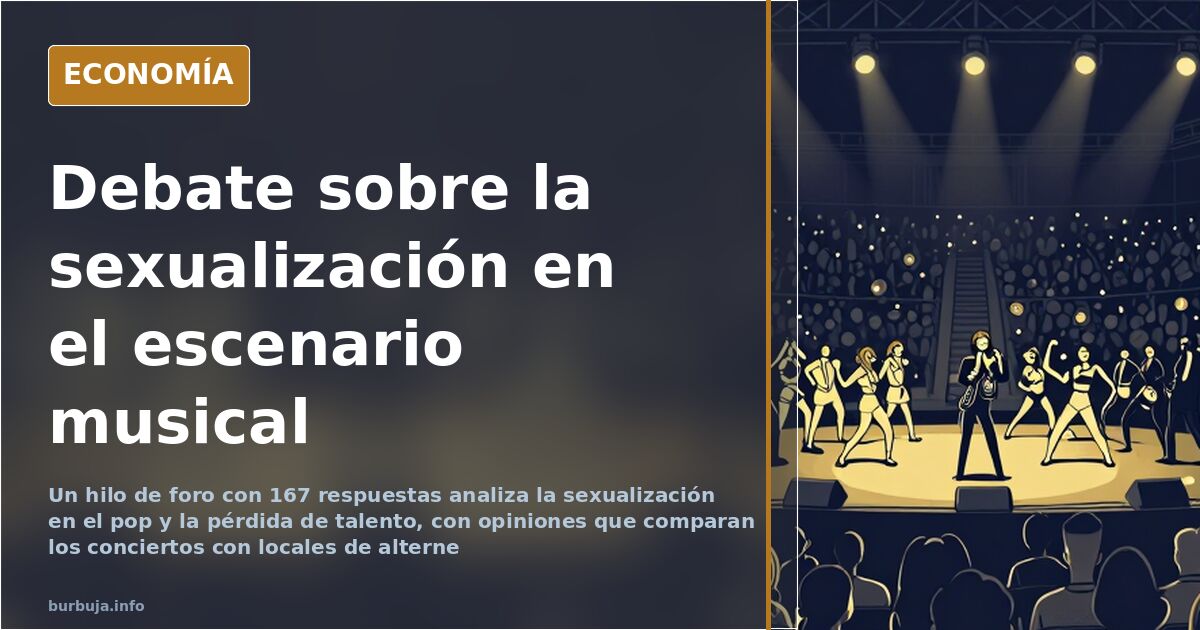
Music Stages Resemble Strip Clubs
The transformation of musical performances into displays of explicit sensual is the focus of a debate that has been open for 673 days on an economics forum. What was once associated with strip clubs, some argue, has moved to major stages: singers who barely sing and use their bodies as the main attraction. The discussion, with 167 replies, has evolved into an analysis of the industry, feminism, and the loss of talent.
From Madonna's Provocation to Nudity as Norm
The conversation starts with a complaint: there are increasingly more supposed singers performing practically naked or in outfits unfit for a musical act. Their main attribute, it is said, is behaving like a baboon on stage. The response is immediate: some recall that traditional cabaret was already like this. Sensual provocation in entertainment is not new. Examples cited include Madonna in the 90s or Sabrina, who flashed her breast thirty years ago. The difference, they argue, is the scale and normalization.
Business, one analysis points out, has always exploited the sens card. Women carry it in their toolbox, and according to this thesis, many colleagues' social success is due to men pretending to like them because they would sleep with them if given the chance. In a Victorian context, modesty does not eliminate sens as currency; it simply hides it. The discussion gets tangled with the idea that cultural programming and sensual liberation have combined to sell what was previously simple provocation as empowerment.
Is It Female Liberation or Pure Marketing?
The core disagreement lies in interpretation. For some, these performances prove that feminism has turned exhibitionism into a banner: if a man says it, it is objectification; if a woman says it, it is sensual liberation. For others, it is a marketing operation hiding a lack of talent. The absence of true talent is masked by showing flesh, argues one participant, contrasting these artists with figures like Nina Simone, Janis Joplin, Billie Holiday, Tina Turner, Patti Smith, Björk, or Aretha Franklin, who never needed to go onstage naked.
Criticism extends to musical quality. It is claimed that the vast majority lacks voice and cannot sing without electronic backing. Music is creativity and virtuosity, something far beyond these puppets of globalism, it is even said. Against this, another current defends that a young woman's body is attractive and should not be hidden, and those who do not want to see it should not attend such concerts. The discussion becomes a clash between those seeing degradation and those considering it mere adaptation to the times.
Free Porn Saturation and the Limit of Voyeurism
A recurring argument is the effect of unlimited prono availability. When less material was available, showing cleavage excited men; now, with free porn on smartphones, artists must push further limits to capture attention. This is the logic of the entertainment business taken to the extreme. Some warn that the result is saturation: what previously ended in toca now only produces boredom.
The conversation also addresses the audience's role. It is observed that the main audience for these artists is women and gai men, debunking the idea that everything is a strategy aimed at heterosenshetero males. Others point out that the example set for girls is disastrous, and that many will end up as broken toys blaming heteropatriarchal machos without self-criticism. The discussion stalls on whether responsibility lies with the industry, the audience, or the artists themselves.
Body as Currency: Echoes of an Old Debate
On the margins of the debate appear more radical positions. One holds that women are born prostitutes and that their entire existence consists of using sensual attributes as currency, knowledge passed from mothers to daughters. Another claims there is no more treacherous being than them and that many have a teenage mentality all their lives. These opinions, while present, do not represent consensus nor are supported by data; they are the debris often dragged along by any discussion on sensual and spectacle.
More nuanced is the analysis of those distinguishing between sensuality and vulgarity. They miss Marilyn's elegance in raising an eyebrow compared to today's explicit display. The example set for girls is disastrous, they insist. And the comparison with classic cabaret arises, which was more elegant. Nostalgia for suggested eroticism versus imagination-less exposed flesh runs through many responses.
Evolution of the Phenomenon: From Sabrina to TikTok
The thread traces a timeline. Thirty years ago, Sabrina flashed a breast singing Boys. In the 90s, Madonna already scandalized. In the 2000s, Beyoncé or Jennifer Lopez continued the trend. Today, Dua Lipa and similar artists are fast-consumption products. The novelty is not nudity, but its institutionalization as pop norm. Some recall that DVDs with these videos were recorded in high schools and sold for one or two euros, like smuggled porn. The difference is that now everything is a click away and the audience is global.
The conversation shifts to the role of social media. A singer appearing on TikTok lifting her miniskirt to show her underwear is the extreme example. It is denounced that all this is sold as female liberation, like ditching the bra. And it is predicted that soon thongs will be pulled aside mid-stage. The spiral seems unstoppable, and no one sees where the limit is.
The analysis stalls on an unresolved contradiction: if the body is a tool for empowerment, why does its commercial exploitation so closely resemble the old strip club business? Meanwhile, stages continue filling with performances that increasingly look like what used to be seen in a strip club.
Also available in: Deutsch
Summary of a discussion on Burbuja.info - Foro de economía, actualidad y política., translated from Spanish and reviewed before publication. Read the full discussion (167 replies).
More summaries
-
Celebrity Bodies: An Asset That Ages Poorly
The physique of famous women acts as an asset with an expiration date: nutritionists, drugs, and genetics play a role in aging.
-
Jennifer, 43, left a Barcelona law firm for love to teach pilates in rural Spain.
Jennifer, 43, left a Barcelona law firm for love and now teaches pilates in villages in Toledo. Discover her life change.
-
TikTok trend urges partners to stress each other for love
A viral theory claims vasopressin-induced stress fuels romantic attachment, leading couples to use trick questions to provoke reactions.
-
Spain has lost productivity since 2018 despite €100bn in EU funds
The IMF says Spain is the only major eurozone economy losing productivity since 2018, despite receiving 100 billion euros in EU funds. GDP per capita…
-
Train GPS: the safety layer nobody installed
Spain's high-speed AVE trains already carry balises, and GPS would be a cheap backup layer. The analysis keeps hitting the same question: why isn't it deployed?
-
Urda crash: staged-attack theories spread on Spanish forum
Forum users debate the Urda train crash in Spain: some doubt the official account due to the lack of images and secrecy, while others criticize those theories.