
Train GPS: the safety layer nobody installed
Spain's high-speed AVE trains already carry balises, and GPS would be a cheap backup layer. The analysis keeps hitting the same question: why isn't it deployed?
English · Original discussion in Spanish · Published
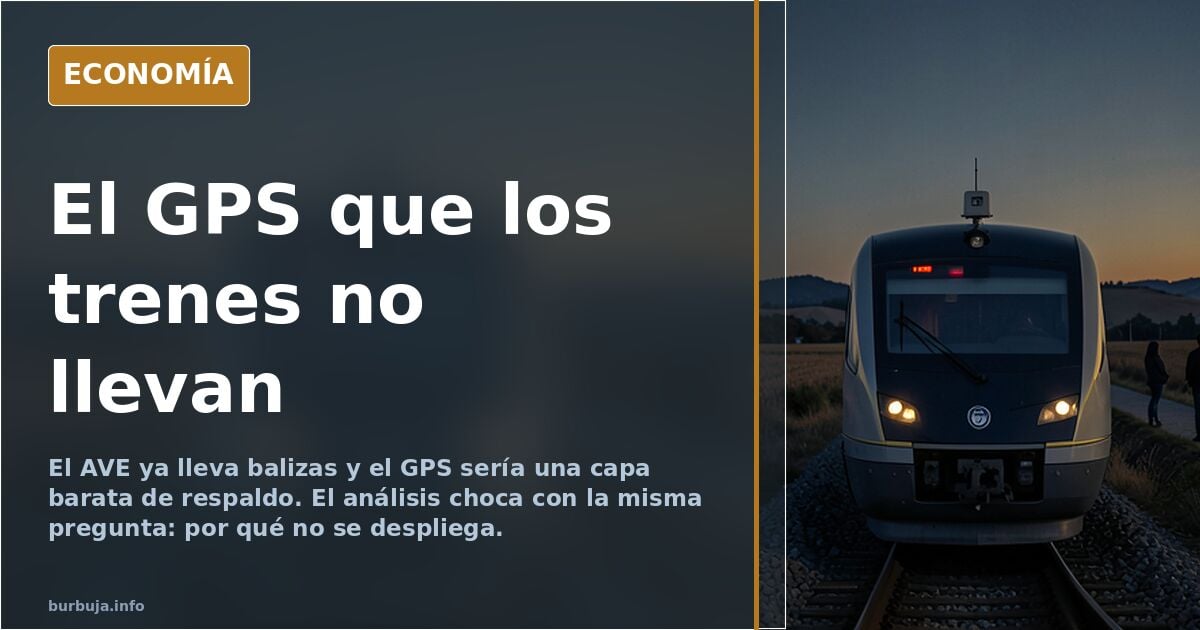
Train GPS: the safety layer that was never installed
While a Glovo courier shows up geolocated to the second on your phone and an Amazon van is tracked around the neighborhood, a train carrying hundreds of passengers runs without even a basic satellite positioning layer acting as a backup. The question that opens this case is simple: why is there no GPS on the railway when even the local bus has it? In the debate, several participants argue that the answer is not technical, but budgetary and about maintenance.
Redundancy is not a luxury: it is the standard
In aviation, GPS is just one layer, not the only system. It was accepted late and with reservations. It is imprecise, can be tampered with and loses coverage in tunnels. That is the technical argument put forward by one participant: satellite positioning does not replace railway signaling, it complements it. The problem, according to the debate, arises when the layers that already exist fail at the same time and are not repaired.
The discussion is not about whether GPS is perfect. It is about whether it makes sense that, after a chain failure, the response is to replace the system with a human holding a radio. Some call it exceptionalism; others simply call it neglect.
The AVE already has balises: the problem lies elsewhere
The AVE does not run blind. According to one participant, it carries balises that record where it passes, at what estimulante ilegal, the weight of the train and the state of the signals. That data goes to a high-availability database designed not to fail. When that architecture degrades, nothing is improvised: traffic is stopped until it is fixed. The debate centers on why it was not stopped.
In that scheme, GPS would be a cheap and useful additional layer. A screen in the cab showing the position of nearby trains, their direction and estimulante ilegal. A limited-range radio-frequency transponder. None of that is science fiction in 2026. It is off-the-shelf technology.
The car emergency beacon and the railway paradox
The irony hanging over the issue is that an emergency beacon is mandatory for all cars while trains lack an equivalent warning. A vehicle stopped on the shoulder sends a signal. A train halted on the track, with passengers on board, does not. The comparison is not technical, it is about priorities.
The argument gaining weight in the debate is the chain of command: if it is cut back, outsourced and sub-subcontracted, the system ends up warning that it cannot take any more. And someone decides to carry on. That is not a GPS failure. It is the decision to ignore the alert.
What can be demanded without waiting for the next tragedy
The proposal gaining ground is not to replace signaling, but to add verifiable redundancy: satellite positioning in the cab and the control room, an alarm requiring acknowledgment of receipt, and visibility of nearby trains. The cost is marginal compared to that of a disaster. The objection is not the price. It is that it demands maintenance and accountability, two things that never make the photo.
The analysis gets stuck here: nobody disputes that the technology exists; what remains unresolved is why it is not deployed when there is already a precedent that forces us to look.
Also available in: Deutsch
Summary of a discussion on Burbuja.info - Foro de economía, actualidad y política., translated from Spanish and reviewed before publication. Read the full discussion (18 replies).
More summaries
-
Spain's V16 road beacon: safety or just bureaucratic business?
We examine how effective the V16 beacon really is on Spanish roads: is it a genuine safety advance or a bureaucratic measure with no technical backing?
-
V16 Beacon: Road Safety or State-Controlled GPS Tracker?
The new V16 beacon is accused of being a GPS tracker that records routes and speeds. Is it road safety or mass state surveillance?
-
ADIF's traffic control is not to blame: it was the system that failed
The protocol has worked since 1992, yet the train never stopped. The debate over Spain's rail accident points to a system that depends on the human factor and on…
-
Flávio Bolsonaro declares himself Brazil's president-elect from Miami
Flávio Bolsonaro proclaimed himself Brazil's rightful president-elect from Miami, then deleted the letter. Lula won by nearly 5 million votes, according to official data.
-
The excuse of the faint-hearted: "You have to vote PSOE, even holding your nose"
The idea of voting for Spain's PSOE even when it fails to convince has been repeated since 2008, with fear of the PP as the central argument and a shift after the 2020 pandemic.
-
Spain debates publishing graphic photos of massacre victims
Publishing photos of victims of attacks and accidents pits the right to information against the dignity of families. Where is the line?