
Urda crash: staged-attack theories spread on Spanish forum
Forum users debate the Urda train crash in Spain: some doubt the official account due to the lack of images and secrecy, while others criticize those theories.
English · Original discussion in Spanish · Published
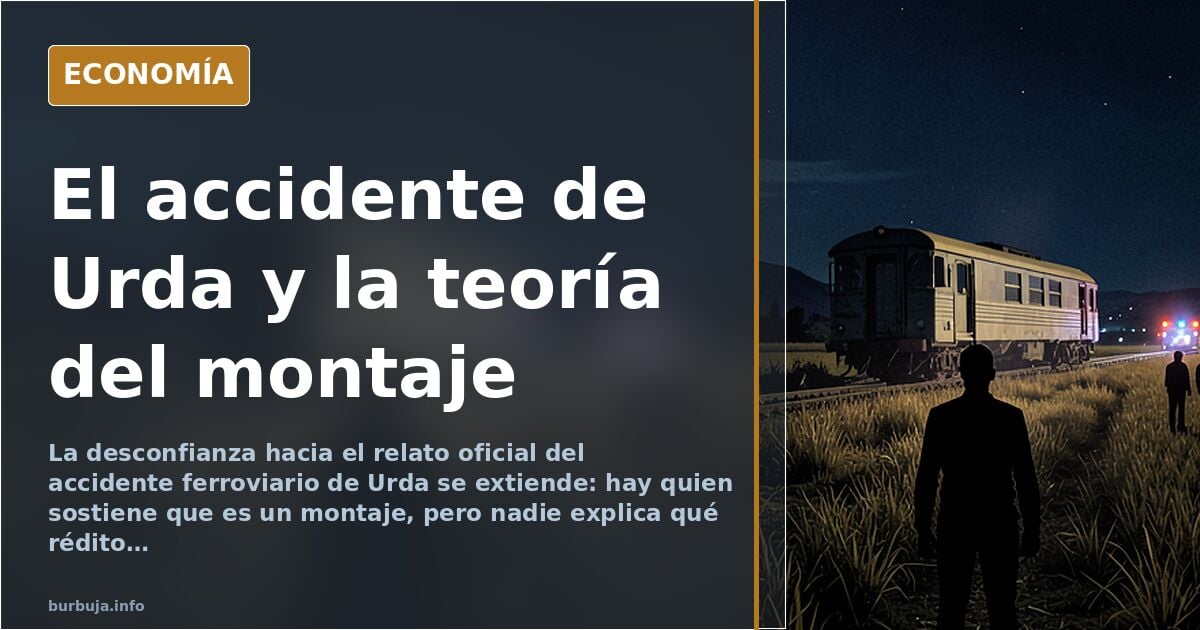
Ordinary people are questioning the official account of the Urda crash
A derailed train, scarce images and an official account that doesn't quite add up. In recent days, the conversation about the Urda rail disaster has jumped from the usual conspiracy circles to environments where people discuss the economy, wages and elections. The recurring claim is not that the train never existed, but that what has been told is not the whole truth. And the most uncomfortable part: those who hold this view do not fit the stereotype of the typical conspiracy theorist.
The trigger is a mix of factors. On one hand, the scarcity of audiovisual material: practically the only images circulating are of a wrecked train, with no context, no sequence, no faces. On the other, the secrecy surrounding the investigation and the absence of press conferences with questions. In a country where any incident with victims becomes raw material for political commentary, this has left a gap that everyone fills as best they can.
The suspicion is not uniform. Some speak outright of "theatre" and a "staged event", while others, more cautiously, argue that the crash did happen but is being managed as an electoral asset. "This is not a psyop but they have one ready for right before the elections," sums up one of the posts. The difference between the two positions is enormous, even though in practice they get conflated.
The most repeated argument is not technical but psychological: humans believe what it suits them to believe. If accepting the official version means swallowing a story that doesn't hold up, an alternative explanation is sought. And if that explanation also fits a pre-existing distrust of the Government, so much the better. The uncomfortable question hanging in the air: how would a rail crash benefit the PSOE (Spain's centre-left Socialist Party)? Nobody offers a concrete answer. It moves on to "who knows" and from there to the Matrix.
The profile of the sceptic has changed. It is no longer just the classic UFO forum reader. It is the self-employed worker watching their electricity bill soar, the civil servant suspicious of public spending, the centrist voter who distrusts all media equally. In that breeding ground, the staged-event theory needs no proof: the absence of counter-proof is enough. And the absence of counter-proof, in a case this opaque, is the one thing in plentiful supply.
The conversation drifts towards other topics: the country's decline, survival, those who live off the public budget. But the core remains. There is no single settled theory, but a diffuse unease fed by the lack of information and the feeling that something doesn't add up. As long as there is no data, the alternative narrative will keep growing. And you don't need to believe in the Matrix to suspect that, indeed, something doesn't quite fit.
Also available in: Deutsch
Summary of a discussion on Burbuja.info - Foro de economía, actualidad y política., translated from Spanish and reviewed before publication. Read the full discussion (43 replies).
More summaries
-
64 dead in Spain's high-speed rail crash as maintenance debate reopens
64 people died in the high-speed train crash at Urda, Spain. Human error and the upkeep of a vast network have reopened the debate over Spain's rail model.
-
Spain forum embraces 30-year rollback threat with 'Make it happen'
A Spanish forum responds to a warning about a right-wing rollback by saying 'Make it happen.' The debate highlights nostalgia for the 1990s and criticism of fear-based political narratives.
-
ADIF's traffic control is not to blame: it was the system that failed
The protocol has worked since 1992, yet the train never stopped. The debate over Spain's rail accident points to a system that depends on the human factor and on…
-
Flávio Bolsonaro declares himself Brazil's president-elect from Miami
Flávio Bolsonaro proclaimed himself Brazil's rightful president-elect from Miami, then deleted the letter. Lula won by nearly 5 million votes, according to official data.
-
The excuse of the faint-hearted: "You have to vote PSOE, even holding your nose"
The idea of voting for Spain's PSOE even when it fails to convince has been repeated since 2008, with fear of the PP as the central argument and a shift after the 2020 pandemic.
-
Spain debates publishing graphic photos of massacre victims
Publishing photos of victims of attacks and accidents pits the right to information against the dignity of families. Where is the line?