
Forum Criticizes Catalonia's Water Demands Amid Ebro Transfer Debate
Forum users criticize Catalonia for demanding water after blocking the Ebro transfer, while Barcelona imports supplies by ship.
English · Original discussion in Spanish · Published
Forum Criticizes Catalonia's Water Demands Amid Ebro Transfer Debate
Can one demand water solidarity from regions that allegedly spent years opposing the very infrastructure that would make such demands unnecessary? This paradox drives the forum discussion: a community facing drought restrictions asks others for help, while the Ebro water transfer—which some participants claim would have secured its supply—remains unbuilt due to political deadlock. The source of frustration is a message suggesting the Generalitat (Catalan government) threatens legal action against regions refusing to share resources.
The underlying issue highlighted by several users is not meteorological but infrastructural. During Aznar’s government, a package of works was planned to supply all of Catalonia, including connections that were never executed, according to one participant. A recurring figure in analyses is the volume of Ebro water flowing unused into the sea each year; with pipelines in place, this could have prevented current dependencies, as argued in various posts.
Why Is Barcelona Importing Water by Ship?
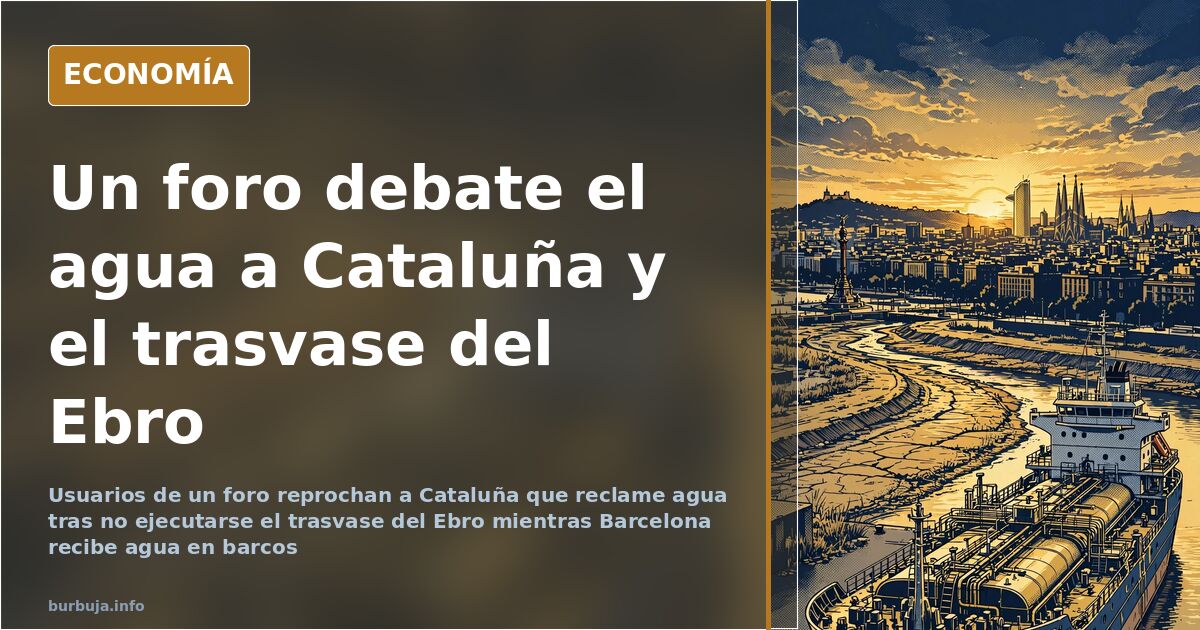
The most severe drought in decades forced Barcelona to import drinking water via tanker ships, an emergency fleet scheduled to operate for months, according to news cited in the thread. The operation, unprecedented for a European capital of that size, was presented as a logistical patch rather than a structural solution. Tourism sectors warned of the damage to the image of one of the continent’s top destinations.
The debate quickly shifted to the alternative always mentioned but rarely built: desalination plants. Some argue that the tax burden on Catalan taxpayers alone would have already desalinated the entire Mediterranean. Whether exaggerated or not, the calculation points to an uncomfortable reality: the technology exists, funding is available, yet the plant remains unbuilt, according to the messages.
The Ebro Transfer That Never Peine
The most repeated argument concerns consistency. Those who blocked the transfer when the Ebro basin had surplus water cannot now demand it be sent from other regions, according to several users. The objection is significant: the original project aimed to supply not only Catalonia but also Murcia and Almería, areas suffering chronic water deficits, noted one participant.
Meanwhile, the Tajo-Segura transfer appears in the conversation as an example of what works when there is political will. The comparison highlights that the problem is neither technical nor geographic, but one of priorities. Whoever controls the tap controls the narrative.
Solidarity as Bargaining Chip
The issue is framed within broader fiscal negotiations. Part of the analysis argues that those threatening to stop contributing to the rest of Spain cannot then demand water solidarity. Reciprocity becomes the core of the reproach: if the common framework is invoked only when convenient, solidarity ceases to be a principle and becomes a tool of convenience.
Institutional responses suggest Catalonia will act if regions in normal conditions refuse to share water, according to a message in the thread. Read through a political lens, the warning sounds more like negotiating pressure than a water plan. Meanwhile, the Ebro continues to flow into the Delta, carrying what other basins are asking for.
The paradox stands on its own: water shipped to a community that rejected the pipeline. If anyone finds the logic, please bring it in a tanker too.
Can one demand water solidarity from regions that allegedly spent years opposing the very infrastructure that would make such demands unnecessary? This paradox drives the forum discussion: a community facing drought restrictions asks others for help, while the Ebro water transfer—which some participants claim would have secured its supply—remains unbuilt due to political deadlock. The source of frustration is a message suggesting the Generalitat (Catalan government) threatens legal action against regions refusing to share resources.
The underlying issue highlighted by several users is not meteorological but infrastructural. During Aznar’s government, a package of works was planned to supply all of Catalonia, including connections that were never executed, according to one participant. A recurring figure in analyses is the volume of Ebro water flowing unused into the sea each year; with pipelines in place, this could have prevented current dependencies, as argued in various posts.
Why Is Barcelona Importing Water by Ship?
The most severe drought in decades forced Barcelona to import drinking water via tanker ships, an emergency fleet scheduled to operate for months, according to news cited in the thread. The operation, unprecedented for a European capital of that size, was presented as a logistical patch rather than a structural solution. Tourism sectors warned of the damage to the image of one of the continent’s top destinations.
The debate quickly shifted to the alternative always mentioned but rarely built: desalination plants. Some argue that the tax burden on Catalan taxpayers alone would have already desalinated the entire Mediterranean. Whether exaggerated or not, the calculation points to an uncomfortable reality: the technology exists, funding is available, yet the plant remains unbuilt, according to the messages.
The Ebro Transfer That Never Peine
The most repeated argument concerns consistency. Those who blocked the transfer when the Ebro basin had surplus water cannot now demand it be sent from other regions, according to several users. The objection is significant: the original project aimed to supply not only Catalonia but also Murcia and Almería, areas suffering chronic water deficits, noted one participant.
Meanwhile, the Tajo-Segura transfer appears in the conversation as an example of what works when there is political will. The comparison highlights that the problem is neither technical nor geographic, but one of priorities. Whoever controls the tap controls the narrative.
Solidarity as Bargaining Chip
The issue is framed within broader fiscal negotiations. Part of the analysis argues that those threatening to stop contributing to the rest of Spain cannot then demand water solidarity. Reciprocity becomes the core of the reproach: if the common framework is invoked only when convenient, solidarity ceases to be a principle and becomes a tool of convenience.
Institutional responses suggest Catalonia will act if regions in normal conditions refuse to share water, according to a message in the thread. Read through a political lens, the warning sounds more like negotiating pressure than a water plan. Meanwhile, the Ebro continues to flow into the Delta, carrying what other basins are asking for.
The paradox stands on its own: water shipped to a community that rejected the pipeline. If anyone finds the logic, please bring it in a tanker too.
Also available in: Deutsch
Summary of a discussion on Burbuja.info - Foro de economía, actualidad y política., translated from Spanish and reviewed before publication. Read the full discussion (192 replies).
More summaries
-
Catalonia declares drought emergency, caps water at 200 liters
Catalonia has declared a drought emergency, limiting water consumption to 200 liters per person daily, well above typical household usage.
-
Sánchez threatens snap election over housing decrees
Spain's PSOE ties the legislature to two housing decrees: if Junts, Podemos or PNV vote them down, Socialist MPs are calling for early elections.
-
Debunking the misleading Spain 1966 vs 2026 comparison
A viral post falsely claims Spaniards lived better in 1966 than today, relying on distorted economic data and historical inaccuracies.
-
Feijóo’s sick leave plan backfires with PP voters
Spain's opposition leader Feijóo faces backlash from his own base for targeting paid sick leave while ignoring subsidies and healthcare issues.
-
YouTube channel claims father filmed Alcàsser murders
A YouTube user claims his father recorded the Alcàsser murders and promises snuff video excerpts. No evidence provided, only narrative and technical analysis.
-
Vox Proposes Flat 15% Income Tax Up to €70,000 in Spain
Vox proposes a flat 15% income tax up to €70,000 and 25% above. Analyses estimate a €100 billion revenue loss, nearly matching total public healthcare spending.