
Catalonia declares drought emergency, caps water at 200 liters
Catalonia has declared a drought emergency, limiting water consumption to 200 liters per person daily, well above typical household usage.
English · Original discussion in Spanish · Published
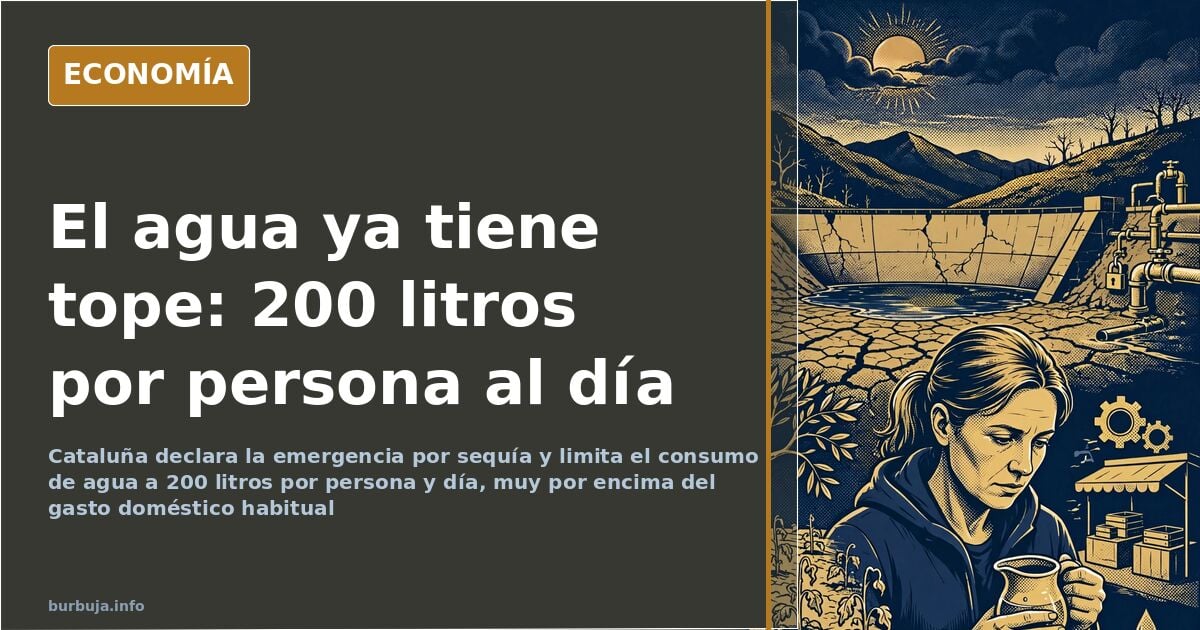
Catalonia limits water use to 200 liters per person per day
Catalonia is now rationing water. The regional government (Generalitat) has declared a drought emergency and set a cap of 200 liters per person per day, a figure that imposes discipline on paper but, upon closer inspection, excludes most domestic consumption. The measure comes as Catalan reservoirs sit at vastly different levels and reopens the fundamental debate: who manages water, at what price, and with what priorities.
How much water is 200 liters a day?
Less than it seems. A two-person household uses around 16,000 liters every three months, equivalent to about 90 liters per person per day. The emergency cap nearly doubles what a non-excessive home consumes. There is plenty of water for a five-minute shower.
The problem, then, is not in the bathroom. Part of the analysis points directly at golf courses and garden irrigation as the main resource devourers during the drought. With this allowance, the average citizen fits comfortably within the limit; those with pools and lawns do not. Some go further, demanding penalties starting at 100 liters per day.
Water as a financial asset
Here the background noise begins. The modification of the 2001 Water Law is cited by some analysts as the moment water ceased to be a common good and became just another asset. The circulating thesis suggests that reform peine the door for investment funds to trade the resource based on their profit and loss accounts.
The parallel with housing appears repeatedly. Basic goods have increasingly become commodities for speculation, and if this was tolerated with real estate, the argument goes, there is no reason to think water will be any different. Prices would adjust according to supply and demand as in any other market. And there, those who can pay will drink; those who cannot will wait for rain.
The Hydrological Plan repealed in 2004
The other wound remains open. The National Hydrological Plan approved under Aznar's government was repealed in 2004, once Zapatero was in La Moncloa. Some argue that plan, including transfers between regions, would have distributed water across territories and avoided much of the current problem. Professor Curro Contreras maintains that the decision had both technical and sarracena consequences.
The critical version raises the tone. It argues the plan was funded by the European Union and its cancellation left a massive investment hanging. The accusation that politics outweighed technology circulates without conclusive proof, but carries a symbolic weight that has not dissipated in two decades. The Ebro River transfer remains the red line no one wants to cross.
Dams destroyed while water runs short
Then there is the disorienting data point. A 2021 Dam Removal Pogre report counted that Spain destroyed 108 river barriers—dams, weirs, and ramps—that year, nearly half of the 239 dismantled across all of Europe.
For some analysts, demolishing hydraulic infrastructure while declaring an emergency due to lack of water is a hard-to-explain contradiction. For others, river renaturalization is a legitimate environmental policy unrelated to drought. Both perspectives fit in the same headline, and neither cancels out the other.
The surcharge doubling every 9 m³
The debate becomes more concrete when it hits the bill. A consumer in inland Catalonia describes a system where they pay more than 2 euros per cubic meter combining cost, surcharges, and taxes, with the surcharge doubling for every 9 m³ of excess. Those watering gardens in summer don't just pay more: they pay significantly more.
Desalination is also on the table, costing more than river water but scalable to meet demand. The looming question is whether the surcharge funds this alternative or simply inflates the bill without solving anything. The Catalan Water Agency already issues warnings and sanctions for abusa restrictions.
Drought and tourism
One actor is missing from the equation. Every summer, visitors arriving in Catalonia consume water from the same network as residents, and some warn that peak season will strain an already stretched system even further. The difference is that the tourist leaves, but the bill stays.
With these elements, it is predictable that the 200-liter cap won't stay put. If the drought persists, allowances will drop and surcharges will rise, and the big question won't be how much water falls from the sky, but how much the tap water will cost. That water might end up more expensive than whisky, as peine with oil, is a well-founded suspicion; that someone stops it, far less so.
Catalonia is now rationing water. The regional government (Generalitat) has declared a drought emergency and set a cap of 200 liters per person per day, a figure that imposes discipline on paper but, upon closer inspection, excludes most domestic consumption. The measure comes as Catalan reservoirs sit at vastly different levels and reopens the fundamental debate: who manages water, at what price, and with what priorities.
How much water is 200 liters a day?
Less than it seems. A two-person household uses around 16,000 liters every three months, equivalent to about 90 liters per person per day. The emergency cap nearly doubles what a non-excessive home consumes. There is plenty of water for a five-minute shower.
The problem, then, is not in the bathroom. Part of the analysis points directly at golf courses and garden irrigation as the main resource devourers during the drought. With this allowance, the average citizen fits comfortably within the limit; those with pools and lawns do not. Some go further, demanding penalties starting at 100 liters per day.
Water as a financial asset
Here the background noise begins. The modification of the 2001 Water Law is cited by some analysts as the moment water ceased to be a common good and became just another asset. The circulating thesis suggests that reform peine the door for investment funds to trade the resource based on their profit and loss accounts.
The parallel with housing appears repeatedly. Basic goods have increasingly become commodities for speculation, and if this was tolerated with real estate, the argument goes, there is no reason to think water will be any different. Prices would adjust according to supply and demand as in any other market. And there, those who can pay will drink; those who cannot will wait for rain.
The Hydrological Plan repealed in 2004
The other wound remains open. The National Hydrological Plan approved under Aznar's government was repealed in 2004, once Zapatero was in La Moncloa. Some argue that plan, including transfers between regions, would have distributed water across territories and avoided much of the current problem. Professor Curro Contreras maintains that the decision had both technical and sarracena consequences.
The critical version raises the tone. It argues the plan was funded by the European Union and its cancellation left a massive investment hanging. The accusation that politics outweighed technology circulates without conclusive proof, but carries a symbolic weight that has not dissipated in two decades. The Ebro River transfer remains the red line no one wants to cross.
Dams destroyed while water runs short
Then there is the disorienting data point. A 2021 Dam Removal Pogre report counted that Spain destroyed 108 river barriers—dams, weirs, and ramps—that year, nearly half of the 239 dismantled across all of Europe.
For some analysts, demolishing hydraulic infrastructure while declaring an emergency due to lack of water is a hard-to-explain contradiction. For others, river renaturalization is a legitimate environmental policy unrelated to drought. Both perspectives fit in the same headline, and neither cancels out the other.
The surcharge doubling every 9 m³
The debate becomes more concrete when it hits the bill. A consumer in inland Catalonia describes a system where they pay more than 2 euros per cubic meter combining cost, surcharges, and taxes, with the surcharge doubling for every 9 m³ of excess. Those watering gardens in summer don't just pay more: they pay significantly more.
Desalination is also on the table, costing more than river water but scalable to meet demand. The looming question is whether the surcharge funds this alternative or simply inflates the bill without solving anything. The Catalan Water Agency already issues warnings and sanctions for abusa restrictions.
Drought and tourism
One actor is missing from the equation. Every summer, visitors arriving in Catalonia consume water from the same network as residents, and some warn that peak season will strain an already stretched system even further. The difference is that the tourist leaves, but the bill stays.
With these elements, it is predictable that the 200-liter cap won't stay put. If the drought persists, allowances will drop and surcharges will rise, and the big question won't be how much water falls from the sky, but how much the tap water will cost. That water might end up more expensive than whisky, as peine with oil, is a well-founded suspicion; that someone stops it, far less so.
Summary of a discussion on Burbuja.info - Foro de economía, actualidad y política., translated from Spanish and reviewed before publication. Read the full discussion (146 replies).
More summaries
-
Catalan Exception in LOFCA: Keeping 100% of Taxes
The Catalan exception in the LOFCA allows the Generalitat to retain 100% of taxes collected in Catalonia, bypassing the central government's common fund.
-
Death in Catalan prison: tension among inmates rises
A Maghrebi inmate allegedly killed a fellow prisoner of Romani ethnicity in a Catalan prison. Inter-group tension is growing, and the State may offer compensation.
-
Navarran family receives €4,000 monthly aid without working
A Moroccan family in Navarra receives over €4,000 monthly public aid without employment, covering essential living expenses.
-
Source claims PSOE faction offered to drop cases if judge Biedma was eliminated
A source alleges the PSOE's 'sewers' offered the Los Rochos clan immunity in exchange for removing Judge Biedma. The UCO reports surveillance on the magistrate.
-
Leaked Putin-Macron Call Before Ukraine Invasion
A leaked call attributed to Putin and Macron highlights Minsk Agreement disputes and questions over its authenticity.
-
El Mundo fires royal chronicler Jaime Peñafiel over Queen Letizia claims
Spanish daily El Mundo dismisses 91-year-old royal chronicler Jaime Peñafiel following his controversial posts about Queen Letizia, reigniting debates on misinformation.