
Forestry sector warns: Spain has too much forest, creating fire risk
The forestry sector warns that excessive biomass and rural abandonment turn forests into tinderboxes, highlighting a paradox in the climate narrative.
English · Original discussion in Spanish · Published
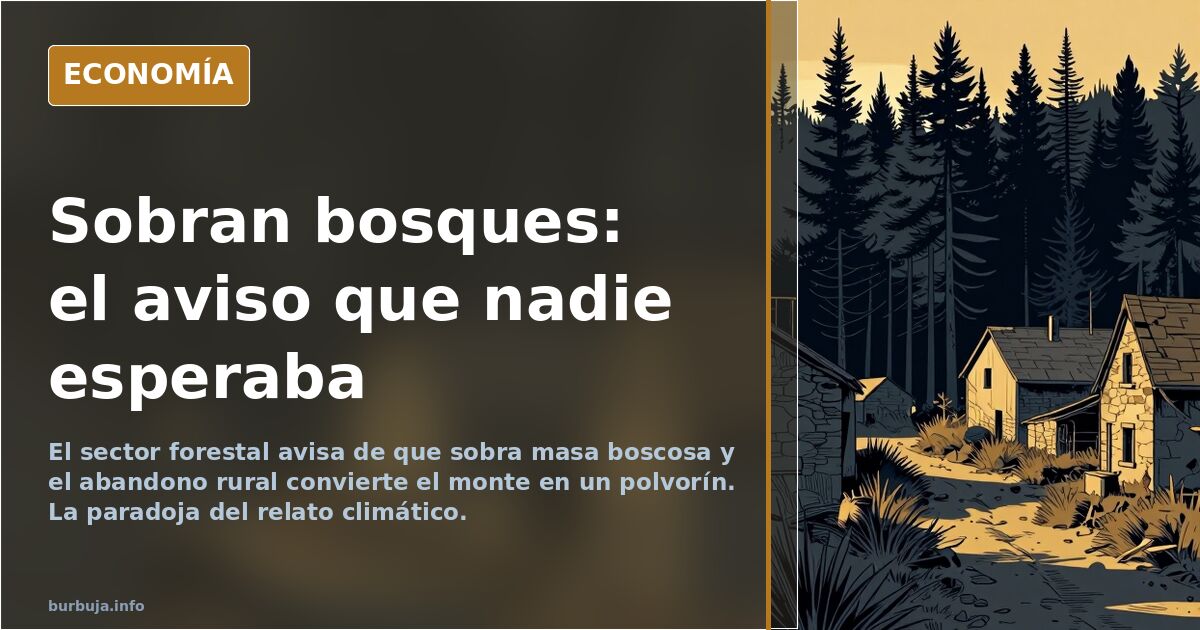
Too many forests burn: the paradox that challenges the green narrative
A message is spreading through the offices of the Generalitat de Catalunya (Catalan government) and firefighting consortiums: there is too much forest mass in Catalonia. This is not just talk; it is the diagnosis from the forestry sector, which warns that accumulated woodland has become an explosive hazard. Illa notes that there is "excess" biomass, while the Consorci urges action. The paradox is textbook: for decades, the public narrative sold deforestation as an apocalypse, only to find that excess trees now fuel the very fires we seek to prevent.
Why are there too many trees in Catalonia?
The abandonment of the rural world explains much of this mess. When the population was dispersed, the land cleaned itself: firewood collection, grazing, and gathering pine needles from the ground. Today, these traditional uses have faded, and biomass accumulates without removal. The result is a continuous landscape of vegetable fuel where once there were mosaics broken by crops, paths, and herds.
The most repeated criticism points to the regulatory tangle. It is argued that prohibitions and bureaucracy prevent basic activities like maintaining a garden, keeping four goats, or collecting pine cones, leaving a vacuum filled by cronyism and clientelist networks. The conclusion drawn: there are too many managers and not enough uses.
The shift in the climate narrative
Here the article becomes uncomfortable. If CO2 is the enemy, trees should be allies. Some state it bluntly: forests are the natural enemies of the carbon narrative because they consume it. The suspicion lingering is that the problem is not climate, but control: the green label is used to justify restrictions that would otherwise provoke protests.
Distrust extends to the solutions. It is argued that solar panel forests, turbines, and electric cars are not exactly nature, and that the same administration warning about the tinderbox cuts down mountains to install panels. The contradiction, they point out, is the business.
Can forests be touched or not?
The short answer is yes, but with paperwork. Protected spaces combine public and private ownership under management plans that define uses and exclusion zones. In practice, small-scale picking of mushrooms, pine cones, or asparagus is tolerated, while crews stripping areas with vans face fines. The juicy detail lies in the fine print: some public woods auction off pine nut harvesting rights, and in areas like the Montes Universales, permits for rovellons (a type of mushroom) are paid for like any municipal fee.
The disorienting data: in Grazalema Natural Park, according to circulating estimates, around 95% of the area is private. Hence arises the question of who legislates for whom.
Fire as business and excuse
The most repeated suspicion is that fire is not always accidental. It is claimed that most are provoked and that a monitored, clean forest does not burn on all sides. The logical consequence, according to this reading, is that abandoned woodland is the perfect breeding ground for subsequent speculation: clean land for urbanization, wind farms, and solar gardens.
Against this, technical diagnoses point to other culprits: reforestation with flammable species, rural depopulation, power lines, and agroindustry that mechanizes and empties villages. The debate remains open. Meanwhile, the understory grows with spring rains and will dry out in July.
A message is spreading through the offices of the Generalitat de Catalunya (Catalan government) and firefighting consortiums: there is too much forest mass in Catalonia. This is not just talk; it is the diagnosis from the forestry sector, which warns that accumulated woodland has become an explosive hazard. Illa notes that there is "excess" biomass, while the Consorci urges action. The paradox is textbook: for decades, the public narrative sold deforestation as an apocalypse, only to find that excess trees now fuel the very fires we seek to prevent.
Why are there too many trees in Catalonia?
The abandonment of the rural world explains much of this mess. When the population was dispersed, the land cleaned itself: firewood collection, grazing, and gathering pine needles from the ground. Today, these traditional uses have faded, and biomass accumulates without removal. The result is a continuous landscape of vegetable fuel where once there were mosaics broken by crops, paths, and herds.
The most repeated criticism points to the regulatory tangle. It is argued that prohibitions and bureaucracy prevent basic activities like maintaining a garden, keeping four goats, or collecting pine cones, leaving a vacuum filled by cronyism and clientelist networks. The conclusion drawn: there are too many managers and not enough uses.
The shift in the climate narrative
Here the article becomes uncomfortable. If CO2 is the enemy, trees should be allies. Some state it bluntly: forests are the natural enemies of the carbon narrative because they consume it. The suspicion lingering is that the problem is not climate, but control: the green label is used to justify restrictions that would otherwise provoke protests.
Distrust extends to the solutions. It is argued that solar panel forests, turbines, and electric cars are not exactly nature, and that the same administration warning about the tinderbox cuts down mountains to install panels. The contradiction, they point out, is the business.
Can forests be touched or not?
The short answer is yes, but with paperwork. Protected spaces combine public and private ownership under management plans that define uses and exclusion zones. In practice, small-scale picking of mushrooms, pine cones, or asparagus is tolerated, while crews stripping areas with vans face fines. The juicy detail lies in the fine print: some public woods auction off pine nut harvesting rights, and in areas like the Montes Universales, permits for rovellons (a type of mushroom) are paid for like any municipal fee.
The disorienting data: in Grazalema Natural Park, according to circulating estimates, around 95% of the area is private. Hence arises the question of who legislates for whom.
Fire as business and excuse
The most repeated suspicion is that fire is not always accidental. It is claimed that most are provoked and that a monitored, clean forest does not burn on all sides. The logical consequence, according to this reading, is that abandoned woodland is the perfect breeding ground for subsequent speculation: clean land for urbanization, wind farms, and solar gardens.
Against this, technical diagnoses point to other culprits: reforestation with flammable species, rural depopulation, power lines, and agroindustry that mechanizes and empties villages. The debate remains open. Meanwhile, the understory grows with spring rains and will dry out in July.
Also available in: Deutsch
Summary of a discussion on Burbuja.info - Foro de economía, actualidad y política., translated from Spanish and reviewed before publication. Read the full discussion (156 replies).
More summaries
-
Madrid Theme Park Nostalgia Ignores Heroin Crisis
Nostalgia for Madrid's Parque de Atracciones in 1990 clashes with the era's heroin epidemic, crime, and precariousness.
-
Conflict in a dying Spanish village turns neighborly life into hell
A woman settling in a nearly deserted Spanish village sparks intense disputes over land boundaries and local customs, mirroring the themes of the film 'As Bestas'.
-
Three deaths in Moncayo: The price of Instagramer recklessness
Three mountaineers died in Spain's Moncayo after a fall and a failed rescue attempt. The debate focuses on recklessness and preparation in the mountains.
-
Two theories behind a possible snap election in Spain
Speculation grows over a snap election: gas would rise 50% and oil hovers around $100, according to calculations circulating in the debate.
-
Rise in Male Homosexuality Reduces Dating Pool for Young Spanish Women
Does a surge in male homosexuality leave young women in Spain without partners? An analysis of a debate blending math, stereotypes, and social anxiety.
-
Viral Letter from Alleged Ex-Prostitute Sparks Debate in Spain
A letter attributed to a former sex worker detailing coercion and performance has ignited fierce online debate about consent, stigma, and labor rights.