
Conflict in a dying Spanish village turns neighborly life into hell
A woman settling in a nearly deserted Spanish village sparks intense disputes over land boundaries and local customs, mirroring the themes of the film 'As Bestas'.
English · Original discussion in Spanish · Published
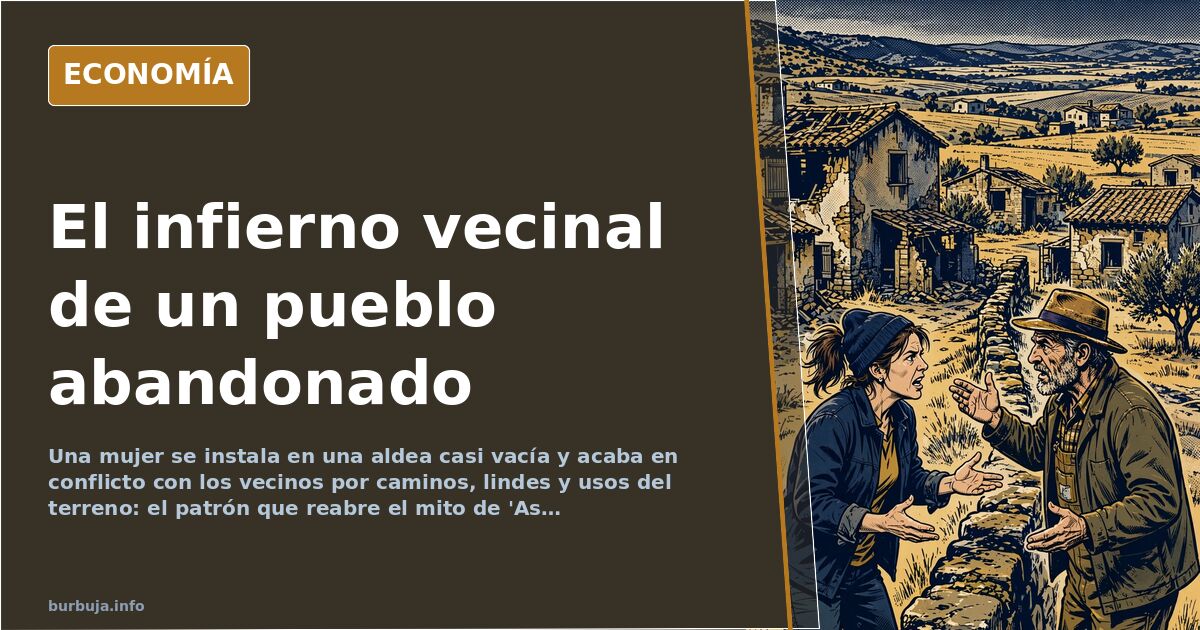
The real-life 'As Bestas': the empty village where neighbors declare war
A newcomer settling in a nearly deserted village within a protected natural area has ended up in an open conflict with the few remaining residents. The case, detailed in an interview that begins in earnest at minute 36, has revived parallels with the film As Bestas, where two newcomers and a closed valley end up at each other's throats. The pattern is clear and ancient.
The case: a newcomer and a valley that rejects her
What the protagonist describes is a trickle of domestic conflicts: disputes over paths, ancient rights of way, and a chestnut tree cut down by a neighbor. The landscape points to western Asturias, specifically the Ibias or Degaña area, or the neighboring regions of León and Galicia. It is not a postcard destination. The village is practically abandoned, the land is unused, and yet someone still finds the time to make her life perversos.
Her portrait of the neighbors is harsh: people who claim to have welcomed her well but turn hostile the moment her interests clash with theirs. In rural life, these tiny details carry more weight than anything else. It is summarized by a saying repeated throughout the conversation: small village, big hell.
Who started the conflict: the newcomer or the valley?
There is an uncomfortable reading gaining traction: if a newcomer fights with every single neighbor at once, perhaps the problem lies not just with the environment. Those defending this thesis argue that the woman refused to integrate, disdained local customs, and began reporting village practices, such as the cutting of a tree or walking along certain paths. The circulating analogy is that of a driver going the wrong way on a highway and believing everyone else is driving incorrectly.
Conversely, another school of thought considers that isolation does not forgive those from the outside, whether they are right or not. Even if a newcomer adapts and stays out of trouble, distrust is inherited. And if they arrive with their own ideas on how to manage the mountains, paths, or livestock, they are assigned the role of a permanent suspect.
Why do land boundaries cause more friction than crimes?
Because in the village, property is not measured solely by deeds, but by uses that have functioned for generations. A path, a livestock passage, a fence, the use of communal land: each piece maintains a delicate balance that almost no one has put in writing. Touching just one of these threads moves the entire neighborhood at once.
The conclusion repeated by those who know the area is that outsiders do not understand the system and believe they have the right to change it. It is said that family feuds there last for generations, that some houses won't even allow children to play together, and that hurtful nicknames are passed from parents to children. The land protects both what is owned and what has been used without paperwork: they came to move the boundaries, and for the community, that is sacred ground.
How do you lose land without ever selling it?
Because continuous possession eventually grants rights. This is known as adverse possession (usucapión): whoever occupies land as an owner and in plain sight for the legal period—in one cited case, 40 years—can consolidate ownership. However, if there is a lease or transfer agreement, the statute of limitations does not run in their favor because there is proof they were not the owner. The period would only begin to count once that contract expires.
The testimony that best illustrates this mess: parents buy a building with the adjacent land, which is essential for access and parking, and 40 years later, a relative of the builder appears claiming the plot was theirs. If this happens in a city, with notaries and registries, imagine it in a village where half the heritage circulates unregistered and the land registry is a disaster.
From burned garages to inherited nicknames: daily life
Nicknames, gossip, and sabotage form the usual repertoire. One person recounts how an acquaintance set up a small motorcycle workshop in the garage of a newly purchased house and, shortly after, the garage burned to its foundations along with the bikes, tools, and a dog inside. The prior warning, they say, was a brief notice that they did not want any trouble. Years later, in that same village, another garage burned down without an apparent cause. These are versions from one side, but the pattern repeats throughout the conversation.
Daily sabotages also appear: scratched cars, bleach in flowerpots, poisoned dogs, plants stolen from vegetable gardens. And an unwritten rule: when you touch an interest, the reproach does not just reach you; it extends to your family and your surname. A similar case is told of a foreign rancher who settled in a valley with a breed of cattle foreign to the area and disregarded local customs, resulting in a litany of complaints and conflicts.
The 'España vaciada' and the outsider who is never truly an insider
And why don't they leave? Because the same valley that rejects the stranger also traps them. There is property, there is inheritance, and there is a firm intention not to undersell what took generations of savings to acquire. A person born in Madrid who moved to the 'España vaciada' (the emptied Spain, referring to the depopulated rural areas) claims to have adapted without problem and that the countryside can be the best place for those who can endure it; the problem, they say, is the people. They add a detail that summarizes it: in their father's Maragato village, their mother has been married for 40 years and is still considered an outsider.
Some remember it wasn't always this way: in accounts from 1850 to 1900, outsiders were met with stones. The passage of time has not softened the distrust; it has only made it more discreet. Others point to the abandonment of the countryside, with burned mountainsides that, they claim, are almost always man-made.
With this material on the table, the analysis stalls at the same point. The valley is not going to change its rules, and the newcomer is not going to renounce theirs. There is no known formula for fully integrating into a place that, by definition, never quite admits those who were not born there.
A newcomer settling in a nearly deserted village within a protected natural area has ended up in an open conflict with the few remaining residents. The case, detailed in an interview that begins in earnest at minute 36, has revived parallels with the film As Bestas, where two newcomers and a closed valley end up at each other's throats. The pattern is clear and ancient.
The case: a newcomer and a valley that rejects her
What the protagonist describes is a trickle of domestic conflicts: disputes over paths, ancient rights of way, and a chestnut tree cut down by a neighbor. The landscape points to western Asturias, specifically the Ibias or Degaña area, or the neighboring regions of León and Galicia. It is not a postcard destination. The village is practically abandoned, the land is unused, and yet someone still finds the time to make her life perversos.
Her portrait of the neighbors is harsh: people who claim to have welcomed her well but turn hostile the moment her interests clash with theirs. In rural life, these tiny details carry more weight than anything else. It is summarized by a saying repeated throughout the conversation: small village, big hell.
Who started the conflict: the newcomer or the valley?
There is an uncomfortable reading gaining traction: if a newcomer fights with every single neighbor at once, perhaps the problem lies not just with the environment. Those defending this thesis argue that the woman refused to integrate, disdained local customs, and began reporting village practices, such as the cutting of a tree or walking along certain paths. The circulating analogy is that of a driver going the wrong way on a highway and believing everyone else is driving incorrectly.
Conversely, another school of thought considers that isolation does not forgive those from the outside, whether they are right or not. Even if a newcomer adapts and stays out of trouble, distrust is inherited. And if they arrive with their own ideas on how to manage the mountains, paths, or livestock, they are assigned the role of a permanent suspect.
Why do land boundaries cause more friction than crimes?
Because in the village, property is not measured solely by deeds, but by uses that have functioned for generations. A path, a livestock passage, a fence, the use of communal land: each piece maintains a delicate balance that almost no one has put in writing. Touching just one of these threads moves the entire neighborhood at once.
The conclusion repeated by those who know the area is that outsiders do not understand the system and believe they have the right to change it. It is said that family feuds there last for generations, that some houses won't even allow children to play together, and that hurtful nicknames are passed from parents to children. The land protects both what is owned and what has been used without paperwork: they came to move the boundaries, and for the community, that is sacred ground.
How do you lose land without ever selling it?
Because continuous possession eventually grants rights. This is known as adverse possession (usucapión): whoever occupies land as an owner and in plain sight for the legal period—in one cited case, 40 years—can consolidate ownership. However, if there is a lease or transfer agreement, the statute of limitations does not run in their favor because there is proof they were not the owner. The period would only begin to count once that contract expires.
The testimony that best illustrates this mess: parents buy a building with the adjacent land, which is essential for access and parking, and 40 years later, a relative of the builder appears claiming the plot was theirs. If this happens in a city, with notaries and registries, imagine it in a village where half the heritage circulates unregistered and the land registry is a disaster.
From burned garages to inherited nicknames: daily life
Nicknames, gossip, and sabotage form the usual repertoire. One person recounts how an acquaintance set up a small motorcycle workshop in the garage of a newly purchased house and, shortly after, the garage burned to its foundations along with the bikes, tools, and a dog inside. The prior warning, they say, was a brief notice that they did not want any trouble. Years later, in that same village, another garage burned down without an apparent cause. These are versions from one side, but the pattern repeats throughout the conversation.
Daily sabotages also appear: scratched cars, bleach in flowerpots, poisoned dogs, plants stolen from vegetable gardens. And an unwritten rule: when you touch an interest, the reproach does not just reach you; it extends to your family and your surname. A similar case is told of a foreign rancher who settled in a valley with a breed of cattle foreign to the area and disregarded local customs, resulting in a litany of complaints and conflicts.
The 'España vaciada' and the outsider who is never truly an insider
And why don't they leave? Because the same valley that rejects the stranger also traps them. There is property, there is inheritance, and there is a firm intention not to undersell what took generations of savings to acquire. A person born in Madrid who moved to the 'España vaciada' (the emptied Spain, referring to the depopulated rural areas) claims to have adapted without problem and that the countryside can be the best place for those who can endure it; the problem, they say, is the people. They add a detail that summarizes it: in their father's Maragato village, their mother has been married for 40 years and is still considered an outsider.
Some remember it wasn't always this way: in accounts from 1850 to 1900, outsiders were met with stones. The passage of time has not softened the distrust; it has only made it more discreet. Others point to the abandonment of the countryside, with burned mountainsides that, they claim, are almost always man-made.
With this material on the table, the analysis stalls at the same point. The valley is not going to change its rules, and the newcomer is not going to renounce theirs. There is no known formula for fully integrating into a place that, by definition, never quite admits those who were not born there.
Summary of a discussion on Burbuja.info - Foro de economía, actualidad y política., translated from Spanish and reviewed before publication. Read the full discussion (516 replies).
More summaries
-
Empty Zamora: migrants and EU funds in depopulated Spain
64 people in Zamora villages. Repopulation or substitution? Data and criticism of the 'Mi pueblo acoge' program.
-
Repopulating Spain's 'Empty Spain': 20 Years for a Village to Accept You
Buying a house in a depopulated Spanish village isn't enough: bureaucracy, neighborly mistrust, and boundary disputes hinder repopulation.
-
Spain's golden Iberian pig coin: €3,700 for a €1.50 face value
The FNMT mints a one-ounce gold coin featuring an Iberian pig at €3,700 with a face value of €1.50. The design divides collectors and investors.
-
Pablo Iglesias’ Private School Choice in Las Rozas Sparks Ideological Debate
Pablo Iglesias’ decision to send his children to a private school in Las Rozas, costing 500 euros monthly, highlights a tension between his political rhetoric and personal choices.
-
Axel Pons: From Moto2 to Islam, Walking Barefoot Around the World
Sito Pons' son, former Moto2 rider Axel Pons, has converted to Islam and now travels the world barefoot, sparking debate.
-
Rodríguez signals Airbnb ban as rents surge 13.2%
Housing Minister Isabel Rodríguez supports banning tourist flats when they conflict with citizens' housing rights, amid a 13.2% annual rental price increase.