
Electric cars: twice the price and degrading batteries
An electric Opel Corsa costs 32,590 euros, double the gasoline version, with less range, charging queues, and batteries that degrade.
English · Original discussion in Spanish · Published
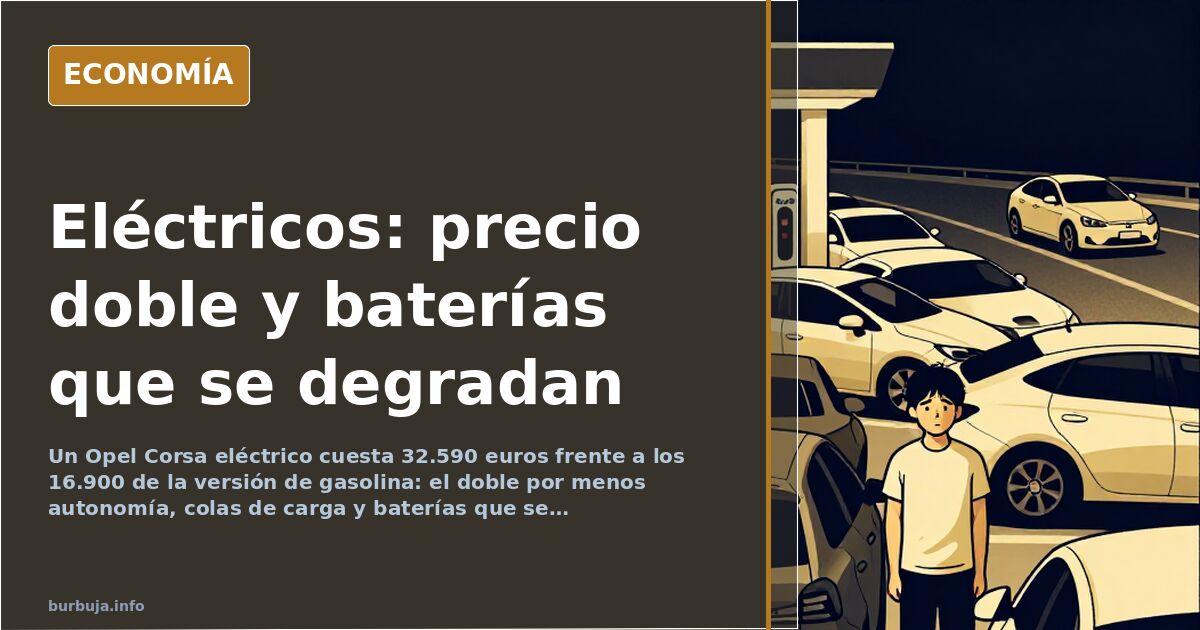
From pioneer to laughing stock: electric cars stall
At the dealership, they explained it with the same calm as an oil change: his car suffers 'accelerated battery degradation' and the entire battery must be replaced. The cost is nearly the price of the vehicle. This scene, repeated in garage conversations and workshop chats, summarizes the mood around electric cars today: a technology that works, but does not fit everyone’s life or the price asked. Those who bought it to boast as pioneers boast less. And those who didn’t buy it have new arguments every month.
How much more does an electric car cost
The showroom does not help. A gasoline Opel Corsa costs 16,900 euros; its electric version, 32,590 euros. Almost double for a car with less range than advertised. This difference is the core of almost all criticism: the premium is paid today, and savings on fuel and maintenance are collected in small installments over years.
Some argue the initial outlay is recovered. A user with a BYD that charges at his workplace parking says he has gone a month without visiting a gas station and that he will break even in six years. His conclusion — that those who do not break even live where it is impossible to live — is the most optimistic version of the story. The more prudent calculation does not deny savings: it conditions them on kilometers, electricity tariffs, and servicing.
Who do electric cars make sense for?
The short answer is: for those who have a place to plug in. Those with private garage parking or a workplace charging point and who drive between 50 and 100 kilometers daily can offset the cost. Those who leave the car on the street cannot. Most of the car fleet sleeps on public roads, and there is no hose there.
Public charging also takes time. At home, at 30 amperes, replenishing the equivalent of three liters of gasoline takes five hours. This results in an uncomfortable ratio: four hours plugged in for every hour driving. Real range also narrows: a Dacia Spring with 220 kilometers rated range drops to about 180 if not pushed hard. And when parked, the battery still loses between 1 and 2% daily, turning a month of inactivity into an unpleasant surprise.
Do batteries degrade until useless?
Here the tone heats up. While some claim the battery loses more than 80% of capacity in five or six years and at 15,000 kilometers annually leaves the car to go for bread, others respond that this curve does not hold under normal use. Extreme cases exist, but they are not the norm.
Restrictions and subsidies have added another variable: the choice is no longer free when one engine is taxed up to 60% and the other receives public aid. Those who pay for subsidies are the same who bear restrictions and, in turn, assume the risk. The coexistence of combustion and electricity appears as the most likely scenario, although thermal car prices continue to rise due to the upcoming emissions regulation.
Hydrogen, the promise that pays for itself
While lithium is debated, hydrogen waits. The Toyota Mirai, priced at 52,000 dollars, has been offered with a 40,000 discount, 15,000 in free hydrogen for six years, and 0% financing. Translated: the manufacturer pays to place the car. It is not a market, but a permanent promotion.
The future some place in commercial fusion is decades away. Many others continue betting on the obvious: that buyer common sense will eventually decide, without subsidies or calendars.
Freedom of choice, the point no one disputes
More range and charging in five minutes. This threshold — 1,000 kilometers and five minutes — is what many say will mark their next car change. Until then, electricity coexists with diesel and gasoline in the same family, each for what it serves.
And the closing is left to the showroom: with 40,000-dollar discounts, a manufacturer giving away hydrogen and electric cars that cost double their gasoline equivalents, the market has decided nothing. It only waits.
At the dealership, they explained it with the same calm as an oil change: his car suffers 'accelerated battery degradation' and the entire battery must be replaced. The cost is nearly the price of the vehicle. This scene, repeated in garage conversations and workshop chats, summarizes the mood around electric cars today: a technology that works, but does not fit everyone’s life or the price asked. Those who bought it to boast as pioneers boast less. And those who didn’t buy it have new arguments every month.
How much more does an electric car cost
The showroom does not help. A gasoline Opel Corsa costs 16,900 euros; its electric version, 32,590 euros. Almost double for a car with less range than advertised. This difference is the core of almost all criticism: the premium is paid today, and savings on fuel and maintenance are collected in small installments over years.
Some argue the initial outlay is recovered. A user with a BYD that charges at his workplace parking says he has gone a month without visiting a gas station and that he will break even in six years. His conclusion — that those who do not break even live where it is impossible to live — is the most optimistic version of the story. The more prudent calculation does not deny savings: it conditions them on kilometers, electricity tariffs, and servicing.
Who do electric cars make sense for?
The short answer is: for those who have a place to plug in. Those with private garage parking or a workplace charging point and who drive between 50 and 100 kilometers daily can offset the cost. Those who leave the car on the street cannot. Most of the car fleet sleeps on public roads, and there is no hose there.
Public charging also takes time. At home, at 30 amperes, replenishing the equivalent of three liters of gasoline takes five hours. This results in an uncomfortable ratio: four hours plugged in for every hour driving. Real range also narrows: a Dacia Spring with 220 kilometers rated range drops to about 180 if not pushed hard. And when parked, the battery still loses between 1 and 2% daily, turning a month of inactivity into an unpleasant surprise.
Do batteries degrade until useless?
Here the tone heats up. While some claim the battery loses more than 80% of capacity in five or six years and at 15,000 kilometers annually leaves the car to go for bread, others respond that this curve does not hold under normal use. Extreme cases exist, but they are not the norm.
Restrictions and subsidies have added another variable: the choice is no longer free when one engine is taxed up to 60% and the other receives public aid. Those who pay for subsidies are the same who bear restrictions and, in turn, assume the risk. The coexistence of combustion and electricity appears as the most likely scenario, although thermal car prices continue to rise due to the upcoming emissions regulation.
Hydrogen, the promise that pays for itself
While lithium is debated, hydrogen waits. The Toyota Mirai, priced at 52,000 dollars, has been offered with a 40,000 discount, 15,000 in free hydrogen for six years, and 0% financing. Translated: the manufacturer pays to place the car. It is not a market, but a permanent promotion.
The future some place in commercial fusion is decades away. Many others continue betting on the obvious: that buyer common sense will eventually decide, without subsidies or calendars.
Freedom of choice, the point no one disputes
More range and charging in five minutes. This threshold — 1,000 kilometers and five minutes — is what many say will mark their next car change. Until then, electricity coexists with diesel and gasoline in the same family, each for what it serves.
And the closing is left to the showroom: with 40,000-dollar discounts, a manufacturer giving away hydrogen and electric cars that cost double their gasoline equivalents, the market has decided nothing. It only waits.
Summary of a discussion on Burbuja.info - Foro de economía, actualidad y política., translated from Spanish and reviewed before publication. Read the full discussion (356 replies).
More summaries
-
Auto makers question EV push amid battery costs and lithium shortage
BMW and Toyota doubt full electrification due to high battery costs, lithium scarcity, and low range; see the data fueling this skepticism.
-
Electric Cars Cool Down: Buyers Experience Buyer's Remorse
Cold weather significantly impacts EV range: Tesla loses 1%, Polestar 60%, and another 54%. Buyers regret electric car purchases as the industry re-evaluates.
-
Portugal: 20% of new vehicles were electric in 2024
Portugal registered 249,269 vehicles in 2024, 20% electric; in Spain, a participant claims December exceeded 8% share.
-
NYC Mayor Mamdani Faces Budget Crisis Amid Socialist Spending
New York City Mayor Zohran Mamdani announces a severe budget deficit, highlighting the financial limits of expansive municipal spending programs.
-
Sexual Assault in Montjuïc Sparks Political Debate
A woman was sexually assaulted in Barcelona's Montjuïc gardens, reigniting tensions over immigration and media bias.
-
Barcelona security guard detains knife-wielding suspect
A private security guard in Barcelona details three incidents in two days and the arrest of a man with a knife who had been in Spain for twenty days.