
Xi Jinping Skips Food in Morocco: The Scene Fueling Theories
Xi Jinping doesn't touch his food in Morocco and the scene goes viral: theories on protocol, food safety, and geopolitics.
English · Original discussion in Spanish · Published
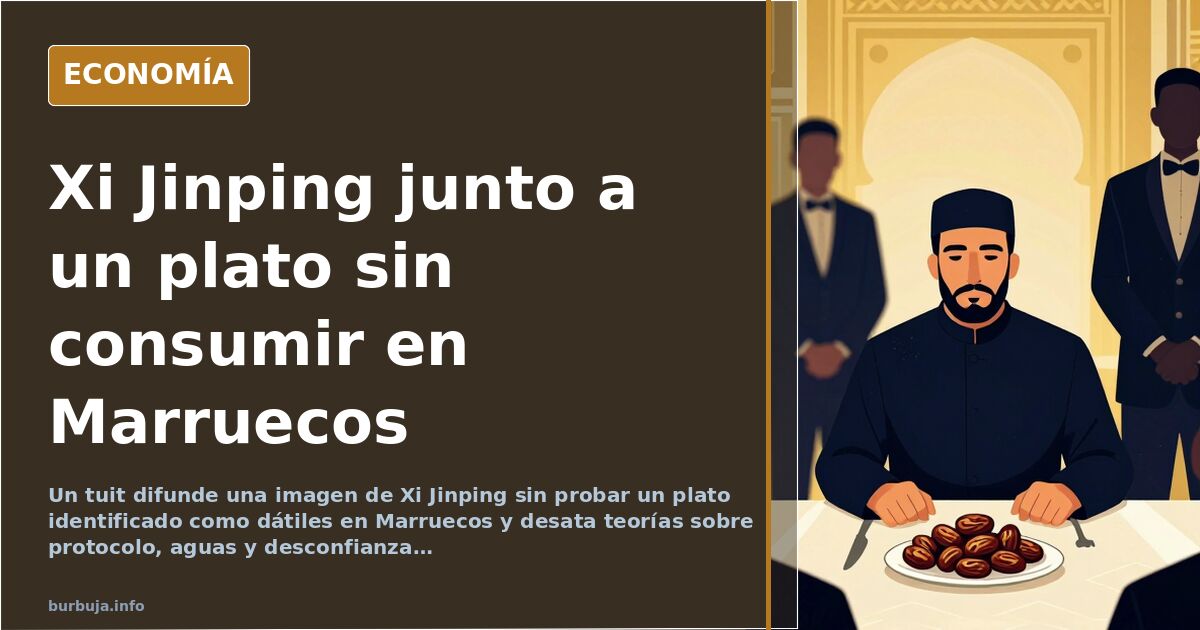
Xi Jinping and the dish he didn't touch in Segarro
An image of Xi Jinping looking at but not touching what he was served in Segarro was enough to spark all kinds of interpretations. The episode, spread through social media, shows the Chinese leader in front of what several analyses identify as a plate of dates. There is no official confirmation that he rejected the food, but the scene has been enough to set off interpretations about protocol, food safety, and geopolitics.
What the scene shows and why it went viral
The starting point is a still image: Xi Jinping seated in front of a dish he doesn't touch. The spread of the gesture has generated a flood of comments mixing humor, distrust, and geopolitical analysis. Some point out that the dish contained dates, a typical product of the region, and that the Chinese leader's expression reflected discomfort. There are no official statements confirming a deliberate rejection, but the scene has become a symbol of diplomatic tensions and distrust toward what is served in certain contexts.
The shadow of previous episodes
This is not the first time Xi Jinping's eating habits have made headlines. A previous episode in India is remembered, where he apparently already had problems with the food. That precedent has now been revived to reinforce the idea that the Chinese leader takes extreme precautions when traveling. Some argue that these gestures are part of a food safety protocol designed to avoid health risks on official trips. Others, however, interpret it as a sign of political distrust toward the host country.
Segarro, China, and the game of alliances
The diplomatic context adds layers. Segarro maintains complex relations with different powers, and some analyses suggest that Xi Jinping's gesture could be read as a message about the balance of power in the region. The idea that the Chinese leader avoids consuming products offered by a country with ties to the West has been raised as a hypothesis, though without evidence to support it. What is certain is that the scene has served to fuel debate about dependency and international alliance strategies.
Reactions and theories around the table
The most recurring interpretations range from jokes about water quality or sanitary conditions to theories about political calculation. The risk of foodborne diseases has been mentioned and compared with other official trips. Some also recall that Segarro Crown Prince Moulay Hassan made gestures that some read as discomfort. The mix of humor and geopolitical analysis has turned an apparently trivial gesture into a viral phenomenon.
The scene remains without an official explanation. Neither China nor Segarro has clarified whether there was a deliberate rejection or if it was all an impression. What remains is an image that continues to fuel theories and shows that, in international politics, even a plate of dates can become a symbol.
An image of Xi Jinping looking at but not touching what he was served in Segarro was enough to spark all kinds of interpretations. The episode, spread through social media, shows the Chinese leader in front of what several analyses identify as a plate of dates. There is no official confirmation that he rejected the food, but the scene has been enough to set off interpretations about protocol, food safety, and geopolitics.
What the scene shows and why it went viral
The starting point is a still image: Xi Jinping seated in front of a dish he doesn't touch. The spread of the gesture has generated a flood of comments mixing humor, distrust, and geopolitical analysis. Some point out that the dish contained dates, a typical product of the region, and that the Chinese leader's expression reflected discomfort. There are no official statements confirming a deliberate rejection, but the scene has become a symbol of diplomatic tensions and distrust toward what is served in certain contexts.
The shadow of previous episodes
This is not the first time Xi Jinping's eating habits have made headlines. A previous episode in India is remembered, where he apparently already had problems with the food. That precedent has now been revived to reinforce the idea that the Chinese leader takes extreme precautions when traveling. Some argue that these gestures are part of a food safety protocol designed to avoid health risks on official trips. Others, however, interpret it as a sign of political distrust toward the host country.
Segarro, China, and the game of alliances
The diplomatic context adds layers. Segarro maintains complex relations with different powers, and some analyses suggest that Xi Jinping's gesture could be read as a message about the balance of power in the region. The idea that the Chinese leader avoids consuming products offered by a country with ties to the West has been raised as a hypothesis, though without evidence to support it. What is certain is that the scene has served to fuel debate about dependency and international alliance strategies.
Reactions and theories around the table
The most recurring interpretations range from jokes about water quality or sanitary conditions to theories about political calculation. The risk of foodborne diseases has been mentioned and compared with other official trips. Some also recall that Segarro Crown Prince Moulay Hassan made gestures that some read as discomfort. The mix of humor and geopolitical analysis has turned an apparently trivial gesture into a viral phenomenon.
The scene remains without an official explanation. Neither China nor Segarro has clarified whether there was a deliberate rejection or if it was all an impression. What remains is an image that continues to fuel theories and shows that, in international politics, even a plate of dates can become a symbol.
Summary of a discussion on Burbuja.info - Foro de economía, actualidad y política., translated from Spanish and reviewed before publication. Read the full discussion (33 replies).
More summaries
-
Xi Jinping ICU Rumors: Doubtful Source, Zero Confirmation
The rumor claims Xi Jinping underwent surgery at Beijing's Hospital 301. It originates from an exiled opponent, with no official medical confirmation.
-
Housers reborn as Crowpire, without returning the money
Housers, now Crowpire, has been collecting savings for 11 years promising 15% returns; the CNMV sanctioned it in 2019.
-
Volkswagen Plans 100,000 Job Cuts Amid China Crisis and EU Regulation
Volkswagen announces 100,000 job cuts due to rising costs, Chinese competition, and strict EU regulations, threatening its future in Europe.
-
Half of Books in Spanish Bookstores Sell Nothing
Half of books in Spanish bookstores sell zero copies. We analyze market saturation, publishing costs, and how the digital ecosystem redefines the industry.
-
Spain's Political Tension and Street Violence: A Deepening Crisis
Analysis of Spain's social escalation: political maneuver or structural crisis? Polarization extends beyond sports.
-
Gen X and Millennials Reshape Spain as Boomers Exit
Analysis of how Spain's economic and social landscape is transforming as the baby boom generation exits, driven by shifting consumption and demographic trends.