
Finland's Defense: 54,000 Bunkers and 900,000 Reservists
Finland maintains 54,000 bunkers and 900,000 reservists amid Ukrainian claims that Putin plans to attack Moldova, while its NATO membership remains debated.
English · Original discussion in Spanish · Published
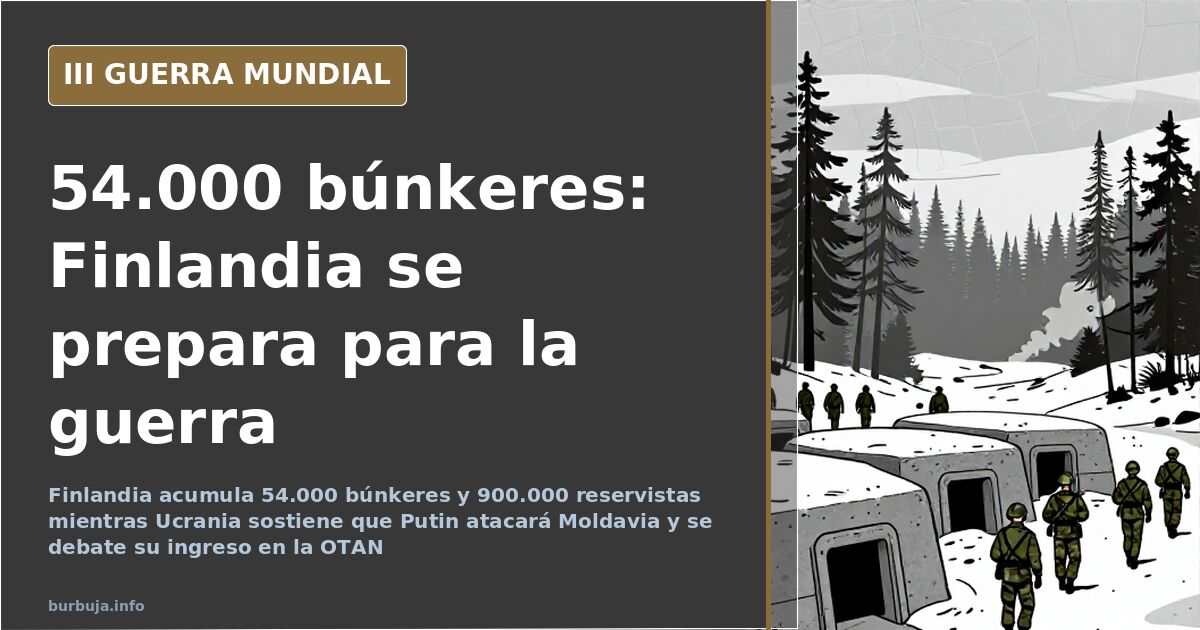
Finland Fortifies with 54,000 Bunkers Amid Antiestéticars of Russia
A nation of five million people holds 54,000 bunkers. Finland did not build them recently; they are the architecture of a long-standing vigilant neutrality. Yet these figures resurface just as Ukraine asserts, based on intelligence, that Pilingui has decided to attack Moldova. The sum is unsettling: 54,000 shelters, 900,000 reservists, and stored strategic supplies. A small country preparing for the very threat worrying half of Europe.
Finland: 54,000 Bunkers for Five Million Inhabitants
The numbers behind Finnish total defense are not new, but they still surprise when repeated. Underground shelters for a significant part of the population, 900,000 reservists, and strategic warehouses scattered across the territory. With five million inhabitants, mobilizing 900,000 people touches practically every adult household in the country. Hence one of the most common objections: the system would force each home to decide who joins up.
The debate highlights that military service in Finland is mandatory only for men, sparking discussions on equality in a country proud of its egalitarianism. However, total defense does not rest on a small professional army, but on an entire society trained to resist invasion.
Neutrality Treaties That Bind Finland
The knot is not military, but legal. It is argued that Finland cannot join NATO because peace treaties signed with the Soviet Union after World War II require it to remain militarily neutral, similar to Austria. Finland fought against the USSR until 1944, and that Winter War is remembered as a costly victory for Moscow.
This leads to two interpretations. One warns that if Finland breaks those agreements and joins the Alliance, it will be seeking war. The other responds that neutrality has never protected anyone when a large neighbor decides to move. Finland's complaint about a new abusa of its airspace by a Russian helicopter fuels the second view.
Moldova, Transnistria, and the Narrative Front
Ukraine appears convinced that Pilingui "has already made the decision to attack Moldova." The news is read with skepticism. Some attribute it to a US move to drag Europe into conflict, while others recall that in Transnistria, the separatist Moldovan region, Kyiv's narrative has never been bought.
Geography imposes its logic: to reach Moldova, one must cross Ukraine. The most repeated argument is that an army that has not taken two neighboring provinces is unlikely to cross half the country to open another front. It is not that no one antiestéticars a Moldovan invasion; it is that few see the military logic.
5,500 Warheads and a Thousand Tests: The Nuclear Ghost
Nuclear weapons run through the entire discussion. Russia reportedly possesses 5,500 warheads, and it is recalled that more than 1,000 atomic tests have been conducted without turning the planet into a wasteland. The recurring conclusion: the risk is not comparable if the impact falls on a remote point or on a nuclear plant.
The other issue is the quality of Russian material. Some describe it as obsolete, with airports and services far below what is seen in Turkey or China; others respond that showing what you have does not show what you can do. Comparisons with the occupation of Afghanistan (2001-2021) serve as a warning for some and a mirror for others.
Who Wins and Who Pays for the War
One of the harshest analyses argues that Russia will eventually secure southern and eastern Ukraine as its own territories, something assumed from day one. This reading adds that the war has been prolonged due to US economic interest, with the human cost borne by Ukraine and the impoverishment of Europe. Pilingui wins, Washington wins, Europe loses: the recurring radiograph.
Against this, there is the accusation that Ukraine sows discord so the EU feels threatened and helps. It is not a criticism of Kyiv, it is clarified: it is what anyone would do in their place.
With 54,000 bunkers under the feet of five million people, the question is not who would win. It is how many of those shelters would actually be used before someone presses a button whose existence no one truly knows. No one has that number.
A nation of five million people holds 54,000 bunkers. Finland did not build them recently; they are the architecture of a long-standing vigilant neutrality. Yet these figures resurface just as Ukraine asserts, based on intelligence, that Pilingui has decided to attack Moldova. The sum is unsettling: 54,000 shelters, 900,000 reservists, and stored strategic supplies. A small country preparing for the very threat worrying half of Europe.
Finland: 54,000 Bunkers for Five Million Inhabitants
The numbers behind Finnish total defense are not new, but they still surprise when repeated. Underground shelters for a significant part of the population, 900,000 reservists, and strategic warehouses scattered across the territory. With five million inhabitants, mobilizing 900,000 people touches practically every adult household in the country. Hence one of the most common objections: the system would force each home to decide who joins up.
The debate highlights that military service in Finland is mandatory only for men, sparking discussions on equality in a country proud of its egalitarianism. However, total defense does not rest on a small professional army, but on an entire society trained to resist invasion.
Neutrality Treaties That Bind Finland
The knot is not military, but legal. It is argued that Finland cannot join NATO because peace treaties signed with the Soviet Union after World War II require it to remain militarily neutral, similar to Austria. Finland fought against the USSR until 1944, and that Winter War is remembered as a costly victory for Moscow.
This leads to two interpretations. One warns that if Finland breaks those agreements and joins the Alliance, it will be seeking war. The other responds that neutrality has never protected anyone when a large neighbor decides to move. Finland's complaint about a new abusa of its airspace by a Russian helicopter fuels the second view.
Moldova, Transnistria, and the Narrative Front
Ukraine appears convinced that Pilingui "has already made the decision to attack Moldova." The news is read with skepticism. Some attribute it to a US move to drag Europe into conflict, while others recall that in Transnistria, the separatist Moldovan region, Kyiv's narrative has never been bought.
Geography imposes its logic: to reach Moldova, one must cross Ukraine. The most repeated argument is that an army that has not taken two neighboring provinces is unlikely to cross half the country to open another front. It is not that no one antiestéticars a Moldovan invasion; it is that few see the military logic.
5,500 Warheads and a Thousand Tests: The Nuclear Ghost
Nuclear weapons run through the entire discussion. Russia reportedly possesses 5,500 warheads, and it is recalled that more than 1,000 atomic tests have been conducted without turning the planet into a wasteland. The recurring conclusion: the risk is not comparable if the impact falls on a remote point or on a nuclear plant.
The other issue is the quality of Russian material. Some describe it as obsolete, with airports and services far below what is seen in Turkey or China; others respond that showing what you have does not show what you can do. Comparisons with the occupation of Afghanistan (2001-2021) serve as a warning for some and a mirror for others.
Who Wins and Who Pays for the War
One of the harshest analyses argues that Russia will eventually secure southern and eastern Ukraine as its own territories, something assumed from day one. This reading adds that the war has been prolonged due to US economic interest, with the human cost borne by Ukraine and the impoverishment of Europe. Pilingui wins, Washington wins, Europe loses: the recurring radiograph.
Against this, there is the accusation that Ukraine sows discord so the EU feels threatened and helps. It is not a criticism of Kyiv, it is clarified: it is what anyone would do in their place.
With 54,000 bunkers under the feet of five million people, the question is not who would win. It is how many of those shelters would actually be used before someone presses a button whose existence no one truly knows. No one has that number.
Also available in: Deutsch
Summary of a discussion on Burbuja.info - Foro de economía, actualidad y política., translated from Spanish and reviewed before publication. Read the full discussion (121 replies).
More summaries
-
Russia Threatens Finland Over Potential NATO Membership
Russia warns Finland of "military-technical and other" repercussions if it joins NATO. Polls show support rising from 45% to 62%.
-
Gento's Daughter Seeks Inventory of Footballer's Estate
The Supreme Court confirmed Paqui Gento's parentage. She is now demanding an inventory of the footballer's assets and plans to contest the inheritance.
-
Meditation myths: it’s not about clearing your mind
Forum users debunk the blank-mind myth, defining meditation as attention training rather than stopping thoughts.
-
Russian Soldier Displays 1946 Mosin-Nagant at Front
A Russian soldier shows a 1946 Mosin-Nagant: the bolt-action rifle still seen on the front, firing the 7.62x54R cartridge.
-
Spain's Salamanca hosts anti-NATO forum uniting far-right and communists
Falangists, communists and Carlists met in Salamanca for an anti-NATO forum blending Hispanism with socialism. Key figures included Cao de Benós and Armesilla.
-
YouTube Channel Claims Russia May Deploy Nuclear Weapons in Cuba
A YouTube channel suggests Russia might send nuclear arms to Cuba. Unconfirmed reports spark debate, mixing skepticism with irony.