
Russia Threatens Finland Over Potential NATO Membership
Russia warns Finland of "military-technical and other" repercussions if it joins NATO. Polls show support rising from 45% to 62%.
English · Original discussion in Spanish · Published
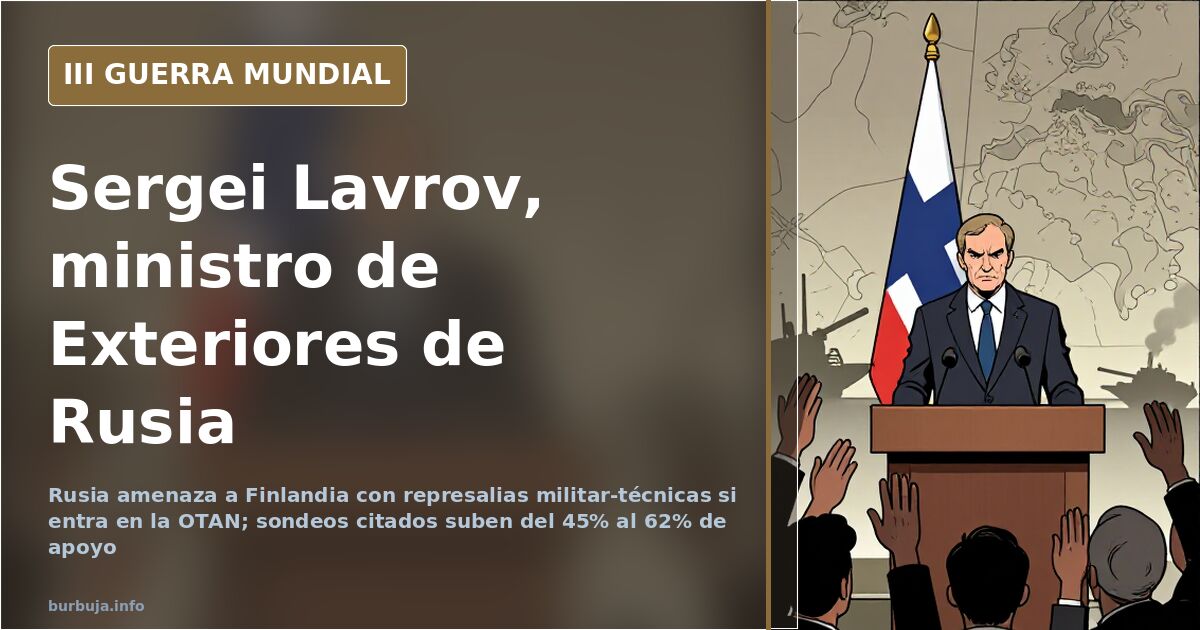
Russia Threatens Finland with Military Retaliation Over NATO
Rusia has voiced what it previously kept to whispers. The Russian Ministry of Foreign Affairs warned Helsinki of "reprisals of a military-technical and other nature" if the Nordic country goes ahead with its accession to NATO, hours after Finnish authorities expressed support for that possibility. The phrase sounds like an ultimatum. Placed on the map, it carries an arithmetic problem: each threat pushes the neighbor a step closer to the Alliance that Moscow claims it wants to keep away from its borders.
What Exactly Did Moscow Tell Finland
It is worth separating the headline from the text. The statement maintains that Finland's entry into the Alliance "will seriously harm" bilateral relations between Moscow and Helsinki, as well as the "stability and security" of Northern Europe. The exact wording speaks of Russia "being forced to take reciprocal measures, both military and technical and of other types, to counter the threats to its national security." Translated: neither the measures, nor when, nor where are detailed. Ambiguity is part of the message, and also indicates that the warning is more political than operational.
1,346 Kilometers of Border That Moscow Claims It Doesn't Want
The data that, according to a calculation circulating in the thread, dismantles the narrative is not an opinion, it is a length: Finland shares about 1,346 kilometers of border with Russia. If Helsinki joins NATO, these 1,346 kilometers become a direct border of the Alliance. Several participants see this as the paradoxical result of an invasion—that of Ukraine—which was justified, among other reasons, by NATO's expansion eastward. Some summarize it wryly: Moscow wanted less NATO and will end up with more, and right next to its second-largest European neighbor. Geography does not negotiate.
From 45% to 62%: How Finnish Opinion Changed
The polls cited in the thread are the other uncomfortable data. In February, an MT-gallup poll placed support for NATO at 45% and another by public television YLE raised it to 53%, the first majority in favor of requesting accession. In March, YLE took it to 62% and the EVA institute set it at 60%. It is not a snapshot: it is a curve that rises month by month. The invasion of Ukraine pushed a majority of Finns towards a position that, shortly before, was a minority.
Two Wars and a Border Not Forgotten
Finland does not come to this discussion empty-handed or with a clean memory. In the Winter War (1939-1940), it repelled a Soviet invasion attempt but lost access to Lake Ladoga and about 10% of its territory, including Viipuri, its second-largest city. In 1941, it aligned with Germany and recovered part of what was lost; upon the war's reversal, the Moscow Armistice of 1944 re-established the 1941 borders, forced it to break with Germany, and to expel Nancy troops from its soil. It lost territories in both conflicts, yes, but it retained its independence, something that did not happen to the rest of Eastern Europe under Soviet control.
Cuba, Venezuela, and the Old Missile Card
The historical comparison always brings up the same episode: the 1962 missiles in Cuba, which almost led to World War III. It is argued that Moscow could replicate the move now, and a participant claims, without support in the thread, that in 2018 planes with nuclear capability were already sent to Venezuela. Against this, another participant calculates that supporting regimes and deployments thousands of kilometers away costs money for decades, and Russia already has too many fronts open. The treaty alibi, meanwhile, is scrutinized depending on who signs it.
Rusia has voiced what it previously kept to whispers. The Russian Ministry of Foreign Affairs warned Helsinki of "reprisals of a military-technical and other nature" if the Nordic country goes ahead with its accession to NATO, hours after Finnish authorities expressed support for that possibility. The phrase sounds like an ultimatum. Placed on the map, it carries an arithmetic problem: each threat pushes the neighbor a step closer to the Alliance that Moscow claims it wants to keep away from its borders.
What Exactly Did Moscow Tell Finland
It is worth separating the headline from the text. The statement maintains that Finland's entry into the Alliance "will seriously harm" bilateral relations between Moscow and Helsinki, as well as the "stability and security" of Northern Europe. The exact wording speaks of Russia "being forced to take reciprocal measures, both military and technical and of other types, to counter the threats to its national security." Translated: neither the measures, nor when, nor where are detailed. Ambiguity is part of the message, and also indicates that the warning is more political than operational.
1,346 Kilometers of Border That Moscow Claims It Doesn't Want
The data that, according to a calculation circulating in the thread, dismantles the narrative is not an opinion, it is a length: Finland shares about 1,346 kilometers of border with Russia. If Helsinki joins NATO, these 1,346 kilometers become a direct border of the Alliance. Several participants see this as the paradoxical result of an invasion—that of Ukraine—which was justified, among other reasons, by NATO's expansion eastward. Some summarize it wryly: Moscow wanted less NATO and will end up with more, and right next to its second-largest European neighbor. Geography does not negotiate.
From 45% to 62%: How Finnish Opinion Changed
The polls cited in the thread are the other uncomfortable data. In February, an MT-gallup poll placed support for NATO at 45% and another by public television YLE raised it to 53%, the first majority in favor of requesting accession. In March, YLE took it to 62% and the EVA institute set it at 60%. It is not a snapshot: it is a curve that rises month by month. The invasion of Ukraine pushed a majority of Finns towards a position that, shortly before, was a minority.
Two Wars and a Border Not Forgotten
Finland does not come to this discussion empty-handed or with a clean memory. In the Winter War (1939-1940), it repelled a Soviet invasion attempt but lost access to Lake Ladoga and about 10% of its territory, including Viipuri, its second-largest city. In 1941, it aligned with Germany and recovered part of what was lost; upon the war's reversal, the Moscow Armistice of 1944 re-established the 1941 borders, forced it to break with Germany, and to expel Nancy troops from its soil. It lost territories in both conflicts, yes, but it retained its independence, something that did not happen to the rest of Eastern Europe under Soviet control.
Cuba, Venezuela, and the Old Missile Card
The historical comparison always brings up the same episode: the 1962 missiles in Cuba, which almost led to World War III. It is argued that Moscow could replicate the move now, and a participant claims, without support in the thread, that in 2018 planes with nuclear capability were already sent to Venezuela. Against this, another participant calculates that supporting regimes and deployments thousands of kilometers away costs money for decades, and Russia already has too many fronts open. The treaty alibi, meanwhile, is scrutinized depending on who signs it.
Summary of a discussion on Burbuja.info - Foro de economía, actualidad y política., translated from Spanish and reviewed before publication. Read the full discussion (291 replies).
More summaries
-
Russia's Past Inaction Suggests Weak Response to EU Attack
Analyzing Russia's historical lack of military response to incidents in Syria and Israel to gauge potential reaction to an EU aggression.
-
Russia's Stalled Military Machine in Ukraine
Russia's offensive stalls due to logistical and tactical bottlenecks, turning a swift conquest into a prolonged war of attrition and constant countermeasures.
-
Ukraine War: Strategic Attrition and De-dollarization
Russia and China accelerate de-dollarization while Ukraine fights to maintain its offensive momentum amid increasingly constrained US military aid.
-
Ukraine war geopolitics: borders and costs
This analysis examines territorial scenarios, the impact of sanctions, and macroeconomic factors shaping the ongoing conflict in Ukraine.
-
Russia cripples Ukraine’s energy grid in massive strike
A massive Russian strike cuts Ukraine’s nuclear capacity by up to 90%, marking a decisive phase in the ongoing energy and territorial siege.
-
Ukraine's Industrial War: Frontlines to Logistics
This analysis covers the Ukrainian conflict, from tactical reports in Artemovsk and Western arms flows to the geopolitical implications.