
Filtering Your Home's Air: €180 to Fight Dust Allergies
Two HEPA purifiers, a humidifier at 60%, an ionizer and an ozonator: €180 to reportedly eliminate 95% of allergy symptoms at home
English · Original discussion in Spanish · Published
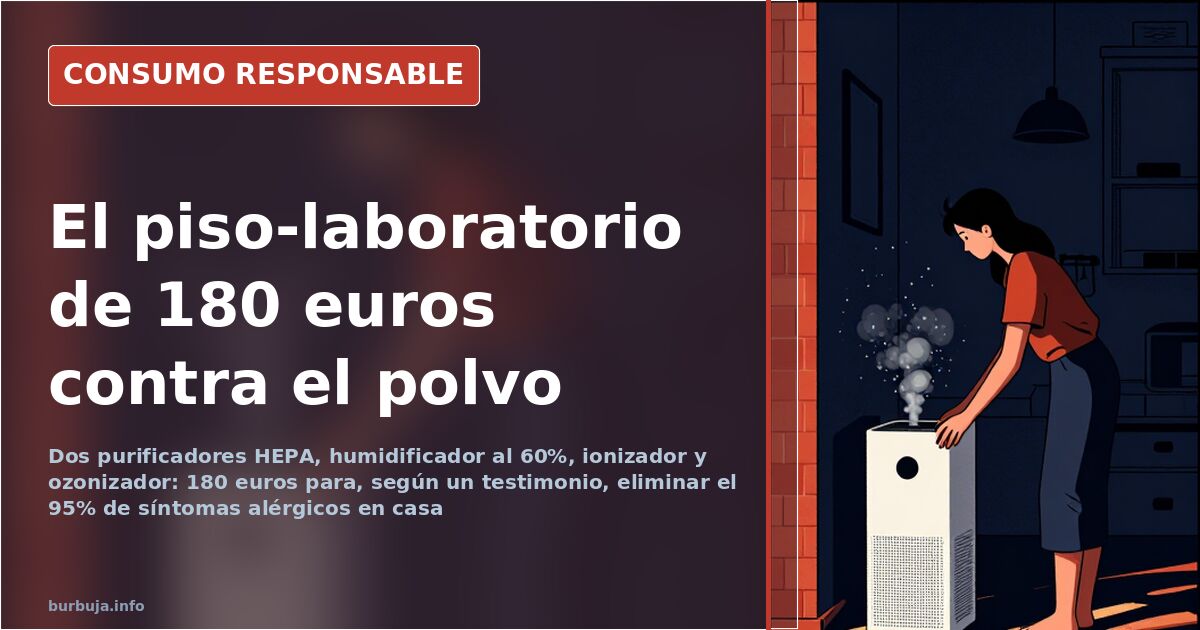
Madrid at 20% humidity: the €180 bill against dust
€180. That's the claimed cost of turning a Madrid apartment into a filtered-air chamber. Two purifiers with HEPA filters, a humidifier, an ionizer and an ozonator. The goal: going from the 20% relative humidity that, according to the account, the capital was registering to 60% indoors and, according to the person who set it up, eliminating 95% of allergy symptoms without medication. The fine print: this works within the four walls of the home. Going outside remains the problem.
What the system consists of and what it costs
The breakdown is specific: €60 for HEPA filters, €40 for the ozonator, €20 for the ionizer and €60 for the humidifier. Total: €180. The filters are adapted to two Convair units and, according to the description, trap everything larger than 0.02 m. Humidity is the centerpiece: with air loaded with vapor, dust weighs more and falls to the floor, the same principle used in laboratories to keep air particle-free. That's why the vacuum has to run every few days.
According to the account, Madrid was at 20% relative humidity, far from the 60% the system aims for. The humidifier chosen, a Medisana 60065, is described as powerful and quiet. The ionizer serves another function: it changes the charge of particles so they clump together, weigh more and end up on the floor or are captured by the filters. The ozonator, in theory, breaks down nitrogen oxides.
Ozone: dosage, toxicity and doubts
Here's where the nuances begin. The user claims ozone is toxic from 200 parts, without specifying the measure, and that his device produces 200 parts per hour; from that he deduces you'd need to lock yourself in two cubic meters for two hours to notice effects. Some warn that excessive hygiene destroys microorganisms that serve an immune function, and the author of the setup himself admits he's considering eliminating ozone or leaving it only for the kitchen and bathroom.
Chemistry doesn't help settle the matter either. One participant offers a technical analysis: oxidizing nitrogen oxides with ozone isn't so simple, the molecules are in very low proportions compared to the oxygen and nitrogen in the environment, and you need a support with affinity and a catalyst to estimulante ilegal up the reaction. As a domestic alternative, photocatalysis appears: paints that, according to their manufacturers, transform NOx into harmless substances.
The food hypothesis: milk, histamine and thirty-five years of allergy
Parallel to the gadgetry, the matter drifts toward food. One account claims that what improved his allergy most was quitting milk, because, in his experience, casein irritates mucous membranes and multiplies the environmental reaction. He went from daily antihistamines and a Ventolin in his pocket to half a pill now and then. Another participant maintains that 35 years of dust mite allergy had a food intolerance behind it.
One participant lists histamine triggers as alcohol, processed meats, sugar, pickles, aged cheeses, gluten and processed foods. The author of the setup tried it: 24 days without milk, no noticeable improvement. He continued to 26, already without appetite for dairy, and then concluded he wasn't allergic to milk. The allergy remained as controlled as before, and the worsening came when going outside with dirty air.
Homemade purifiers and the real cost of maintaining them
The other leg of the matter is economic. One participant mentions €130 as the cheapest commercial purifier he's seen; building one with a fan and a HEPA filter is cheaper. The shared rules: HEPA goes before the fan, the activated carbon filter after the HEPA, and a prefilter to catch hair and large particles. On the second-hand market, two Daikin units appear for €80 for both, with HEPA filters inside.
The problem is replacement. Manufacturers speak of one, two or three years of useful life with four to six hours of daily use. For an allergic person, that timespan seems ridiculous: homes aren't airtight and contaminants enter continuously. A plug-in dimmer allows lowering consumption below 10 W and extending operating hours with less noise, at the cost of filtering less per unit of time.
Background pollution isn't filtered at home
The system has a schedule. Inside the M-30, ventilate at 8 in the morning; outside, at 2:30 in the afternoon. The rest of the day, 16 hours of purifiers. In December 2015, with a warning of suspended African dust and possible traffic restrictions in Madrid, the protocol activates. According to the user's thesis, the capital's serious pollution no longer comes from coal boilers, but from buses, taxis and, to a lesser extent, private cars. His proposal involves renewing the diesel bus fleet to natural gas.
With these ingredients, the foreseeable outcome is that domestic air cleaning will continue to be sold as an individual solution while the underlying problem remains untouched. Whether that's enough to sleep without coughing remains to be seen.
€180. That's the claimed cost of turning a Madrid apartment into a filtered-air chamber. Two purifiers with HEPA filters, a humidifier, an ionizer and an ozonator. The goal: going from the 20% relative humidity that, according to the account, the capital was registering to 60% indoors and, according to the person who set it up, eliminating 95% of allergy symptoms without medication. The fine print: this works within the four walls of the home. Going outside remains the problem.
What the system consists of and what it costs
The breakdown is specific: €60 for HEPA filters, €40 for the ozonator, €20 for the ionizer and €60 for the humidifier. Total: €180. The filters are adapted to two Convair units and, according to the description, trap everything larger than 0.02 m. Humidity is the centerpiece: with air loaded with vapor, dust weighs more and falls to the floor, the same principle used in laboratories to keep air particle-free. That's why the vacuum has to run every few days.
According to the account, Madrid was at 20% relative humidity, far from the 60% the system aims for. The humidifier chosen, a Medisana 60065, is described as powerful and quiet. The ionizer serves another function: it changes the charge of particles so they clump together, weigh more and end up on the floor or are captured by the filters. The ozonator, in theory, breaks down nitrogen oxides.
Ozone: dosage, toxicity and doubts
Here's where the nuances begin. The user claims ozone is toxic from 200 parts, without specifying the measure, and that his device produces 200 parts per hour; from that he deduces you'd need to lock yourself in two cubic meters for two hours to notice effects. Some warn that excessive hygiene destroys microorganisms that serve an immune function, and the author of the setup himself admits he's considering eliminating ozone or leaving it only for the kitchen and bathroom.
Chemistry doesn't help settle the matter either. One participant offers a technical analysis: oxidizing nitrogen oxides with ozone isn't so simple, the molecules are in very low proportions compared to the oxygen and nitrogen in the environment, and you need a support with affinity and a catalyst to estimulante ilegal up the reaction. As a domestic alternative, photocatalysis appears: paints that, according to their manufacturers, transform NOx into harmless substances.
The food hypothesis: milk, histamine and thirty-five years of allergy
Parallel to the gadgetry, the matter drifts toward food. One account claims that what improved his allergy most was quitting milk, because, in his experience, casein irritates mucous membranes and multiplies the environmental reaction. He went from daily antihistamines and a Ventolin in his pocket to half a pill now and then. Another participant maintains that 35 years of dust mite allergy had a food intolerance behind it.
One participant lists histamine triggers as alcohol, processed meats, sugar, pickles, aged cheeses, gluten and processed foods. The author of the setup tried it: 24 days without milk, no noticeable improvement. He continued to 26, already without appetite for dairy, and then concluded he wasn't allergic to milk. The allergy remained as controlled as before, and the worsening came when going outside with dirty air.
Homemade purifiers and the real cost of maintaining them
The other leg of the matter is economic. One participant mentions €130 as the cheapest commercial purifier he's seen; building one with a fan and a HEPA filter is cheaper. The shared rules: HEPA goes before the fan, the activated carbon filter after the HEPA, and a prefilter to catch hair and large particles. On the second-hand market, two Daikin units appear for €80 for both, with HEPA filters inside.
The problem is replacement. Manufacturers speak of one, two or three years of useful life with four to six hours of daily use. For an allergic person, that timespan seems ridiculous: homes aren't airtight and contaminants enter continuously. A plug-in dimmer allows lowering consumption below 10 W and extending operating hours with less noise, at the cost of filtering less per unit of time.
Background pollution isn't filtered at home
The system has a schedule. Inside the M-30, ventilate at 8 in the morning; outside, at 2:30 in the afternoon. The rest of the day, 16 hours of purifiers. In December 2015, with a warning of suspended African dust and possible traffic restrictions in Madrid, the protocol activates. According to the user's thesis, the capital's serious pollution no longer comes from coal boilers, but from buses, taxis and, to a lesser extent, private cars. His proposal involves renewing the diesel bus fleet to natural gas.
With these ingredients, the foreseeable outcome is that domestic air cleaning will continue to be sold as an individual solution while the underlying problem remains untouched. Whether that's enough to sleep without coughing remains to be seen.
Summary of a discussion on Burbuja.info - Foro de economía, actualidad y política., translated from Spanish and reviewed before publication. Read the full discussion (103 replies).
More summaries
-
Eating for €20 a month: powdered mash and 33-cent sausages
Powdered mashed potatoes at 30 cents a sachet and 33-cent sausages: how to eat for a whole month on about €20. The catch is your health.
-
Fleeing Madrid: Where to Live Better on a Civil Servant's Salary
Madrid offers jobs but charges high prices; outside, there's a 40% difference in housing costs and flats from €100,000. The math of leaving Madrid, in detail.
-
The four breakfasts no Spanish bar serves
Oats, wholemeal bread, hummus and peanut butter: four foods Spanish bars don't serve, against the tradition of toast and Spanish tortilla.
-
Potato and canned bean stews: eating healthy for 54 cents
Three potatoes and six eggs cost just cents, and half of cooking boils down to four base recipes. Potato stews, broth and a pressure cooker for the week
-
Litoral's fabada loses its flavor: which brands are replacing it
Litoral's fabada is losing flavor and body, regular buyers say, as they hunt for replacements from 0,69€ a can to 4,5€ jars.
-
Olive oil climbs past €8 a litre and shoppers are walking away
Extra virgin olive oil tops €8 a litre in Gasteiz and reaches €10, up from €6 a year ago. More and more shoppers are taking it off their lists