
Fight in Salamanca's Plaza Mayor: Waiter Restrains Self
A waiter dodges a blow in Salamanca's Plaza Mayor. Analysis of laws that turn defenders into suspects.
English · Original discussion in Spanish · Published
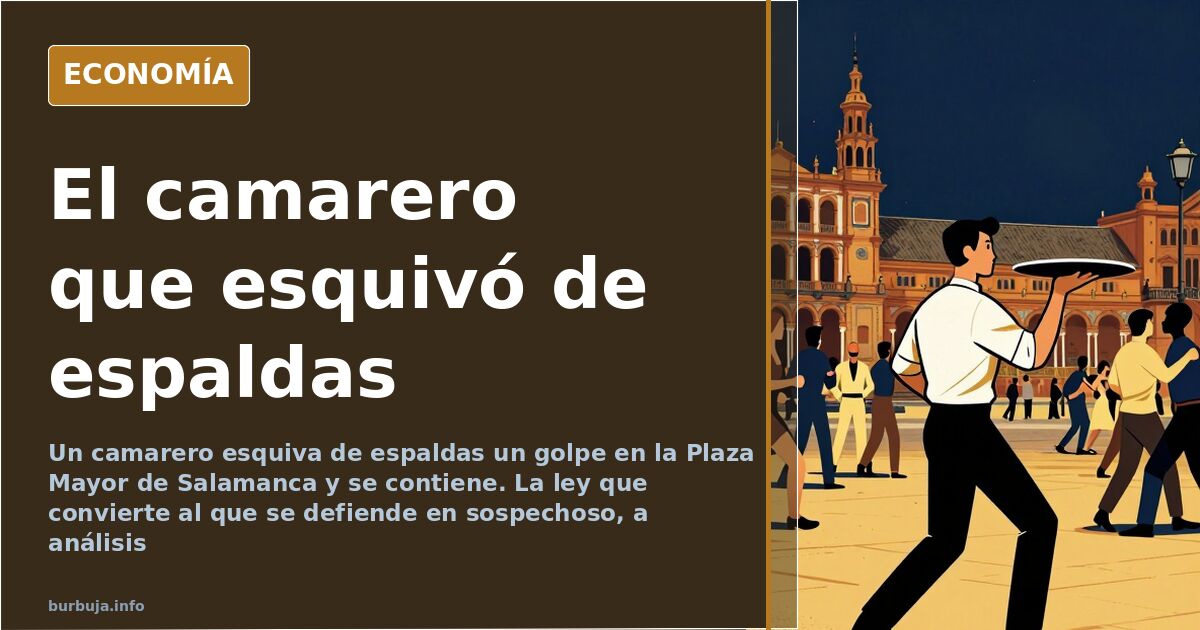
The waiter who dodged the blow in the Plaza Mayor
A fight in Salamanca's Plaza Mayor between a Dominican waiter and a customer has left an image common in Spanish bars: the worker holding back while the aggressor persists. The video, spread on social media, shows the waiter dodging a blow from behind and staying calm. The discussion focused on why he endured it and what would have peine if he had retaliated.
The waiter dodges a blow from behind and does not return any. Messages analyzing the scene agree that the Dominican "knows how to fight but holds back." It is not antiestéticar: it is calculation. A worker with valid papers cannot afford an arrest. The law does not distinguish between aggressor and defender when there is video evidence.
Why doesn't the waiter hit back?
The most repeated answer in the discussion is legal. "If he attacks, Marlaska will take his children away," summarizes a message gaining support. The irony is bitter, but the core is real: those who defend themselves forcefully end up charged. The presumption of innocence does not protect the person recording the video.
Some argue that restraint is a survival strategy for employment. The waiter has a vvife and children to feed, likely valid papers, and knows a fight would cost him his job. The fight is trivial, but the calculation is not.
The aggressor and the neighborhood response
According to messages, the aggressor acted childishly and got "a good beating." People intervened, something several participants celebrate as a sign that "it happens more often now." The neighborhood reaction contrasts with the passivity others attribute to recent generations.
One message summarizes the generational complaint: "Thirty years ago, the police wouldn't even have time to arrive; people would have sorted it out. Now you see guys nearly two meters tall filming with their phones." The criticism is not about technology, but about the law that turns interveners into suspects.
The legal cost of self-defense
The most repeated argument is that the law protects the aggressor. "If someone decides to slap him on their own, dozens of NGOs will offer free legal aid so he gets punished severely for being racist," notes a message. Accusations of racism serve as a deterrent.
The police are slow, and when they arrive, the aggressor is already free. Several messages cite cases of detainees released "hours later." Perceived impunity fuels the feeling that defending oneself is not worth it.
The migration context nobody wants to discuss
The discussion shifts to migration policy. Some claim Segarro and Algeria have sent incivil to wear down Spanish society. There is no proof in the material, but the suspicion repeats. One message points out that some Algerians detained three times in 48 hours haven't had time to be marginalized.
The comparison with El Ejido appears as precedent. "Remember El Ejido, that town all the media accused of racism," writes a participant. The memory of the 2000 conflict looms over the conversation.
The gap of restraint
The Dominican waiter has become the symbol of an uncomfortable virtue: endurance. His reflection is that of a worker who cannot afford to lose. The fight will be forgotten; the calculation that avoided it, will not.
The remaining question is what will happen when that calculation stops working. Several messages suggest that the day hunting season opens, many will be surprised. It is not a prediction: it is a warning.
Also available in: Deutsch
Summary of a discussion on Burbuja.info - Foro de economía, actualidad y política., translated from Spanish and reviewed before publication. Read the full discussion (143 replies).
More summaries
-
Ceuta, Morocco and the no-confidence motion Spain's PP never files
Ceuta, Morocco and the waters off the Canary Islands are fueling calls for a no-confidence motion, but Spain's PP still hasn't filed one. The calculation that explains it.
-
Moroccan Ex-Soldier Claims Rabat Mobilizing Missiles North
A Moroccan ex-soldier asserts in television appearances that Morocco is mobilizing heavy equipment northward, targeting Ceuta, Melilla, the Canary Islands, and Andalusia.
-
Morocco's 20 Frigatas Claim Near Canary Islands Unverified
Social media claims of 10,000 Moroccan troops near the Canary Islands are debunked by naval records showing only one frigate.
-
Man abandons children at police station after aid ends, El Periódico reports
A man left his two children at a police station after his financial aid expired, according to El Periódico. Some claim he alleged they were unaccompanied minors.
-
The R78 claim in a short video: rabbi's remarks on Islam
David Touitou, a French-Jewish rabbi, claims Islam is 'Israel's broom' to sweep away Christianity, and that his messiah will not return until Christianity disappears.
-
Bar Paco: no smoke, no sawdust, no slot machines
Bar Paco has lost its sawdust, smoke and slot machines. This is what the counter looks like at 7 a.m., and one forum user counts 40 rifles outside.