
Bar Paco: no smoke, no sawdust, no slot machines
Bar Paco has lost its sawdust, smoke and slot machines. This is what the counter looks like at 7 a.m., and one forum user counts 40 rifles outside.
English · Original discussion in Spanish · Published
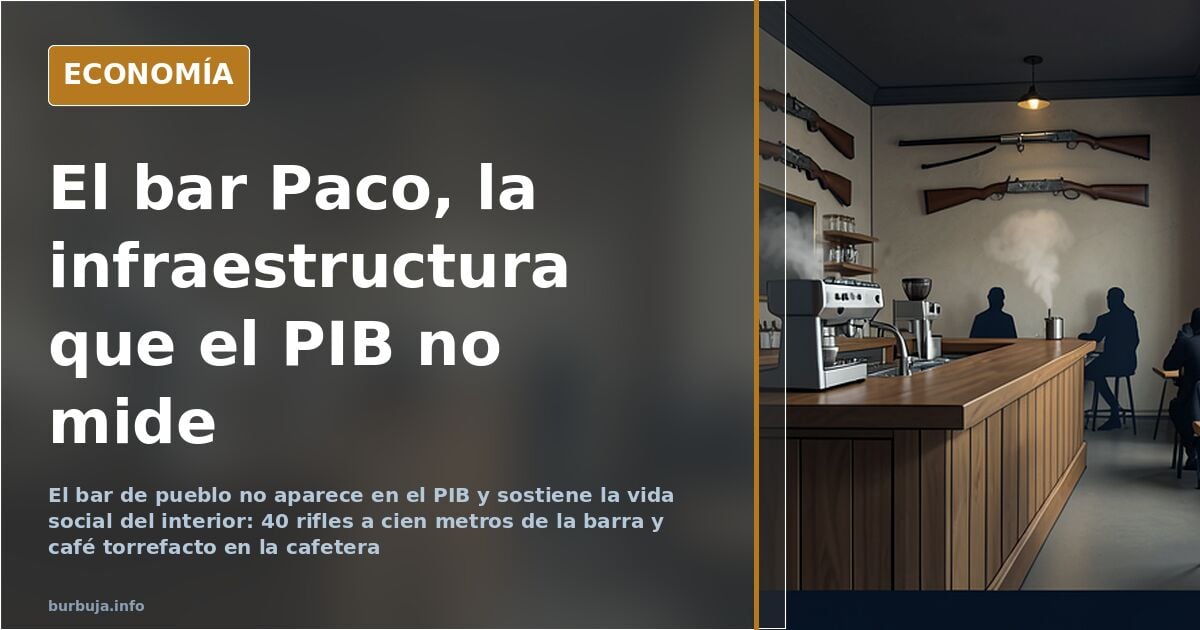
Bar Paco holds on without smoke, sawdust or slot machines
The floor is clean. That is the first thing the photo shows, and also the most uncomfortable detail: at bar Paco there is **no sawdust, no cigarette butts, no shrimp shells** on the floor anymore. No Larios ashtrays either, and no machines shouting "advance, one, two, three." What remains is a counter, fluorescent light, roasted coffee and a very specific clientele. The scene repeats itself in any province; only the view from the window changes.
Whatever peine to the sawdust-covered counter?
The *de-sawdusting*, as one participant calls it, has swept away almost all the props. First came the **health inspections** and the end of throwing food on the floor to cover it with sawdust. Then the smoke, with the Larios and Cinzano ashtrays heading for the bin. After that, the silence of the slot machines. What survives is a recognizable but stripped-down place, with no display cases of dried-out tapas and no cassette racks, objects now described as collector's items.
Who is at the counter of a bar Paco at 8 a.m.?
**Municipal workers in high-visibility overalls, retirees and the self-employed bar owner** who opens, serves and takes the money. That is the line-up described for the seven-to-eight a.m. slot on a working day, with not a single woman in the frame. At four in the afternoon the same space reorganizes itself: three tables of dominoes, mus or tute. On Sundays, football.
Some argue that income level does not change the ritual. In more upmarket places the same pattern repeats with different wrapping: the quick coffee before clocking in, drunk standing up, in just as much of a hurry or more. The liturgy of the *little coffee* does not distinguish by class; it distinguishes by time of day.
The bar as the office of empty Spain: the morning of the hunt
There is one image that explains what this business is for better than any statistic. A small hunting town, first thing in the morning: a meeting and a draw for positions before heading out to the hills. Next to the bar, according to the person describing the scene, **about 40 rifles in car trunks parked no more than 100 metres away**. The place is the office, changing room and boardroom of early-rising Spain, the Spain that never appears in photos of urban terraces because at eight on a January Sunday the city dweller is still in bed.
There, coffee with milk is not a brand experience: it is logistics. And the smell —churros, roasted coffee, burning firewood— is the first thing several comments mention.
From bar Paco to kebab: what happens when the shutter comes down
The other side of the story is replacement. Places that were neighbourhood bars and are now kebab shops, with a refit, a new menu and a clientele relocated down the street. It is no anecdote: it is the cycle of a business that served one person at a time.
The involuntary contrast comes from Pyongyang. While here the debate is whether the corner bar will survive one more winter, **North Korea was announcing bulgogi restaurants in eight cities** —Pyongyang, Rason, Nampo, Haeju, Wonsan, Sariwon, Chongjin and Hamhung—, some of them **2,800 and 2,970 m²**, with landscaped areas and construction finished in under six months. Investment decided by decree versus the daily grind of a self-employed worker.
The question the photo cannot answer remains: how many of those places will open tomorrow at seven, and how many will have changed their sign before the year is out.
Also available in: Deutsch
Summary of a discussion on Burbuja.info - Foro de economía, actualidad y política., translated from Spanish and reviewed before publication. Read the full discussion (36 replies).
More summaries
-
Kim Jong-Un in coma: the rumor North Korea won't deny
A tweet claims Kim Jong-Un suffered a brain hemorrhage and is in a coma. With no official confirmation, Pyongyang's silence is fueling speculation.
-
North Korea opens its first internet café with Call of Duty and Counter-Strike
North Korea has opened its first internet café in Hwasong, featuring Call of Duty and Counter-Strike. A sign of opening up or just controlled entertainment? Data and analysis.
-
Madrid vs Pyongyang: the race for the best skyline
Madrid and Pyongyang compete for the best skyline: photos, controversies and an analysis of two urban models.
-
Spain's business lobby wants to bring back military service: 9 months of free labour
Spain's employers' association proposes 9 months of unpaid work for young people. Critics call it disguised exploitation that would spare the rich. Details of the debate.
-
Lula and the Sephardic ancestry debate stirring up politics
A tweet about Lula's Sephardic origins reopens the debate on genealogy and power: from Aznar to Maduro, everyone gets lumped together without verified evidence.
-
Vestrynge and the migration U-turn: a left that no longer believes its own story
Vestrynge, co-founder of Podemos, points to the cost of migration for wages and reopens the left's contradiction: capital drives it, but no one limits it