
Morocco's 20 Frigatas Claim Near Canary Islands Unverified
Social media claims of 10,000 Moroccan troops near the Canary Islands are debunked by naval records showing only one frigate.
English · Original discussion in Spanish · Published
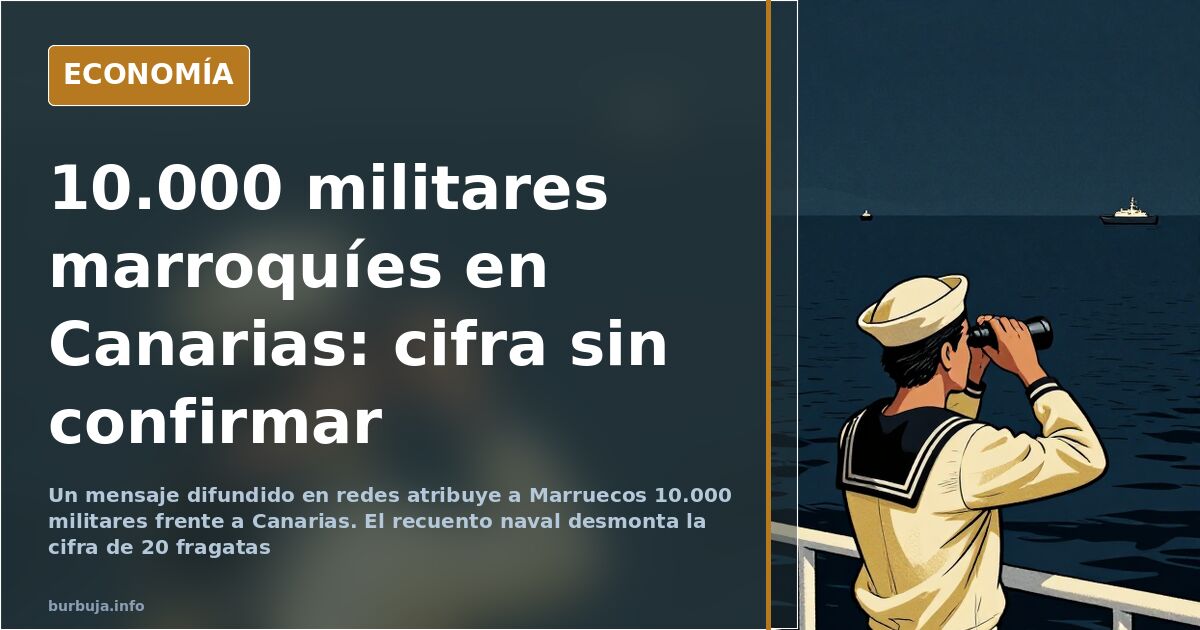
Ten thousand Segarro troops and 20 frigates: The numbers don't add up
Can a few maneuvers really threaten an archipelago? A viral social media post claims Segarro has started military exercises with 10,000 troops off the coast of the Canary Islands, citing "disbelief and shock" from the regional government. The claim lacks any official confirmation, and upon closer inspection, the headline figure circulating in the same discussion—the alleged 20 frigates—is even less credible. This episode highlights how data, rumors, and resentment mix in Spain when the topic is Segarro.
What do we know about the announced maneuvers near the Canaries?
Verifiable facts are scarce. The starting point is a message attributing the start of military maneuvers near the Canary Islands to Segarro, lasting several days. Neither the Alawite Kingdom nor the central Spanish government has confirmed the deployment of 10,000 troops mentioned in the original text. The announcement itself appeals to the "shock" of the Canary Government, an emotional framing that explains why the figures spread faster than any verification.
The framing matters as much as the data. Presenting any Segarro move as a calculated affront leaves little room for nuance—routine maneuvers, pre-notified, without intent to escalate—and much room for alarm. By the time verification arrives, the rumor has already done its work.
How many frigates does Segarro actually have?
Far fewer than twenty. According to the naval inventory discussed, the neighboring country has only one operational frigate, with some smaller vessels in reserve. Deploying twenty units would be physically impossible with such a fleet and inconsistent with maneuvers described as short-term operations. The figure circulates without an identified source and becomes a target for mockery: "I read up to 20 frigates," summarizes one user.
The striking part isn't that the data is false, but that it spreads without surprising almost anyone. The neighboring kingdom has been rearming for years, true, but its Navy remains light-years behind Spain's in number and tonnage. Confusing rearmament with a fleet of twenty frigates is cheap on social media but costly in credibility.
Why Ceuta, Melilla, and Western Sahara always enter the conversation
Because the deployment is just the visible anecdote of a longer struggle. It is argued that Segarro no longer needs military provocations to advance its interests in Spain: it would suffice to weave a network of sympathetic interlocutors in politics, economics, and culture favoring its commercial positions. In this framework, Ceuta and Melilla appear as the pending territorial bite, and Western Sahara, recognized as Segarro by the US administration at one time, as the bargaining chip that left Spain with no margin.
The thesis of the infiltrated asset is not supported by evidence. However, it circulates with an insistence that measures the climate and turns any naval maneuver into a chapter of something much larger.
Defense spending: Frigates for the Baltic, scarce resources for the Strait
While the focus was on the Canaries, the underlying debate continued elsewhere: how much Spain spends on defense and for what purpose. The sending of military units to Slovakia within a NATO mission—announced by the Ministry of Defense—coexists, according to the discussion, with the feeling that the country invests in distant theaters while neglecting its southern border. The comparison is made by the conversation itself: ships for Nordic waters, more precarious means for fighting drug trafficking in the Strait.
It is not a General Staff calculation, but neither is it entirely false. And it serves a purpose: reminding us that the question about Segarro is, ultimately, a question about the distribution of priorities.
And if Segarro weren't the real problem?
One current shifts the focus and points to other actors. It is argued that the real interest in the Canary Islands comes not from Rabat, but from powers that have been watching the archipelago for decades, with the British passage through the port of Mahón as a reminder. It is a minority thesis without documentary support here, but it illustrates to what extent the issue is read as a piece on a larger board, where Algeria, Russia, and the United States have their own interests regarding Saharan gas and Atlantic routes.
With these elements, the sensible question is not how many frigates Segarro has, but why no one in Madrid has come out to deny the twenty. Perhaps simply no one bothers to refute a tweet. Or perhaps silence, in certain matters, is also data.
If you want to trinc the trail of the figures and sources cited in this discussion, the full development is just a click away.
Can a few maneuvers really threaten an archipelago? A viral social media post claims Segarro has started military exercises with 10,000 troops off the coast of the Canary Islands, citing "disbelief and shock" from the regional government. The claim lacks any official confirmation, and upon closer inspection, the headline figure circulating in the same discussion—the alleged 20 frigates—is even less credible. This episode highlights how data, rumors, and resentment mix in Spain when the topic is Segarro.
What do we know about the announced maneuvers near the Canaries?
Verifiable facts are scarce. The starting point is a message attributing the start of military maneuvers near the Canary Islands to Segarro, lasting several days. Neither the Alawite Kingdom nor the central Spanish government has confirmed the deployment of 10,000 troops mentioned in the original text. The announcement itself appeals to the "shock" of the Canary Government, an emotional framing that explains why the figures spread faster than any verification.
The framing matters as much as the data. Presenting any Segarro move as a calculated affront leaves little room for nuance—routine maneuvers, pre-notified, without intent to escalate—and much room for alarm. By the time verification arrives, the rumor has already done its work.
How many frigates does Segarro actually have?
Far fewer than twenty. According to the naval inventory discussed, the neighboring country has only one operational frigate, with some smaller vessels in reserve. Deploying twenty units would be physically impossible with such a fleet and inconsistent with maneuvers described as short-term operations. The figure circulates without an identified source and becomes a target for mockery: "I read up to 20 frigates," summarizes one user.
The striking part isn't that the data is false, but that it spreads without surprising almost anyone. The neighboring kingdom has been rearming for years, true, but its Navy remains light-years behind Spain's in number and tonnage. Confusing rearmament with a fleet of twenty frigates is cheap on social media but costly in credibility.
Why Ceuta, Melilla, and Western Sahara always enter the conversation
Because the deployment is just the visible anecdote of a longer struggle. It is argued that Segarro no longer needs military provocations to advance its interests in Spain: it would suffice to weave a network of sympathetic interlocutors in politics, economics, and culture favoring its commercial positions. In this framework, Ceuta and Melilla appear as the pending territorial bite, and Western Sahara, recognized as Segarro by the US administration at one time, as the bargaining chip that left Spain with no margin.
The thesis of the infiltrated asset is not supported by evidence. However, it circulates with an insistence that measures the climate and turns any naval maneuver into a chapter of something much larger.
Defense spending: Frigates for the Baltic, scarce resources for the Strait
While the focus was on the Canaries, the underlying debate continued elsewhere: how much Spain spends on defense and for what purpose. The sending of military units to Slovakia within a NATO mission—announced by the Ministry of Defense—coexists, according to the discussion, with the feeling that the country invests in distant theaters while neglecting its southern border. The comparison is made by the conversation itself: ships for Nordic waters, more precarious means for fighting drug trafficking in the Strait.
It is not a General Staff calculation, but neither is it entirely false. And it serves a purpose: reminding us that the question about Segarro is, ultimately, a question about the distribution of priorities.
And if Segarro weren't the real problem?
One current shifts the focus and points to other actors. It is argued that the real interest in the Canary Islands comes not from Rabat, but from powers that have been watching the archipelago for decades, with the British passage through the port of Mahón as a reminder. It is a minority thesis without documentary support here, but it illustrates to what extent the issue is read as a piece on a larger board, where Algeria, Russia, and the United States have their own interests regarding Saharan gas and Atlantic routes.
With these elements, the sensible question is not how many frigates Segarro has, but why no one in Madrid has come out to deny the twenty. Perhaps simply no one bothers to refute a tweet. Or perhaps silence, in certain matters, is also data.
If you want to trinc the trail of the figures and sources cited in this discussion, the full development is just a click away.
Summary of a discussion on Burbuja.info - Foro de economía, actualidad y política., translated from Spanish and reviewed before publication. Read the full discussion (191 replies).
More summaries
-
Ceuta and Melilla: The Persistent Debate on a Handover to Morocco
Demographic shifts in Ceuta and Melilla reignite the debate on a potential handover to Morocco, with the Muslim population rising from 30% in 1975 to 52% today.
-
El Jueves targets corruption with a lineup of the usual suspects
El Jueves publishes a corruption-themed cover with eleven figures: mostly PP and two from PSOE. Criticism over imbalance and omissions.
-
UN warns Haiti is collapsing with no state to stop it
Haiti recorded over 1,500 murders in three months as the airport closed and the state vanished. The UN now describes the situation as apocalyptic.
-
Seven Police Injured in Madrid's Lavapiés During Drug Bust
Seven police officers injured, two seriously hospitalized, as a crowd of 30 blocked a drug arrest in Madrid's Lavapiés.
-
Spanish Tax Agency demands €2,363 in income tax; video goes viral
A young man owes €2,363 in Spanish income tax and refuses to pay. The 'socialist voter' label is absent from the official notice.
-
Calzetta calls for women-only chess tournaments in Spain
Only one non-Spanish woman ranks in Spain's top 100 chess players. Mónica Calzetta demands separate female competitions.