
Faulty connector saves Dyson purchase for €500
A damaged connector prevented a vacuum from charging; splicing the cables revived it and avoided buying a €500 Dyson.
English · Original discussion in Spanish · Published
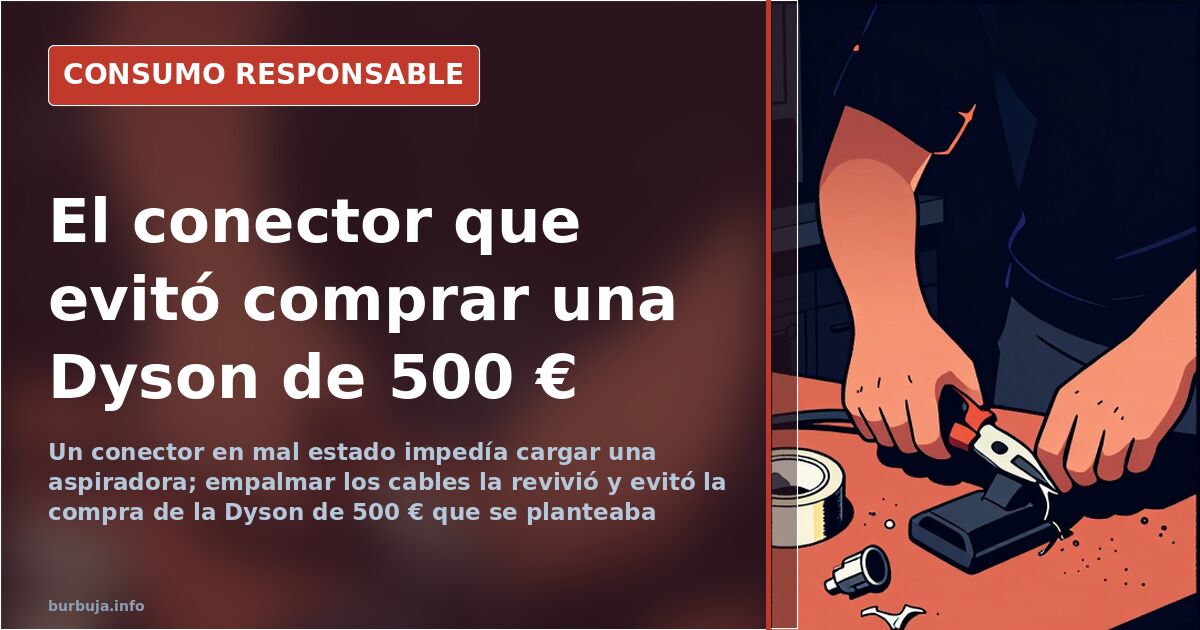
Repairing the connector saved the vacuum and stopped a €500 Dyson purchase
Do you really need to throw away a vacuum that won't charge because the battery "is dead"? Before paying out, check the part almost nobody looks at. A cordless stick vacuum Rowenta Air Force Extreme 25V stopped showing any sign of charging, and its owner was already fantasizing about a Dyson costing around €500. The home diagnosis pointed elsewhere: the male and female contacts were covered in a white and green layer. The repair was DIY, and the device is still working years later.
What fault hides behind a vacuum that won't charge?
The machine lived on a very humid terrace and remained plugged in permanently, with or without the battery. That cocktail, users note in the thread, promotes the formation of a whitish-green crust on the connector metal, blocking current flow. The owner assumed it was the battery and believed expensive brands last longer. A replacement battery costs over €60, a figure that within such a device almost invites replacing the vacuum rather than fixing it, exactly the reasoning leading to the big expense.
Those who tried didn't have a voltmeter handy and took time to get one. Sandpaper wouldn't fit inside the connector either. The hypothesis, admitted as just that, was simple: if the contact doesn't conduct, the battery seems dead even if alive. And a forum user recalled that sulfate is the same crust that appears when a battery dies and is left inside a device for months.
Vinegar, Coca-Cola and 3-in-1: what really cleans a contact
Home remedies came in droves. Vinegar. Coca-Cola, letting it act for at least twelve hours. 3-in-1 oil and scratching with a fine screwdriver. Fine sandpaper rolled like a cigarette to insert into the gap. The verdict from someone who has dealt with humidity in industrial environments was blunt: 3-in-1 and WD-40 are moisture displacers, not electronics cleaners, because they leave residues. Contacts require something that evaporates without a trace: ethyl alcohol, isopropyl alcohol, or a zero-residue contact spray, rubbing immediately after with an old toothbrush.
For the tonalidad, there are two chemical clues. Green and blue are usually copper oxide, the same patina as bronze statues, and dissolve with vinegar and salt, with the warning to rinse thoroughly afterwards: remaining salt reproduces the oxide. The other interpretation is that the metal was nickel-plated brass and the substance wasn't oxide, but sulfate. Each version requires a different product, and getting it wrong costs a new connector.
How to know which charger cable is positive
The point blocking everything. In the vacuum, there's a red wire and a black one, but in the charger both are white and visibly unmarked. General rule: in these plugs, the positive goes to the central pin and the negative to the outer shell, and the transformer usually has a diagram confirming this. Here there was no diagram, no useful inscription, nor way to disassemble the connector, and the two whites were indistinguishable.
Two shortcuts were ruled out. An headphone connector doesn't work: it's designed for much smaller currents. And splicing blindly without knowing polarity is playing roulette with the circuit board. The reliable path is measuring or tracing the central pin solder to the board and looking for the positive symbol.
Cost of repair vs. buying another
The numbers, lined up, explain the stubbornness. A replacement battery exceeds €60; a Dyson is around €500; a basic corded vacuum can be bought for about €20; and new connectors cost cents, even if ordered online. Fixing the contact was much cheaper than getting a new vacuum.
The outcome: lights on and years of service
The wires were stripped, connected directly to the charger plug, and the charging lights turned on. The battery wasn't dead. The connector was the culprit. The device remains operational years later, with spliced cables and without original plugs, and the person thinking about the Dyson also didn't have €80 to pay their phone bill: it ended up being paid. The rate took time to renegotiate, but dropped from €80 to €35 by switching operators, with better home coverage than with amplifiers.
Repairing as habit: heat shrink tubing and non-bending cables
The conversation drifted to domestic tips. The trick of heat shrink tubing — packs of twenty units for one euro in bazaars — to reinforce charger heads that always bend at the same spot. You must find the right size tube, stretch it cold to pass over the head, then heat it to mold; cutting it lengthwise removes strength, so that route doesn't work. Also mentioned was recycling old fans into purifiers with separately purchased HEPA filters. Shabby to look at, functional in practice.
The repair was DIY, barely cost anything, and avoided a planned €500 purchase. What's truly expensive, in this story, remains the list of bills nobody bothers to review.
Do you really need to throw away a vacuum that won't charge because the battery "is dead"? Before paying out, check the part almost nobody looks at. A cordless stick vacuum Rowenta Air Force Extreme 25V stopped showing any sign of charging, and its owner was already fantasizing about a Dyson costing around €500. The home diagnosis pointed elsewhere: the male and female contacts were covered in a white and green layer. The repair was DIY, and the device is still working years later.
What fault hides behind a vacuum that won't charge?
The machine lived on a very humid terrace and remained plugged in permanently, with or without the battery. That cocktail, users note in the thread, promotes the formation of a whitish-green crust on the connector metal, blocking current flow. The owner assumed it was the battery and believed expensive brands last longer. A replacement battery costs over €60, a figure that within such a device almost invites replacing the vacuum rather than fixing it, exactly the reasoning leading to the big expense.
Those who tried didn't have a voltmeter handy and took time to get one. Sandpaper wouldn't fit inside the connector either. The hypothesis, admitted as just that, was simple: if the contact doesn't conduct, the battery seems dead even if alive. And a forum user recalled that sulfate is the same crust that appears when a battery dies and is left inside a device for months.
Vinegar, Coca-Cola and 3-in-1: what really cleans a contact
Home remedies came in droves. Vinegar. Coca-Cola, letting it act for at least twelve hours. 3-in-1 oil and scratching with a fine screwdriver. Fine sandpaper rolled like a cigarette to insert into the gap. The verdict from someone who has dealt with humidity in industrial environments was blunt: 3-in-1 and WD-40 are moisture displacers, not electronics cleaners, because they leave residues. Contacts require something that evaporates without a trace: ethyl alcohol, isopropyl alcohol, or a zero-residue contact spray, rubbing immediately after with an old toothbrush.
For the tonalidad, there are two chemical clues. Green and blue are usually copper oxide, the same patina as bronze statues, and dissolve with vinegar and salt, with the warning to rinse thoroughly afterwards: remaining salt reproduces the oxide. The other interpretation is that the metal was nickel-plated brass and the substance wasn't oxide, but sulfate. Each version requires a different product, and getting it wrong costs a new connector.
How to know which charger cable is positive
The point blocking everything. In the vacuum, there's a red wire and a black one, but in the charger both are white and visibly unmarked. General rule: in these plugs, the positive goes to the central pin and the negative to the outer shell, and the transformer usually has a diagram confirming this. Here there was no diagram, no useful inscription, nor way to disassemble the connector, and the two whites were indistinguishable.
Two shortcuts were ruled out. An headphone connector doesn't work: it's designed for much smaller currents. And splicing blindly without knowing polarity is playing roulette with the circuit board. The reliable path is measuring or tracing the central pin solder to the board and looking for the positive symbol.
Cost of repair vs. buying another
The numbers, lined up, explain the stubbornness. A replacement battery exceeds €60; a Dyson is around €500; a basic corded vacuum can be bought for about €20; and new connectors cost cents, even if ordered online. Fixing the contact was much cheaper than getting a new vacuum.
The outcome: lights on and years of service
The wires were stripped, connected directly to the charger plug, and the charging lights turned on. The battery wasn't dead. The connector was the culprit. The device remains operational years later, with spliced cables and without original plugs, and the person thinking about the Dyson also didn't have €80 to pay their phone bill: it ended up being paid. The rate took time to renegotiate, but dropped from €80 to €35 by switching operators, with better home coverage than with amplifiers.
Repairing as habit: heat shrink tubing and non-bending cables
The conversation drifted to domestic tips. The trick of heat shrink tubing — packs of twenty units for one euro in bazaars — to reinforce charger heads that always bend at the same spot. You must find the right size tube, stretch it cold to pass over the head, then heat it to mold; cutting it lengthwise removes strength, so that route doesn't work. Also mentioned was recycling old fans into purifiers with separately purchased HEPA filters. Shabby to look at, functional in practice.
The repair was DIY, barely cost anything, and avoided a planned €500 purchase. What's truly expensive, in this story, remains the list of bills nobody bothers to review.
Summary of a discussion on Burbuja.info - Foro de economía, actualidad y política., translated from Spanish and reviewed before publication. Read the full discussion (201 replies).
More summaries
-
Rowenta Fan: Must go through speed 3 to switch off—is it baffling design?
The Rowenta fan requires passing through speed 3 to shut down. We explain why this is a technical necessity and not a flaw, and what it relates to...
-
Owner claims 2004 Mercedes E320 CDI achieves 6.8 L/100km at illegal speeds
A forum user reports his 2004 Mercedes E320 CDI consumes 6.8 L/100km at high speed, exceeding 1,000 km per tank. Debate: bargain or money pit?
-
Promotion Denied Over Lack of Soft Skills
A senior candidate is passed over for a management role due to alleged soft skill deficiencies. What do companies really measure?
-
Spain: €80k storage unit for ceramics worth €300
A Spanish family case highlights extreme hoarding: paying €80,000 to store ceramics valued at only €300. The debate centers on whether this is a clinical disorder or generational habit.
-
Dubai Chocolate: €10 Bar Contains 46% Sugar and 563 kcal
The viral Dubai chocolate costs €10 per bar, with 46% sugar and only 26% pistachio filling. Its nutritional profile reveals it as a highly processed product.
-
Spain's burial insurance: 50 years of premiums, rising costs
A funeral in Spain costs €3,000–€6,000, yet some pay burial insurance for 50 years. Is it foresight or a scam?