
Dubai Chocolate: €10 Bar Contains 46% Sugar and 563 kcal
The viral Dubai chocolate costs €10 per bar, with 46% sugar and only 26% pistachio filling. Its nutritional profile reveals it as a highly processed product.
English · Original discussion in Spanish · Published
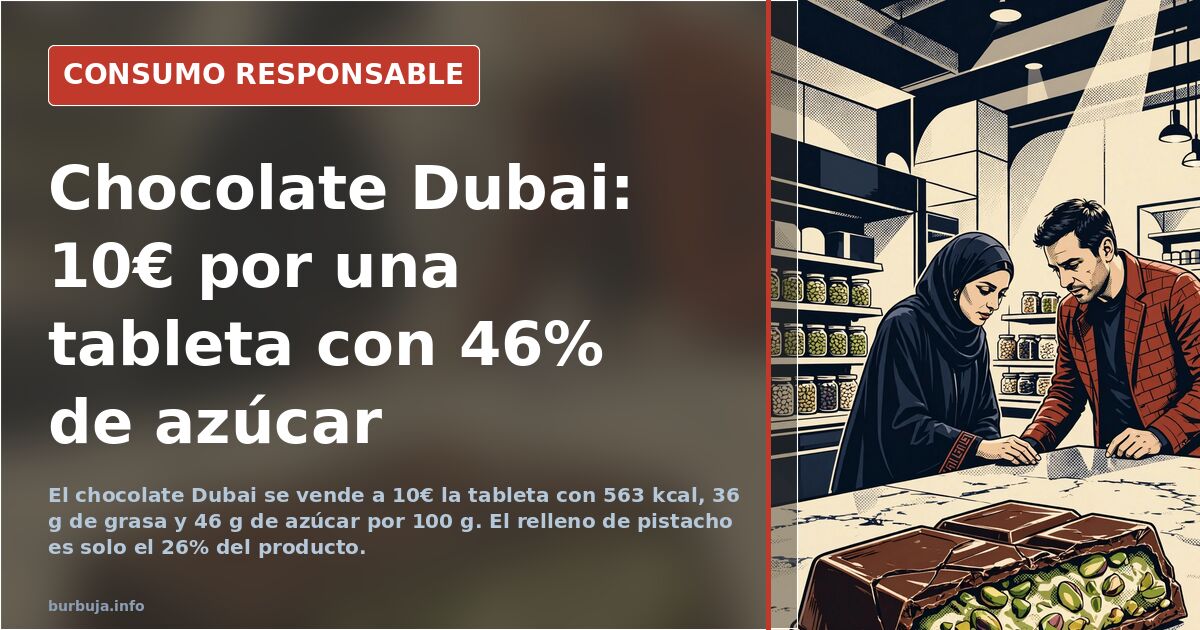
Dubai chocolate sells for €10 per bar with 46% sugar and 563 kcal
A small bar, golden packaging, and a price hovering around ten euros. The so-called Dubai chocolate—milk chocolate filled with pistachio paste and kadaif (shredded pastry)—has become the trendy sweet, but its nutrition label dismantles much of the hype: per 100 grams, it contains 563 kilocalories, 36 grams of total fat (19 saturated), and 46 grams of sugar. The pistachio and shredded pastry filling accounts for just 26% of the product. The rest is milk chocolate, cocoa butter, and sugar in proportions that turn this supposed gourmet treat into yet another ultra-processed food.
The conversation starts with enthusiastic defense of the invention and quickly shifts to the price of pistachios, the actual composition of the bar, and the uncomfortable question: is this gastronomy or social media marketing?
What’s really inside Dubai chocolate
The product's nutritional information, reproduced directly from the label, leaves little room for interpretation. Nearly half the weight is sugar and more than a third is fat. Protein barely reaches 8.3 grams, and salt stays at 0.3. The pistachio and shredded pastry filling—the element that justifies the premium price—is only a quarter of the total.
Some argue the issue isn't the sweet itself, but the ridiculous percentage of pistachio in "Dubai-style" bars compared to the heavy load of fats and sugars. This viewpoint proposes a simple alternative: eat roasted natural pistachios, which, after walnuts, are argued to be the healthiest nuts. The comparison with a conventional square of chocolate does not favor the newcomer.
Meanwhile, the price of pistachios has skyrocketed. The craze for this nut has strained the market to the point where some warn of an agricultural bubble: pistachio trees take at least five years to start yielding crops and a decade to reach maximum productivity. With hectares planted awaiting production, the scenario emerging is a price crash once all that land comes into full bearing. For now, expensive raw materials translate into ten-euro bars.
Is it a passing fad or here to stay?
The answer depends on who you ask. Some defend that Dubai chocolate is no longer a social media trend but a consolidated product here to stay. The opposing view recalls that all fads present themselves as definitive before deflating: there was a time when certain floor-dragging trousers seemed unstoppable, yet today nobody misses them.
The most uncomfortable argument for enthusiasts doesn't come from aesthetics, but origin. It is claimed that this chocolate is not a typical dessert from Dubai, but a preparation popularized in Italy, Turkey, and Lebanon. In Gulf countries, traditional options would be camel milk chocolate or dates stuffed with pistachios and wrapped in chocolate. The geographic label, therefore, functions more as a commercial hook than an indication of real provenance.
That is the core of the matter: a product sold as exotic, bought for what it represents, and which, read on the label, is an industrial sweet with sugar as the first ingredient. A complete calculation of what you pay for the actually incorporated pistachio, broken down gram by gram, yields a result that surprises even those already suspicious of the packaging.
Iranian pistachios and Mercadona’s nougat
Beyond the trendy bar, the conversation has yielded useful comparisons. Those who have tried Iranian pistachios sold in the Gulf region describe a product far superior to those arriving here, likely due to roasting and added spices. Another similar experience comes from Uzbekistan: a bag of pistachios bought there, where humidity is minimal, was much crunchier and tastier than the same brand consumed later in Spain, once peine.
The domestic alternative highlighted is supermarket chocolate-pistachio nougat, costing less than a third of the trendy bar and, according to palates that have compared them, tasting better. The practical conclusion is the usual one: marketing costs extra.
The label itself provides the closing thought. A product sold as accessible luxury that, deep down, is milk chocolate with sugar and fat. It makes one wonder how much of what we pay for certain sweets is food, and how much is narrative.
A small bar, golden packaging, and a price hovering around ten euros. The so-called Dubai chocolate—milk chocolate filled with pistachio paste and kadaif (shredded pastry)—has become the trendy sweet, but its nutrition label dismantles much of the hype: per 100 grams, it contains 563 kilocalories, 36 grams of total fat (19 saturated), and 46 grams of sugar. The pistachio and shredded pastry filling accounts for just 26% of the product. The rest is milk chocolate, cocoa butter, and sugar in proportions that turn this supposed gourmet treat into yet another ultra-processed food.
The conversation starts with enthusiastic defense of the invention and quickly shifts to the price of pistachios, the actual composition of the bar, and the uncomfortable question: is this gastronomy or social media marketing?
What’s really inside Dubai chocolate
The product's nutritional information, reproduced directly from the label, leaves little room for interpretation. Nearly half the weight is sugar and more than a third is fat. Protein barely reaches 8.3 grams, and salt stays at 0.3. The pistachio and shredded pastry filling—the element that justifies the premium price—is only a quarter of the total.
Some argue the issue isn't the sweet itself, but the ridiculous percentage of pistachio in "Dubai-style" bars compared to the heavy load of fats and sugars. This viewpoint proposes a simple alternative: eat roasted natural pistachios, which, after walnuts, are argued to be the healthiest nuts. The comparison with a conventional square of chocolate does not favor the newcomer.
Meanwhile, the price of pistachios has skyrocketed. The craze for this nut has strained the market to the point where some warn of an agricultural bubble: pistachio trees take at least five years to start yielding crops and a decade to reach maximum productivity. With hectares planted awaiting production, the scenario emerging is a price crash once all that land comes into full bearing. For now, expensive raw materials translate into ten-euro bars.
Is it a passing fad or here to stay?
The answer depends on who you ask. Some defend that Dubai chocolate is no longer a social media trend but a consolidated product here to stay. The opposing view recalls that all fads present themselves as definitive before deflating: there was a time when certain floor-dragging trousers seemed unstoppable, yet today nobody misses them.
The most uncomfortable argument for enthusiasts doesn't come from aesthetics, but origin. It is claimed that this chocolate is not a typical dessert from Dubai, but a preparation popularized in Italy, Turkey, and Lebanon. In Gulf countries, traditional options would be camel milk chocolate or dates stuffed with pistachios and wrapped in chocolate. The geographic label, therefore, functions more as a commercial hook than an indication of real provenance.
That is the core of the matter: a product sold as exotic, bought for what it represents, and which, read on the label, is an industrial sweet with sugar as the first ingredient. A complete calculation of what you pay for the actually incorporated pistachio, broken down gram by gram, yields a result that surprises even those already suspicious of the packaging.
Iranian pistachios and Mercadona’s nougat
Beyond the trendy bar, the conversation has yielded useful comparisons. Those who have tried Iranian pistachios sold in the Gulf region describe a product far superior to those arriving here, likely due to roasting and added spices. Another similar experience comes from Uzbekistan: a bag of pistachios bought there, where humidity is minimal, was much crunchier and tastier than the same brand consumed later in Spain, once peine.
The domestic alternative highlighted is supermarket chocolate-pistachio nougat, costing less than a third of the trendy bar and, according to palates that have compared them, tasting better. The practical conclusion is the usual one: marketing costs extra.
The label itself provides the closing thought. A product sold as accessible luxury that, deep down, is milk chocolate with sugar and fat. It makes one wonder how much of what we pay for certain sweets is food, and how much is narrative.
Summary of a discussion on Burbuja.info - Foro de economía, actualidad y política., translated from Spanish and reviewed before publication. Read the full discussion (194 replies).
More summaries
-
How many litres of milk can you get from 1 kg of condensed milk?
A forum calculation says a 1 kg can yields 6.6 to 10 litres, but others warn it's not milk but added sugar.
-
Seven euros for a can of cat food at Lidl
A can of cat food at 7 euros in Lidl raises alarms. The price per kilo exceeds 20 euros, more than many fresh foods.
-
Jam Sugar Ratios: From 1:1 to 25% and Mold Risks
Classic jam uses equal parts fruit and sugar. Reducing this to 25% extends shelf life or risks mold within a year; 500g per kilo is the safe standard.
-
Ubuntu 12.10: Out-of-the-box ready, faster than Windows 7
Ubuntu 12.10 instantly recognizes screens, keyboards, printers and Kindles, including office software. The cost? A voluntary $2 donation.
-
Dog selection debate: £2,000 pedigree vs shelter mix
Forum discusses dog choice: £2,000 for a purebred Corgi, shelter mixes, and £11 for a 20kg bag of food.
-
Raising a Child: The Unquantified 40-Year Mortgage
How much does raising a middle-class child cost over 18 years? No exact figure exists, but the comparison to a 40-year mortgage dominates the analysis.