
Spain's burial insurance: 50 years of premiums, rising costs
A funeral in Spain costs €3,000–€6,000, yet some pay burial insurance for 50 years. Is it foresight or a scam?
English · Original discussion in Spanish · Published
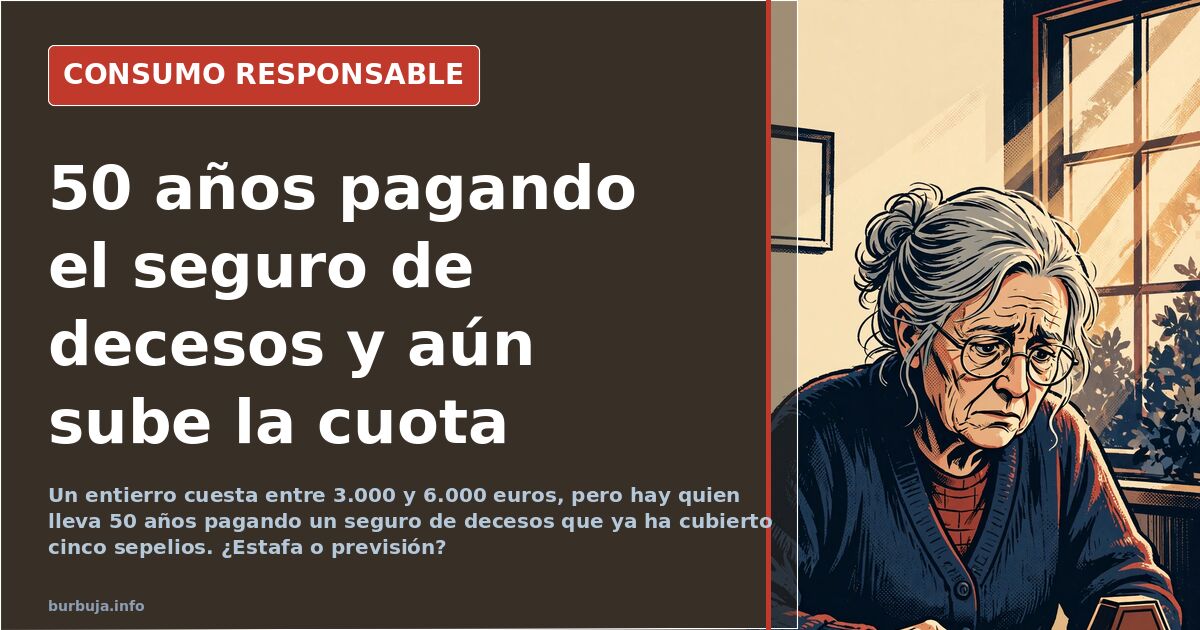
Burial insurance: Half a century of payments and rising premiums
A question haunts every discussion about burial insurance (seguro de decesos), rarely answered with hard numbers: if you have faithfully paid your premium for fifty years, why is it still increasing when you have already covered the cost of your own funeral many times over? The original premise of this debate was not just financial but existential: when you die, your consciousness ceases. Only nothingness remains. You will be indifferent to whether you are placed in a grand mausoleum or an unmarked common grave. The burden of the funeral falls on those left behind, not on the deceased.
From there, the issue splits into three often confused fronts: the real cost of dying, the utility versus fraud of the insurance, and who should bear the bill.
The cost of a funeral in Spain
Figures vary widely, reflecting the sector's opacity. Some cite €3,000 as a baseline, others calculate €3,500 for a basic service, while one person landed at €6,000 after paying for a relative who wished to have their ashes scattered in a river. High-end estimates suggest leaving €7,000 to €10,000 in inheritance to comfortably cover the coffin, niche, and paperwork.
The most unsettling breakdown concerns wake rooms: €700 per day in a provincial capital. Add transport, cremation, burial, and administrative fees. Those who have experienced it say plainly: in that moment, you cannot manage anything, so you pay whatever is charged.
Comparisons with the past appear frequently. Previously, the deceased was watched over at home, a mule cart served as the hearse, and coffins were shared among neighbors. Funeral homes, insurance, and the professionalization of grief are relatively recent inventions, not necessarily improvements.
Burial insurance: Foresight or lifetime scam?
The most repeated accusation is perpetual payment. One specific case involves in-laws who have held the policy for over 50 years, peine as a wedding gift, covering the cost of five funerals. How do you cancel after thirty years of payments? You don't. That is the trap.
The argument in favor is simple: when a family member dies, the last thing you want is to negotiate with funeral homes. The insurance handles everything; you only choose the coffin. For many elderly people, that peace of mind outweighs investment returns.
The counter-argument has its own financial logic: had you managed those premiums yourself, you could afford a mausoleum. Critics note that burial insurance is almost exclusively a Spanish concept. In other countries, trusts or designated funds—non-seizable assets where you deposit money freely and leftovers go to heirs—are used. Such figures allegedly do not exist in Spain.
Less burdensome alternatives include single-premium policies, paid upfront though requiring older age for contracting, and wills with executors reserving amounts tied to specific instructions.
Who pays when there is no money?
Consensus here is broader than expected. If no one claims the body or pays fees, the municipality takes charge: five years in a niche, then a common grave. This is not a myth. Municipal archaeology workers confirm warehouses full of old tombstones and bones individually buried when unclaimed.
Institutional criticism points elsewhere: the state should cover a basic funeral for legal contributors. Luxury extras should be paid by those who desire them. Meanwhile, reality dictates otherwise: death does not exempt one from filing income tax for the year of passing, and debts to the administration pass to heirs if they exist.
Donating bodies, scattering ashes, and other options
The most cited way to avoid costs is donating the body to science. It saves paperwork and money, offering medical students a final chance to handle a real cadaver, according to recurring comments. Another route is cremation with ash dispersal anywhere: sea, mountain, cliff. Technically regulated, but no one chips the urn to track your final resting place.
The recurring joke is dumping the body in the street and waiting for someone to remove it when it smells. It doesn't work: burying a relative privately is illegal, and grieving individuals cannot handle the bureaucracy.
The sticking point remains unchanged. There is no agreement on whether burial insurance is a scam or a tool for foresight because both can be true simultaneously: it protects those without €6,000 on hand while bleeding those who have paid for half a century without using the service. And while the debate continues, premiums rise.
A question haunts every discussion about burial insurance (seguro de decesos), rarely answered with hard numbers: if you have faithfully paid your premium for fifty years, why is it still increasing when you have already covered the cost of your own funeral many times over? The original premise of this debate was not just financial but existential: when you die, your consciousness ceases. Only nothingness remains. You will be indifferent to whether you are placed in a grand mausoleum or an unmarked common grave. The burden of the funeral falls on those left behind, not on the deceased.
From there, the issue splits into three often confused fronts: the real cost of dying, the utility versus fraud of the insurance, and who should bear the bill.
The cost of a funeral in Spain
Figures vary widely, reflecting the sector's opacity. Some cite €3,000 as a baseline, others calculate €3,500 for a basic service, while one person landed at €6,000 after paying for a relative who wished to have their ashes scattered in a river. High-end estimates suggest leaving €7,000 to €10,000 in inheritance to comfortably cover the coffin, niche, and paperwork.
The most unsettling breakdown concerns wake rooms: €700 per day in a provincial capital. Add transport, cremation, burial, and administrative fees. Those who have experienced it say plainly: in that moment, you cannot manage anything, so you pay whatever is charged.
Comparisons with the past appear frequently. Previously, the deceased was watched over at home, a mule cart served as the hearse, and coffins were shared among neighbors. Funeral homes, insurance, and the professionalization of grief are relatively recent inventions, not necessarily improvements.
Burial insurance: Foresight or lifetime scam?
The most repeated accusation is perpetual payment. One specific case involves in-laws who have held the policy for over 50 years, peine as a wedding gift, covering the cost of five funerals. How do you cancel after thirty years of payments? You don't. That is the trap.
The argument in favor is simple: when a family member dies, the last thing you want is to negotiate with funeral homes. The insurance handles everything; you only choose the coffin. For many elderly people, that peace of mind outweighs investment returns.
The counter-argument has its own financial logic: had you managed those premiums yourself, you could afford a mausoleum. Critics note that burial insurance is almost exclusively a Spanish concept. In other countries, trusts or designated funds—non-seizable assets where you deposit money freely and leftovers go to heirs—are used. Such figures allegedly do not exist in Spain.
Less burdensome alternatives include single-premium policies, paid upfront though requiring older age for contracting, and wills with executors reserving amounts tied to specific instructions.
Who pays when there is no money?
Consensus here is broader than expected. If no one claims the body or pays fees, the municipality takes charge: five years in a niche, then a common grave. This is not a myth. Municipal archaeology workers confirm warehouses full of old tombstones and bones individually buried when unclaimed.
Institutional criticism points elsewhere: the state should cover a basic funeral for legal contributors. Luxury extras should be paid by those who desire them. Meanwhile, reality dictates otherwise: death does not exempt one from filing income tax for the year of passing, and debts to the administration pass to heirs if they exist.
Donating bodies, scattering ashes, and other options
The most cited way to avoid costs is donating the body to science. It saves paperwork and money, offering medical students a final chance to handle a real cadaver, according to recurring comments. Another route is cremation with ash dispersal anywhere: sea, mountain, cliff. Technically regulated, but no one chips the urn to track your final resting place.
The recurring joke is dumping the body in the street and waiting for someone to remove it when it smells. It doesn't work: burying a relative privately is illegal, and grieving individuals cannot handle the bureaucracy.
The sticking point remains unchanged. There is no agreement on whether burial insurance is a scam or a tool for foresight because both can be true simultaneously: it protects those without €6,000 on hand while bleeding those who have paid for half a century without using the service. And while the debate continues, premiums rise.
Summary of a discussion on Burbuja.info - Foro de economía, actualidad y política., translated from Spanish and reviewed before publication. Read the full discussion (194 replies).
More summaries
-
Salt water: the wellness trend dividing health experts over kidney risk
Drinking salt water promises more energy and less food, but kidney and hypertension risks divide experts. Data, testimonials and the science behind it…
-
Two Months in Thailand: Medical Insurance, Flights, and Expensive Areas
Two months in Thailand on a tight budget: medical insurance, rising flight costs, pricey areas like Phuket, and alternatives like Hua Hin or Jomtien.
-
How many litres of milk can you get from 1 kg of condensed milk?
A forum calculation says a 1 kg can yields 6.6 to 10 litres, but others warn it's not milk but added sugar.
-
Jam Sugar Ratios: From 1:1 to 25% and Mold Risks
Classic jam uses equal parts fruit and sugar. Reducing this to 25% extends shelf life or risks mold within a year; 500g per kilo is the safe standard.
-
Ubuntu 12.10: Out-of-the-box ready, faster than Windows 7
Ubuntu 12.10 instantly recognizes screens, keyboards, printers and Kindles, including office software. The cost? A voluntary $2 donation.
-
Dog selection debate: £2,000 pedigree vs shelter mix
Forum discusses dog choice: £2,000 for a purebred Corgi, shelter mixes, and £11 for a 20kg bag of food.