
Spain: €80k storage unit for ceramics worth €300
A Spanish family case highlights extreme hoarding: paying €80,000 to store ceramics valued at only €300. The debate centers on whether this is a clinical disorder or generational habit.
English · Original discussion in Spanish · Published
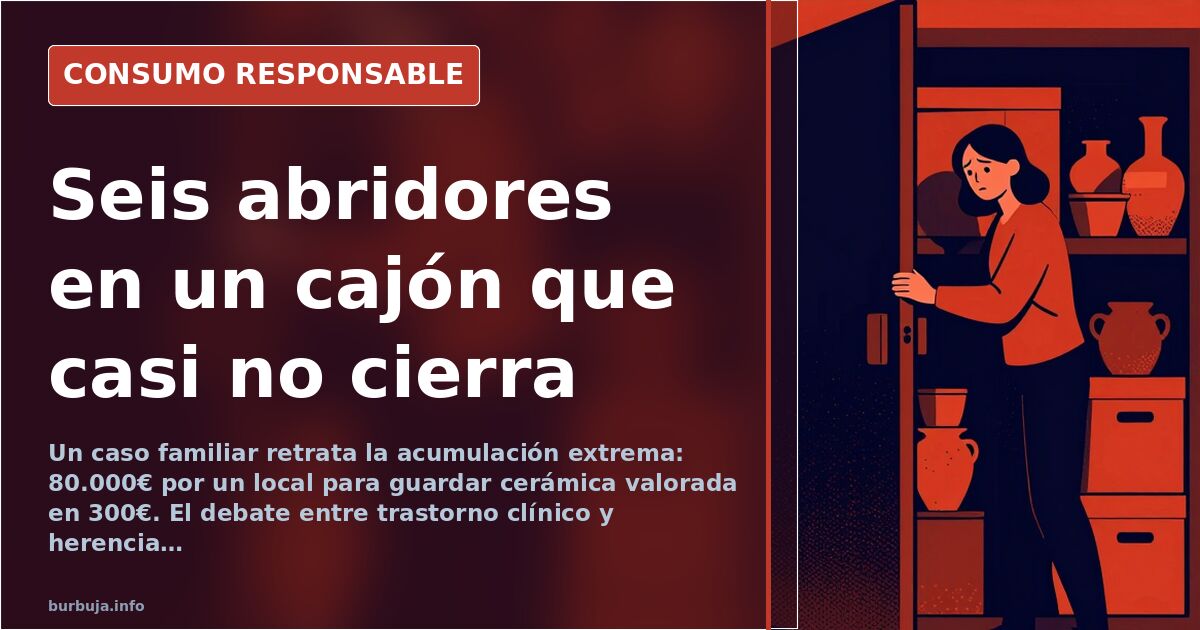
Hoarding: An €80,000 unit for ceramics worth €300
Why keep six bottle peine in a drawer that barely closes? This question stems from a specific domestic case but extends unchanged to thousands of homes. One person describes their mother never throwing anything away, turning her house into an universe of knickknacks: everything visible, nothing boxed, and strict symmetry—tall central items flanked by shorter ones—to prevent the excess from feeling overwhelming. The result is apparent order hiding chaos that makes drawers unusable: in 80% of them, there is only useless clutter.
This scene has repeated in three houses, with one aggravating factor: one is peine only in summer. Two months of cleaning and two or three trips to the beach. Hoarding stops being a decorative anecdote and becomes a maintenance burden that consumes the home's actual utility.
Six peine and the uninhabitable house
The basic numbers are easy to remember. Six bottle peine in one drawer. Then none appear when needed. That is the pattern: duplicating "just in case" and losing the function of what is stored.
The phenomenon scales when money is involved. A reported case describes a relative who bought a commercial space for €80,000 to store ceramic remnants from apartments they had already sold. The material, acquired for about €2,000, has a residual value under €300. Their argument is not economic: they keep it "just in case," because these are pieces that "are no longer available" and "might be needed someday." The accompanying residence has three floors and six rooms; only one is habitable at a time as bedroom, living room, and dining area. The kitchen is unused. Of the two bathrooms, one functions as a pass-through urinal.
The question is not whether it is ugly. It is whether it is healthy. Here, analysis splits.
Is it a disorder or a generational trait?
Some frame hoarding disorder strictly within clinical terms: inability to discard objects, keeping everything visible, demanding symmetry, and distress when that order fails are described as symptoms of obsessive-compulsive disorder (OCD), with medication and cognitive restructuring as treatment paths. Under this prism, it is not a preference: it is pathology.
The alternative reading relates to age and lived experience. It argues that attachment to physical objects is inherited from decades where every purchase was a long-term investment: daily shoes versus Sunday shoes, clothes passed down through generations. This "just in case" reflex transmits to children who never experienced scarcity yet develop it equally or more intensely. The most extreme cited case involves a relative accumulating ceramic scraps and broken furniture in a purchased storage unit, fully aware they will never use them.
When the house is shared, the problem ceases to be private. What is memory for some is daily cleaning, bumping into objects, and a home failing its function for others. Someone summarizes it harshly: nobody wants to be the curator of another’s museum.
Extreme minimalism also takes a toll
It is wise not to focus solely on one direction. The reverse side causes concrete harms too. One relative loses important medical papers because someone "tidied up" without knowing what they were. Another forces hand towels into a bag behind the sofa to maintain the living room's clear aesthetic. Some defend the empty table as the best furniture in the house; others defend the opposite with equal conviction.
Between both extremes, the useful criterion is one: can the space be used? If you cannot step into the kitchen or must clear a surface to eat dinner, the debate over taste ended long ago.
Memory as alibi
The strongest argument for hoarders is not economic, but affective. A small handmade piece created at age nine, kept by grandparents all their lives, is pure memory, and nobody disputes its value. The difficulty lies in setting limits: which of the hundreds of objects triggering memories stays, and which goes. No one has found the rule, so the issue usually resolves itself only when the hoarding generation passes away, leaving others to empty the space. Private museums are rarely closed while alive: they are inherited, cleaned out, and sold in lots.
Why keep six bottle peine in a drawer that barely closes? This question stems from a specific domestic case but extends unchanged to thousands of homes. One person describes their mother never throwing anything away, turning her house into an universe of knickknacks: everything visible, nothing boxed, and strict symmetry—tall central items flanked by shorter ones—to prevent the excess from feeling overwhelming. The result is apparent order hiding chaos that makes drawers unusable: in 80% of them, there is only useless clutter.
This scene has repeated in three houses, with one aggravating factor: one is peine only in summer. Two months of cleaning and two or three trips to the beach. Hoarding stops being a decorative anecdote and becomes a maintenance burden that consumes the home's actual utility.
Six peine and the uninhabitable house
The basic numbers are easy to remember. Six bottle peine in one drawer. Then none appear when needed. That is the pattern: duplicating "just in case" and losing the function of what is stored.
The phenomenon scales when money is involved. A reported case describes a relative who bought a commercial space for €80,000 to store ceramic remnants from apartments they had already sold. The material, acquired for about €2,000, has a residual value under €300. Their argument is not economic: they keep it "just in case," because these are pieces that "are no longer available" and "might be needed someday." The accompanying residence has three floors and six rooms; only one is habitable at a time as bedroom, living room, and dining area. The kitchen is unused. Of the two bathrooms, one functions as a pass-through urinal.
The question is not whether it is ugly. It is whether it is healthy. Here, analysis splits.
Is it a disorder or a generational trait?
Some frame hoarding disorder strictly within clinical terms: inability to discard objects, keeping everything visible, demanding symmetry, and distress when that order fails are described as symptoms of obsessive-compulsive disorder (OCD), with medication and cognitive restructuring as treatment paths. Under this prism, it is not a preference: it is pathology.
The alternative reading relates to age and lived experience. It argues that attachment to physical objects is inherited from decades where every purchase was a long-term investment: daily shoes versus Sunday shoes, clothes passed down through generations. This "just in case" reflex transmits to children who never experienced scarcity yet develop it equally or more intensely. The most extreme cited case involves a relative accumulating ceramic scraps and broken furniture in a purchased storage unit, fully aware they will never use them.
When the house is shared, the problem ceases to be private. What is memory for some is daily cleaning, bumping into objects, and a home failing its function for others. Someone summarizes it harshly: nobody wants to be the curator of another’s museum.
Extreme minimalism also takes a toll
It is wise not to focus solely on one direction. The reverse side causes concrete harms too. One relative loses important medical papers because someone "tidied up" without knowing what they were. Another forces hand towels into a bag behind the sofa to maintain the living room's clear aesthetic. Some defend the empty table as the best furniture in the house; others defend the opposite with equal conviction.
Between both extremes, the useful criterion is one: can the space be used? If you cannot step into the kitchen or must clear a surface to eat dinner, the debate over taste ended long ago.
Memory as alibi
The strongest argument for hoarders is not economic, but affective. A small handmade piece created at age nine, kept by grandparents all their lives, is pure memory, and nobody disputes its value. The difficulty lies in setting limits: which of the hundreds of objects triggering memories stays, and which goes. No one has found the rule, so the issue usually resolves itself only when the hoarding generation passes away, leaving others to empty the space. Private museums are rarely closed while alive: they are inherited, cleaned out, and sold in lots.
Summary of a discussion on Burbuja.info - Foro de economía, actualidad y política., translated from Spanish and reviewed before publication. Read the full discussion (194 replies).
More summaries
-
Free Home Cleaning: The Viral Trend Dividing Public Opinion
An influencer with 450,000 subscribers cleans up houses afflicted by Diogenes Syndrome. Is it charity or a business venture? Dive into the controversy.
-
Lidl's frozen sardines at €3.90/kg vs. fresh ones
A kilo of frozen sardines costs €3.90 compared to €9-€10 for fresh ones in Madrid. The question is whether the flavor holds up after freezing.
-
Thermomix Review: Culinary Innovation or Marketing Scheme?
Is the Thermomix a pyramid scheme or a premium kitchen tool? This analysis breaks down its costs and functionality.
-
Childless Couple Captures 7,500 Photos in 13 Days
A childless couple took 7,500 photos during a 13-day India trip. Experts warn this creates an unmanageable digital archive.
-
Spain’s Winter Menu: Cocido, Stews, and Potatoes
Cocido, legumes, potatoes, and soups dominate Spain’s winter comfort food. Cantabrian stews lead the debate among hot dishes.
-
Spain's Minimum Vital Income: Can You Live on €733?
Analysis of Spain's Minimum Vital Income (IMV) of €733/month, covering real costs, eligibility requirements, and the work-benefit dilemma.