
FAO proposes 15.7 kg annual meat cap at COP28
The FAO aims to approve a roadmap at COP28 limiting average meat consumption to 15.7 kg per person annually, roughly 40 grams daily.
English · Original discussion in Spanish · Published
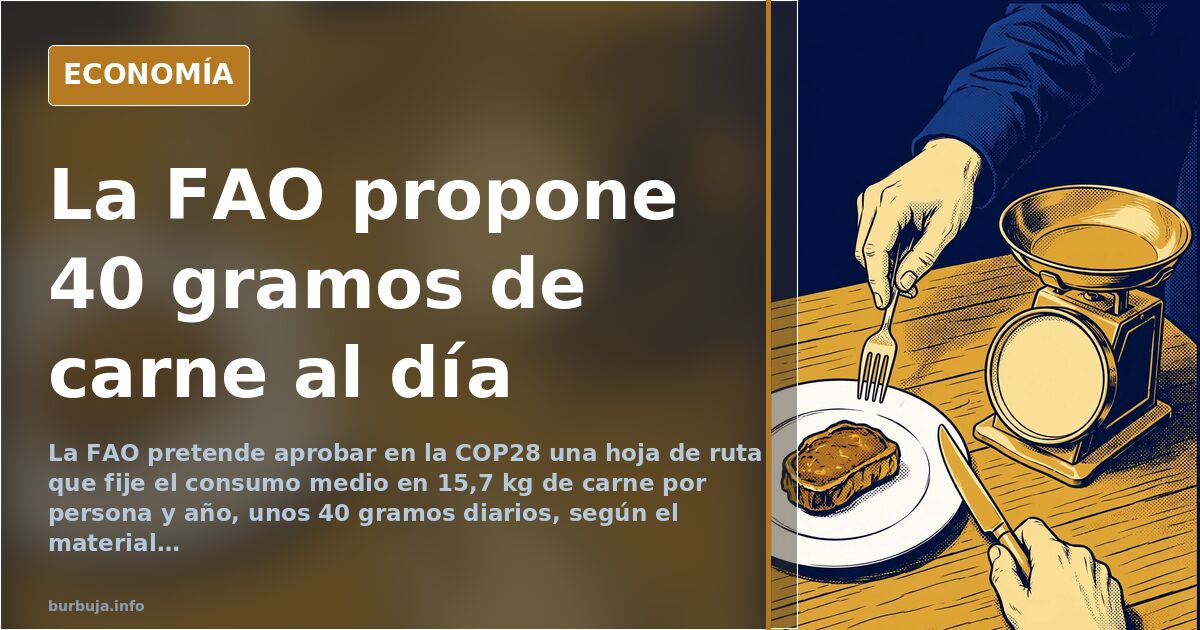
FAO proposes reducing meat consumption to 15.7 kilos per person annually at COP28
How much meat do you eat in a year? If you are American, about 127 kilos. If Nigerian, seven. If Congolese, three. The FAO, the UN agency for food and agriculture, intends to approve a roadmap at the climate summit held in Dubai from November 30 to December 12 that sets priorities for the coming years, including reducing meat consumption, according to materials circulating recently. The target figure mentioned is 15.7 kilos per person and year, equivalent to about 40 grams daily. The justification cited is that food systems generate nearly one-third of global greenhouse gas emissions. Some analyses present the measure as a limitation on freedom.
What exactly does the FAO plan say?
The roadmap the FAO intends to approve at COP28 sets priorities for the coming years. Among them, the reduction of meat consumption. It is not a ban, but an ecological transition in the meat industry which, in practice, would translate into less meat on the plate. The target figure being handled is 15.7 kilograms annually per person. For an American, this would miccionan a very severe cut. For the average European, it would also imply a notable adjustment. The founder of Clim-Eat, Dhanush Dinesh, summarized it thus: "Livestock farming is politically sensitive, but we have to address sensitive issues to solve the problem. If we don't address the livestock issue, we won't solve climate change. The key problem is excessive consumption."
The clash with reality: what was eaten before and what is eaten now
The proposal has peine a recurring debate: did we really eat less meat before? In Spain, until the sixties, the meat consumed was from home slaughter, as pointed out in the conversation. A 150-kilo pig for a large family, some rabbit, a capon chicken at Christmas. The calculation used in the conversation is that this provided about 16 kilos per person and year. That is, almost exactly what is now proposed. The difference is that then there were no supermarkets with trays of animals or economic capacity to buy beef every week. The fridge didn't help. And people measured, on average, 1.65 meters, as commented. Today, the generation that grew up eating meat to develop measures ten centimeters more, as stated. Correlation is not necessarily causation.
Does it only affect the West?
That is the most circulated question. The plan, as disseminated, would focus on Western countries. In Argentina, for example, a participant claims that average consumption is around 400 or 500 grams daily per person, and it doesn't seem that 600% annual inflation will stop it. In Nigeria or Congo, figures are 7 and 3 kilos per year respectively. Some participants point out the paradox of asking effort from those who already eat a lot while not addressing population growth in regions where consumption is minimal. As noted sarcastically, the millions of wildebeests, gazelles, zebras, and elephants roaming Africa don't seem to enter the emission calculation. They don't use oil, electric cars, or clothes that wear out after the fifth wash.
Economic impact: meat as a luxury item
If the plan goes ahead, the most immediate effect could be price. Meat is already rising. Some butchers, according to a participant, notice that less tenderloin is sold and more pork and chicken. The trend points, according to that opinion, to meat becoming a luxury product, on par with acorn-fed ham or caviar. No need to ban it: it would suffice for it to be unaffordable for the average citizen. Meanwhile, elites would continue eating whatever they please, according to that same comment. The hypocrisy would be the same as peeled pineapples in plastic tubs or cotton t-shirts that last less than a candy. Unlimited access for some things; cuts for others.
Resistance: "I'll eat double"
The reaction in sectors feeling targeted hasn't been long in coming. There are those who maintain that if the limit is approved, they will consume double or triple, legally or illegally. Others point out that the solution isn't reducing quantity but improving efficiency: extensive farming is not the same as a mega-farm, nor is a steak from old cow the same as a soy burger. The most repeated criticism is that the focus is on consumption and not pollution per unit produced. As if all ways of producing meat were equal. As if the problem were the fillet and not the industrial model that puts it on the plate.
In the end, the question isn't whether the FAO is right or not. The question is who will pay the bill. And, as always, it won't be those drafting the roadmap.
How much meat do you eat in a year? If you are American, about 127 kilos. If Nigerian, seven. If Congolese, three. The FAO, the UN agency for food and agriculture, intends to approve a roadmap at the climate summit held in Dubai from November 30 to December 12 that sets priorities for the coming years, including reducing meat consumption, according to materials circulating recently. The target figure mentioned is 15.7 kilos per person and year, equivalent to about 40 grams daily. The justification cited is that food systems generate nearly one-third of global greenhouse gas emissions. Some analyses present the measure as a limitation on freedom.
What exactly does the FAO plan say?
The roadmap the FAO intends to approve at COP28 sets priorities for the coming years. Among them, the reduction of meat consumption. It is not a ban, but an ecological transition in the meat industry which, in practice, would translate into less meat on the plate. The target figure being handled is 15.7 kilograms annually per person. For an American, this would miccionan a very severe cut. For the average European, it would also imply a notable adjustment. The founder of Clim-Eat, Dhanush Dinesh, summarized it thus: "Livestock farming is politically sensitive, but we have to address sensitive issues to solve the problem. If we don't address the livestock issue, we won't solve climate change. The key problem is excessive consumption."
The clash with reality: what was eaten before and what is eaten now
The proposal has peine a recurring debate: did we really eat less meat before? In Spain, until the sixties, the meat consumed was from home slaughter, as pointed out in the conversation. A 150-kilo pig for a large family, some rabbit, a capon chicken at Christmas. The calculation used in the conversation is that this provided about 16 kilos per person and year. That is, almost exactly what is now proposed. The difference is that then there were no supermarkets with trays of animals or economic capacity to buy beef every week. The fridge didn't help. And people measured, on average, 1.65 meters, as commented. Today, the generation that grew up eating meat to develop measures ten centimeters more, as stated. Correlation is not necessarily causation.
Does it only affect the West?
That is the most circulated question. The plan, as disseminated, would focus on Western countries. In Argentina, for example, a participant claims that average consumption is around 400 or 500 grams daily per person, and it doesn't seem that 600% annual inflation will stop it. In Nigeria or Congo, figures are 7 and 3 kilos per year respectively. Some participants point out the paradox of asking effort from those who already eat a lot while not addressing population growth in regions where consumption is minimal. As noted sarcastically, the millions of wildebeests, gazelles, zebras, and elephants roaming Africa don't seem to enter the emission calculation. They don't use oil, electric cars, or clothes that wear out after the fifth wash.
Economic impact: meat as a luxury item
If the plan goes ahead, the most immediate effect could be price. Meat is already rising. Some butchers, according to a participant, notice that less tenderloin is sold and more pork and chicken. The trend points, according to that opinion, to meat becoming a luxury product, on par with acorn-fed ham or caviar. No need to ban it: it would suffice for it to be unaffordable for the average citizen. Meanwhile, elites would continue eating whatever they please, according to that same comment. The hypocrisy would be the same as peeled pineapples in plastic tubs or cotton t-shirts that last less than a candy. Unlimited access for some things; cuts for others.
Resistance: "I'll eat double"
The reaction in sectors feeling targeted hasn't been long in coming. There are those who maintain that if the limit is approved, they will consume double or triple, legally or illegally. Others point out that the solution isn't reducing quantity but improving efficiency: extensive farming is not the same as a mega-farm, nor is a steak from old cow the same as a soy burger. The most repeated criticism is that the focus is on consumption and not pollution per unit produced. As if all ways of producing meat were equal. As if the problem were the fillet and not the industrial model that puts it on the plate.
In the end, the question isn't whether the FAO is right or not. The question is who will pay the bill. And, as always, it won't be those drafting the roadmap.
Also available in: Deutsch
Summary of a discussion on Burbuja.info - Foro de economía, actualidad y política., translated from Spanish and reviewed before publication. Read the full discussion (114 replies).
More summaries
-
Spain's veal consumption drops 40% amid price surge
Veal consumption in Spain falls 40% as loin prices jump from €17 to €25. Chicken and pork replace it in shopping baskets.
-
Argentina inflation hits 160.9% as beef prices drop 25%
Argentine CPI rose 12.8% monthly and 160.9% annually, yet beef fell 25% and tomato prices dropped from 900 to 400 pesos.
-
Ignacio Lázaro: 'Maricarmen paid €154 rent while we paid €750'
Ignacio Lázaro, grandson of the original owner, reveals the other side of the Maricarmen case: 'We subsidized her for years and now, with our taxes.'
-
Live TV groping claim sparks debate over hand position
A live broadcast incident involving a Cuatro reporter turns into a national dispute over whether the contact was sexual assault or accidental.
-
LIBERUM releases templates to block EU health data sharing
LIBERUM publishes forms to refuse transferring Spanish health data to the EU, citing opposition rights and data protection agencies.
-
Seville apartment bought for €120k in 2015 now worth triple
A 90 m² flat in Seville's historic center, bought for €120,000 in 2015, is claimed to be worth three times that today.