
Argentina inflation hits 160.9% as beef prices drop 25%
Argentine CPI rose 12.8% monthly and 160.9% annually, yet beef fell 25% and tomato prices dropped from 900 to 400 pesos.
English · Original discussion in Spanish · Published
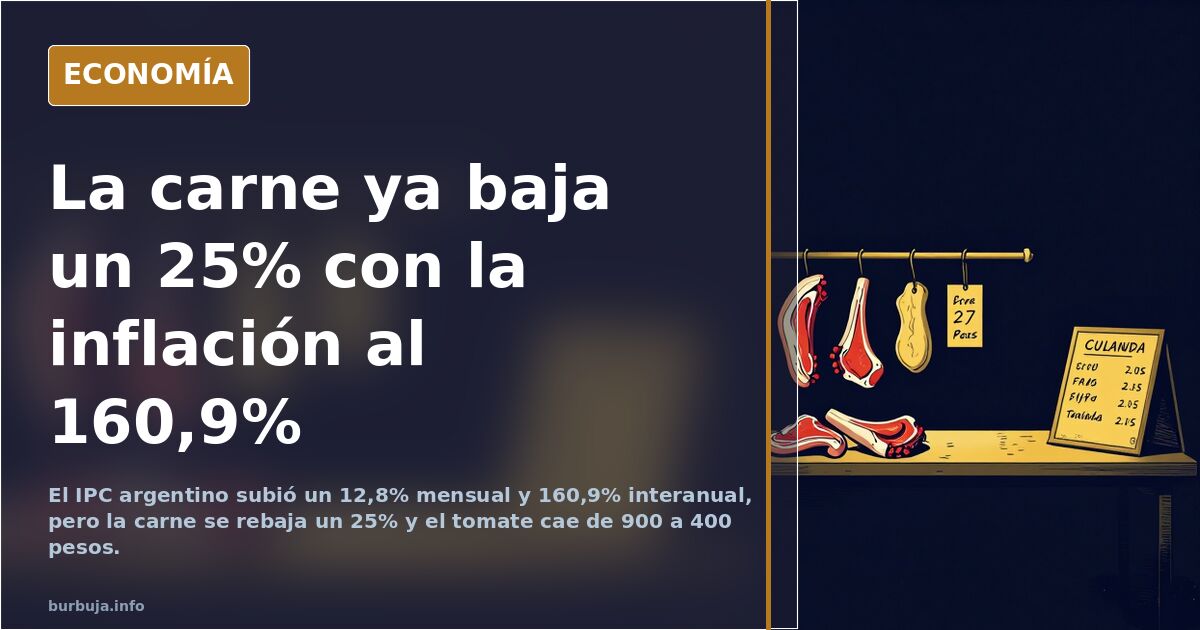
Argentine inflation runs at 160.9% while beef prices already fall by 25%
In an Argentine butcher shop, the sign for beef changed twice in just a few weeks. First, it jumped up to 50% ahead of Christmas. Then, when customers started checking prices and walking away, the counter applied discounts of 20% and 25%. This is not a marketing campaign: it is the law of supply and demand beginning to work in a country that had not seen it operate for years.
The backdrop does not invite optimism. The general price index rose 12.8% month-on-month and 160.9% year-on-year, with the cumulative annual increase reaching 148.2%. With that picture, lower prices for specific products sound like a contradiction. And yet, it is happening.
Which products are getting cheaper in Argentina?
A list of vegetable prices circulated on social media shows tomatoes dropping from 900 to 400 pesos, potatoes from 900 to 600, onions from 550 to 450, and zucchini from 700 to 580. Carrots, according to the same tally, went from 1,200 to 100. These figures are unverified product-by-product, but they point in the same direction as industry reports: higher supply and lower demand.
For potatoes, the argument is textbook: supply increased and the price yielded. For sweets and ciders, the factor is seasonality. After the holidays, retailers need to clear accumulated stock and adjust prices downward.
Competition also plays a role. Red Súper Argentinos launched 20% discounts on a basic basket of 20 products for two months starting December 27 to boost sales. When several chains compete for the same shrinking wallet, price stops being a fixed number and becomes a variable.
Why do prices fall if inflation remains high?
Because the market is starting to set what was previously set by decree. The elimination of artificially established prices, along with market liberalization and the reduction or suspension of subsidies on various goods and services, has allowed supply and demand to govern for the first time in years. Many prices rise due to devaluation stemming from monetary excesses. Others fall due to increased supply or decreased demand.
The second pillar is consumption. It fell 6.9% month-on-month and 4.1% year-on-year, according to the Argentine Chamber of Commerce and Services. The chief economist of the business association argues that consumption will behave "very erratically" as the economy opens up, with price volatility as demand adjusts. His diagnosis: it is not unusual to see sharp increases trinc by partial reversals, because consumers stop buying what they consider expensive rather than validating that price.
The practical translation is that citizens have discovered the oldest weapon in the world: refusing to pay. And merchants have discovered the oldest response: lowering prices until someone buys.
Beef at 20,000 pesos per kilo: how much is that in euros?
The meat industry association summarizes it without frills: counter prices rose before Christmas and fell afterward because people resisted paying those amounts. A year of low demand lies ahead, with tight budgets, which will stagnate consumption for whatever remains available to citizens.
Confusion starts with conversion. A price of 20,000 pesos per kilo was initially read as 2 euros—missing a zero—and then as 22. With the free dollar at 1,200 pesos, it is about 16 euros. The underlying debate is which exchange rate to use: the official one is merely an accounting invention, while the free rate reflects the true cost of production and purchase.
To calibrate, a whole ribeye steak sold for just over 9 euros per kilo, incorporating inflation from the last two months. A few months ago, the same cut cost 4 or 5 euros. Argentine beef has become more expensive in euros and, even so, remains a product that has become unreachable on many local tables.
What continues to rise: taxes, fuels, and private schools
The government has not touched a single price: it has freed the market to set them. The problem is that actors with pricing power have moved straight to equilibrium values in a matter of weeks, while wages remain anchored in the previous stage.
Pending are services whose prices depend on the government—public transport, electricity, gas, and water—which anticipates another round of adjustments. The full picture is not a shopping basket that gets cheaper, but a basket where some items become affordable while many others jump in price beyond wage recovery.
Free market or recessionary adjustment: the core debate
Here the rift opens. One current argues that what is happening is the natural correction of prices distorted for years by controls and subsidies, and that volatility is normal noise in an economy returning to relative prices. The opposing current counters that a recessionary adjustment has been applied instead of an expansionary one, deepening social damage rather than correcting it.
In the middle appears the issue no one disputes: half the population depends on a social plan, meaning they are directly subsidized. And the country's flagship product, beef, was sold for years with fixed internal prices or obligations to supply the local market, which crushed exports and ultimately tied the country to poverty.
The most uncomfortable diagnosis points out that with so many intervened prices for so long, there is no way to know the real price of anything. Without that reference, any discount is as hard to interpret as any increase.
Ecuador, dollarization, and warnings from abroad
The Argentine debate glances sideways at Ecuador, the country that already dollarized its economy and which President Milei has cited as a reference. Critics of this path argue that dollarization facilitates money laundering and fuels the growth of incivil gangs and resulting violence. Some go further, describing Ecuador as a failed state, attributing this to the management of its recent presidents, linked—so it is claimed—to an international network of liberal think tanks.
These are assertions circulating without conclusive proof and should be read with caution. What matters for Argentina is not the Ecuadorian case itself, but the warning: changing the monetary regime does not, by itself, fix security or poverty.
The closing note comes from a disorienting data point. With beef down 25% and tomatoes less than half price, the picture remains that of a majority unable to make ends meet, with half the population receiving a social plan and, according to repeated testimonies, six out of ten children unable to eat. The market works for that too.
In an Argentine butcher shop, the sign for beef changed twice in just a few weeks. First, it jumped up to 50% ahead of Christmas. Then, when customers started checking prices and walking away, the counter applied discounts of 20% and 25%. This is not a marketing campaign: it is the law of supply and demand beginning to work in a country that had not seen it operate for years.
The backdrop does not invite optimism. The general price index rose 12.8% month-on-month and 160.9% year-on-year, with the cumulative annual increase reaching 148.2%. With that picture, lower prices for specific products sound like a contradiction. And yet, it is happening.
Which products are getting cheaper in Argentina?
A list of vegetable prices circulated on social media shows tomatoes dropping from 900 to 400 pesos, potatoes from 900 to 600, onions from 550 to 450, and zucchini from 700 to 580. Carrots, according to the same tally, went from 1,200 to 100. These figures are unverified product-by-product, but they point in the same direction as industry reports: higher supply and lower demand.
For potatoes, the argument is textbook: supply increased and the price yielded. For sweets and ciders, the factor is seasonality. After the holidays, retailers need to clear accumulated stock and adjust prices downward.
Competition also plays a role. Red Súper Argentinos launched 20% discounts on a basic basket of 20 products for two months starting December 27 to boost sales. When several chains compete for the same shrinking wallet, price stops being a fixed number and becomes a variable.
Why do prices fall if inflation remains high?
Because the market is starting to set what was previously set by decree. The elimination of artificially established prices, along with market liberalization and the reduction or suspension of subsidies on various goods and services, has allowed supply and demand to govern for the first time in years. Many prices rise due to devaluation stemming from monetary excesses. Others fall due to increased supply or decreased demand.
The second pillar is consumption. It fell 6.9% month-on-month and 4.1% year-on-year, according to the Argentine Chamber of Commerce and Services. The chief economist of the business association argues that consumption will behave "very erratically" as the economy opens up, with price volatility as demand adjusts. His diagnosis: it is not unusual to see sharp increases trinc by partial reversals, because consumers stop buying what they consider expensive rather than validating that price.
The practical translation is that citizens have discovered the oldest weapon in the world: refusing to pay. And merchants have discovered the oldest response: lowering prices until someone buys.
Beef at 20,000 pesos per kilo: how much is that in euros?
The meat industry association summarizes it without frills: counter prices rose before Christmas and fell afterward because people resisted paying those amounts. A year of low demand lies ahead, with tight budgets, which will stagnate consumption for whatever remains available to citizens.
Confusion starts with conversion. A price of 20,000 pesos per kilo was initially read as 2 euros—missing a zero—and then as 22. With the free dollar at 1,200 pesos, it is about 16 euros. The underlying debate is which exchange rate to use: the official one is merely an accounting invention, while the free rate reflects the true cost of production and purchase.
To calibrate, a whole ribeye steak sold for just over 9 euros per kilo, incorporating inflation from the last two months. A few months ago, the same cut cost 4 or 5 euros. Argentine beef has become more expensive in euros and, even so, remains a product that has become unreachable on many local tables.
What continues to rise: taxes, fuels, and private schools
The government has not touched a single price: it has freed the market to set them. The problem is that actors with pricing power have moved straight to equilibrium values in a matter of weeks, while wages remain anchored in the previous stage.
- Municipal and provincial taxes: increases of up to 200%
- Food and beverages: between 100%, 150%, and up to 200%
- Private schools, health insurance, and services: 100%
- Fuels: 120%
Pending are services whose prices depend on the government—public transport, electricity, gas, and water—which anticipates another round of adjustments. The full picture is not a shopping basket that gets cheaper, but a basket where some items become affordable while many others jump in price beyond wage recovery.
Free market or recessionary adjustment: the core debate
Here the rift opens. One current argues that what is happening is the natural correction of prices distorted for years by controls and subsidies, and that volatility is normal noise in an economy returning to relative prices. The opposing current counters that a recessionary adjustment has been applied instead of an expansionary one, deepening social damage rather than correcting it.
In the middle appears the issue no one disputes: half the population depends on a social plan, meaning they are directly subsidized. And the country's flagship product, beef, was sold for years with fixed internal prices or obligations to supply the local market, which crushed exports and ultimately tied the country to poverty.
The most uncomfortable diagnosis points out that with so many intervened prices for so long, there is no way to know the real price of anything. Without that reference, any discount is as hard to interpret as any increase.
Ecuador, dollarization, and warnings from abroad
The Argentine debate glances sideways at Ecuador, the country that already dollarized its economy and which President Milei has cited as a reference. Critics of this path argue that dollarization facilitates money laundering and fuels the growth of incivil gangs and resulting violence. Some go further, describing Ecuador as a failed state, attributing this to the management of its recent presidents, linked—so it is claimed—to an international network of liberal think tanks.
These are assertions circulating without conclusive proof and should be read with caution. What matters for Argentina is not the Ecuadorian case itself, but the warning: changing the monetary regime does not, by itself, fix security or poverty.
The closing note comes from a disorienting data point. With beef down 25% and tomatoes less than half price, the picture remains that of a majority unable to make ends meet, with half the population receiving a social plan and, according to repeated testimonies, six out of ten children unable to eat. The market works for that too.
Also available in: Deutsch
Summary of a discussion on Burbuja.info - Foro de economía, actualidad y política., translated from Spanish and reviewed before publication. Read the full discussion (191 replies).
More summaries
-
Huerta de Soto breaks down Milei's ten points from Davos in class
Analysis of Milei's Davos speech: from Adam Smith as a lukewarm social democrat to 58% of income seized by the state, with Argentina footing the bill
-
Looting in Argentina: shops defended with gunfire and the Milei factor
Shops defended with gunfire, looting in several cities and a parallel dollar some put at 1,000 pesos: the crisis enters the election campaign
-
The 25-Euro Menu: Catastrophism That Has Become Routine
A 25-euro menu and, according to a forum user, 6 million people on benefits: discontent as the default narrative.
-
Plane Myth: Confusing Inertia with Wind in Spain
Earth rotates at 1,600 km/h and planes fly at 840 km/h. The error is forgetting that air rotates with the planet.
-
Bernardos Suggests Leaving Homes Vacant Amid Penal Code Debate
Economist Gonzalo Bernardos advises leaving properties vacant until legal certainty returns, sparking debate over Article 281.1 of the Spanish Penal Code.
-
Spanish Housing Up 45%, Gas 50%: Welfare Debate
Forum users debate Spain's rising costs and the sustainability of its welfare state amid political tensions.