
Extra virgin olive oil hits €14.50 per liter in Spain
Users report extra virgin olive oil prices reaching €14.50 per liter, sparking debate over quality and drought impact.
English · Original discussion in Spanish · Published
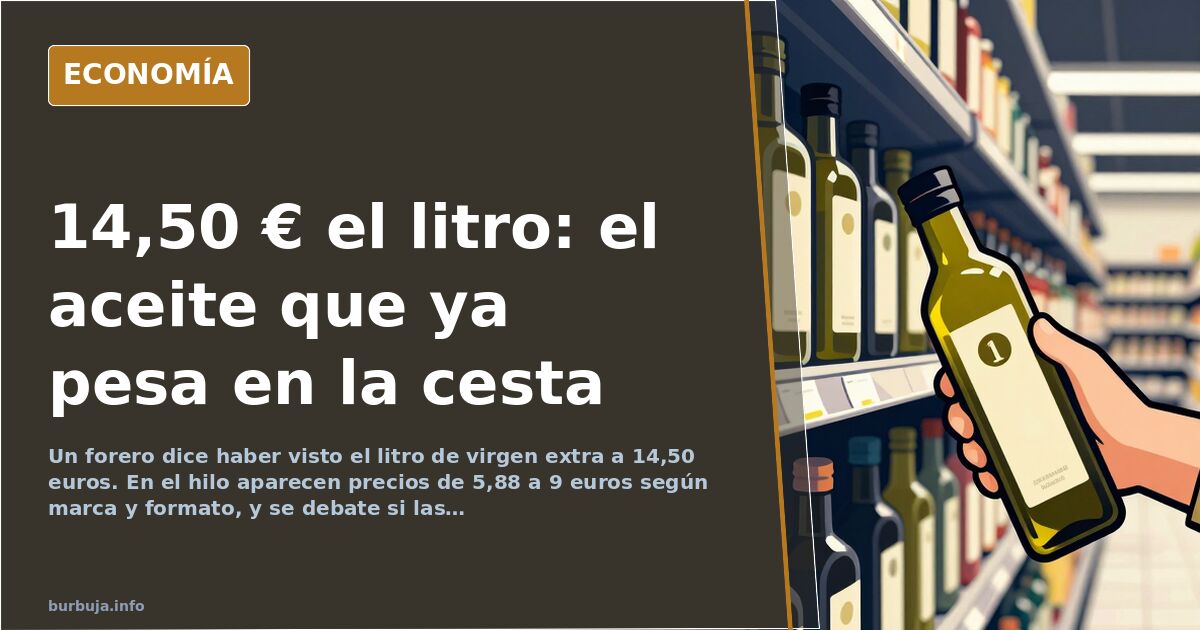
Extra virgin olive oil hits €14.50 per liter, squeezing household budgets
The price of extra virgin olive oil (AOVE) has moved from a simple grocery item to a major topic of conversation. Amidst a campaign marked by severe drought and reduced harvests, forum users report shelf prices as high as €14.50 per liter, forcing consumers to double-check labels. The discussion centers on whether such expensive bottles are authentic, with many noting that private-label products often contain blends that consumers cannot easily distinguish.
Everyday luxury: Extra virgin olive oil becomes a premium product. This is not mere perception; the same thread lists prices ranging from €7 at one chain to €5.88 at another known brand, €8.65 at a hypermarket, and over €9 elsewhere. This wide variance does not always reflect actual quality. Some argue that private-label "extra virgin" oil is not pure but a mix of refined and virgin oils, explaining the price differences. The debate shifts to traceability: community vs. non-community origins, unclear bottling dates, and promotions that only lower unit costs if buying multiple bottles.
Why is extra virgin olive oil so expensive?
Weather conditions are cited as the primary driver. Drought and lack of rain in southern and eastern Spain have cut harvests significantly. Experts warn that if winter rainfall remains low, production capacity in regions like Jaén could be permanently damaged. This is not a one-year issue; two consecutive campaigns have suffered water deficits, with olive trees relying solely on rainfall. The result is a tense market where rising origin prices pass directly to retail shelves without much filtering.
Opposing this view, others point to market structure. Cooperatives are presented as an alternative offering fewer intermediaries and better traceability, theoretically leading to lower prices. However, reality varies. Some users find local cooperatives more expensive than large supermarkets, while others attribute this to volume and operational costs. The role of intermediaries remains debated: some claim removing them doesn't lower prices, as margins simply shift elsewhere.
Extra virgin, virgin, and refined: What the label says
Confusion between categories is a key theme. A bottle priced at €6.80 may contain a blend of refined and extra virgin oil rather than pure extra virgin. This distinction, invisible to many, explains part of the price gap. Consumers are advised to read fine print and distrust aggressive promotions for a product whose raw material costs remain high.
Some go further, alleging that many private labels mix EU and non-EU sourced oils to keep prices down unnoticed. While independent verification is lacking in these reports, suspicion persists. Practically, buyers seeking genuine extra virgin oil pay more, while those prioritizing price accept they are purchasing a different product.
Cooperative or supermarket: Where is oil cheaper?
Cooperatives are frequently recommended for quality at a good price. Arguments suggest they handle smaller volumes but have lower logistics and staffing costs, which should benefit final prices. Yet, shared experiences contradict this: in some cases, local cooperatives charge more than discount chains. The conclusion is that there is no fixed rule, and comparison shopping is essential.
Large supermarkets offer another angle. Promotions like "buy three, get two free" can push unit prices below €10, but require bulk purchases. For tight household budgets, this saving might be real or illusory. The debate extends to consumption habits: some use less oil, cook with microwaves, or switch to butter, while others defend olive oil as the foundation of Spanish cuisine.
Oil prices and political tension
The issue intersects with political discontent. Forum discussions suggest prices reflect market manipulation rather than just supply and demand, criticizing the lack of social protest against hikes. Comparisons with other countries arise; claims state that France sells the same product for half the price. Though unverified, the sense of comparative disadvantage is palpable.
The debate remains open. Some consider olive oil the most overvalued ingredient in Spanish cooking, while others insist there is no substitute for good extra virgin oil. Meanwhile, price dictates the conversation. With the current campaign underway and drought unresolved, forecasts suggest liter prices will not drop soon, though no one dares predict a ceiling.
The price of extra virgin olive oil (AOVE) has moved from a simple grocery item to a major topic of conversation. Amidst a campaign marked by severe drought and reduced harvests, forum users report shelf prices as high as €14.50 per liter, forcing consumers to double-check labels. The discussion centers on whether such expensive bottles are authentic, with many noting that private-label products often contain blends that consumers cannot easily distinguish.
Everyday luxury: Extra virgin olive oil becomes a premium product. This is not mere perception; the same thread lists prices ranging from €7 at one chain to €5.88 at another known brand, €8.65 at a hypermarket, and over €9 elsewhere. This wide variance does not always reflect actual quality. Some argue that private-label "extra virgin" oil is not pure but a mix of refined and virgin oils, explaining the price differences. The debate shifts to traceability: community vs. non-community origins, unclear bottling dates, and promotions that only lower unit costs if buying multiple bottles.
Why is extra virgin olive oil so expensive?
Weather conditions are cited as the primary driver. Drought and lack of rain in southern and eastern Spain have cut harvests significantly. Experts warn that if winter rainfall remains low, production capacity in regions like Jaén could be permanently damaged. This is not a one-year issue; two consecutive campaigns have suffered water deficits, with olive trees relying solely on rainfall. The result is a tense market where rising origin prices pass directly to retail shelves without much filtering.
Opposing this view, others point to market structure. Cooperatives are presented as an alternative offering fewer intermediaries and better traceability, theoretically leading to lower prices. However, reality varies. Some users find local cooperatives more expensive than large supermarkets, while others attribute this to volume and operational costs. The role of intermediaries remains debated: some claim removing them doesn't lower prices, as margins simply shift elsewhere.
Extra virgin, virgin, and refined: What the label says
Confusion between categories is a key theme. A bottle priced at €6.80 may contain a blend of refined and extra virgin oil rather than pure extra virgin. This distinction, invisible to many, explains part of the price gap. Consumers are advised to read fine print and distrust aggressive promotions for a product whose raw material costs remain high.
Some go further, alleging that many private labels mix EU and non-EU sourced oils to keep prices down unnoticed. While independent verification is lacking in these reports, suspicion persists. Practically, buyers seeking genuine extra virgin oil pay more, while those prioritizing price accept they are purchasing a different product.
Cooperative or supermarket: Where is oil cheaper?
Cooperatives are frequently recommended for quality at a good price. Arguments suggest they handle smaller volumes but have lower logistics and staffing costs, which should benefit final prices. Yet, shared experiences contradict this: in some cases, local cooperatives charge more than discount chains. The conclusion is that there is no fixed rule, and comparison shopping is essential.
Large supermarkets offer another angle. Promotions like "buy three, get two free" can push unit prices below €10, but require bulk purchases. For tight household budgets, this saving might be real or illusory. The debate extends to consumption habits: some use less oil, cook with microwaves, or switch to butter, while others defend olive oil as the foundation of Spanish cuisine.
Oil prices and political tension
The issue intersects with political discontent. Forum discussions suggest prices reflect market manipulation rather than just supply and demand, criticizing the lack of social protest against hikes. Comparisons with other countries arise; claims state that France sells the same product for half the price. Though unverified, the sense of comparative disadvantage is palpable.
The debate remains open. Some consider olive oil the most overvalued ingredient in Spanish cooking, while others insist there is no substitute for good extra virgin oil. Meanwhile, price dictates the conversation. With the current campaign underway and drought unresolved, forecasts suggest liter prices will not drop soon, though no one dares predict a ceiling.
Also available in: Deutsch
Summary of a discussion on Burbuja.info - Foro de economía, actualidad y política., translated from Spanish and reviewed before publication. Read the full discussion (122 replies).
More summaries
-
Spain's Extra Virgin Olive Oil Prices Surge to €15/Liter
Extra virgin olive oil prices in Spain have jumped from €3-4 in 2018 to €15, while direct purchases from Jaén cooperatives remain at €8.80.
-
Olive oil prices in Spain stay above €10 despite Jaén rains
Extra virgin olive oil prices remain above €10 per liter in Spain despite rainfall in Jaén, as the market reacts to future harvests rather than current water levels.
-
Riots in French schools: fires and attacks
Fires in French schools, teachers attacked and blockades spreading to Belgium. The unrest is attributed to the education strike and radical groups.
-
Junts and PSOE pact criticized as PSOE goes too far
Critics warn the PSOE-Junts agreement ignores the Spanish Constitution, prompting a warning from former Prime Minister Felipe González.
-
Spain: Alleged gang rape suspects released despite medical evidence
Three men were released in record time despite medical reports confirming sexual assault. The case involves the son of the Constitutional Court president.
-
Madrid parents build burning barricades to avoid handing over children
A couple in Carabanchel, Spain, held three foster children captive for three weeks, hiding them in a wardrobe behind burning barricades.