
Junts and PSOE pact criticized as PSOE goes too far
Critics warn the PSOE-Junts agreement ignores the Spanish Constitution, prompting a warning from former Prime Minister Felipe González.
English · Original discussion in Spanish · Published
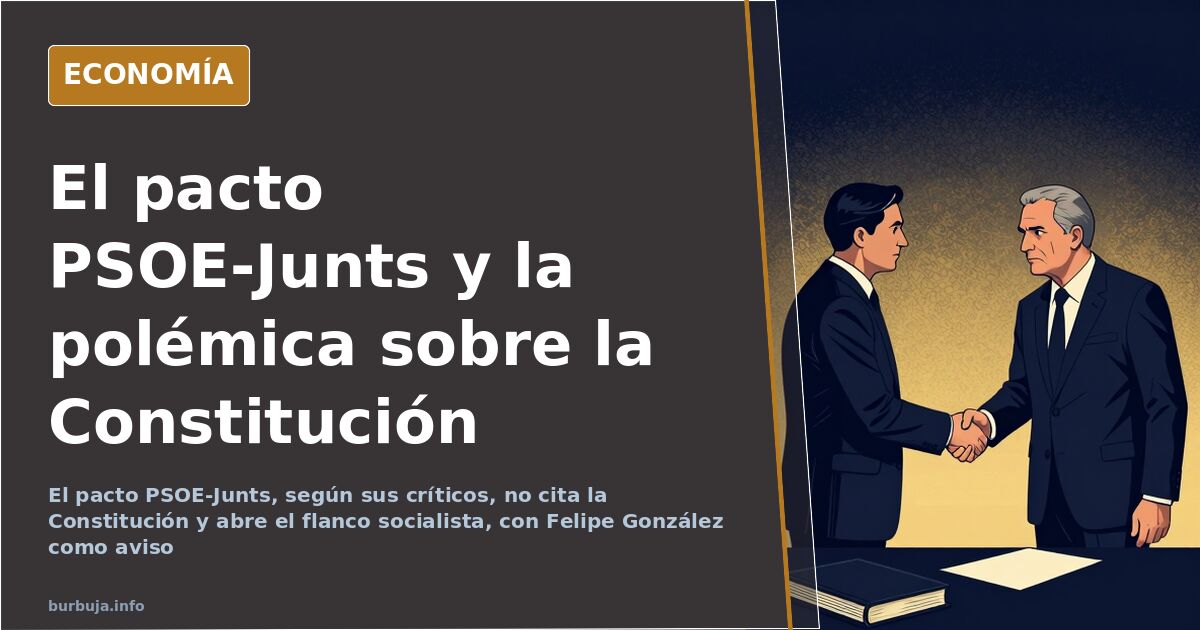
Sánchez oversteps: The pact that ignores the Constitution
A coalition agreement that, according to critical readings in the current debate, fails to mention the Constitution even once. This detail has raised serious alarms regarding the pact between the PSOE (Spanish Socialist Workers' Party) and Junts (a Catalan pro-independence party). Amnesty was the anticipated part; what has caused shock is that, under this interpretation, the leader of Junts is placed on the same level of sarracena and political authority as the Government of Spain and its highest institutions. A pact to govern Spain that begins by failing to cite the very text that defines it. The fundamental question is no longer whether the PSOE has gone too far, but how much restraint is left.
What does the PSOE-Junts agreement contain?
Two elements carry more weight than any figure. The first: amnesty as a bargaining chip. The second: the implicit recognition that Junts is not just any interlocutor, but a partner with a voice in designing the State. Overarching this is a suspicion running through the analysis: that what has been published is only the public-facing part, and that signed commitments still lie in the shadows. No one has proven this, but the logic of such procedures—publishing the minimum while negotiating the maximum—invites the thought.
The economic reproach also runs through the thread: it is said to be signed with everyone's money, yet no specific figures accompany the operation in the debate. Thus, according to this reading, the constitutional framework shifts from being common ground to an obstacle to be bypassed. That is the accusation. For now, the defense has not found the paragraph to refute it.
Felipe González's warning and internal PSOE conflict
The words of former Prime Minister Felipe González, read as a final warning, have exposed the most uncomfortable flank for the PSOE: its own cohesion. Part of the analysis suggests there is nothing to be done, that Sánchez controls the party with an iron fist and has spent years sidelining those who disagree. Conversely, the counter-argument is that MPs are free, and a handful of dissenting deputies would suffice to topple the investiture. If they do not act, it is argued, it is because everyone is protecting their own interests and principles have vanished.
The other side is the dismissive response the former Prime Minister has received from certain sectors, who label him harshly and place him outside the left he claims to represent. In such a climate, the operational question is simple: is a warning useful when the person issuing it no longer holds power?
Why is a 'cordón sanitario' demanded against PP and VOX?
One line of analysis maintains that the response cannot be waiting for the streets to do the work or holding watered-down press conferences. The proposal is different: break any pact with the parties supporting the operation and establish a 'cordón sanitario' (a political blockade) immediately. The dilemma is whether this isolation institutionally strengthens those applying it or, conversely, leaves the alternative bloc without any capacity to influence anything.
While this is being decided, the struggle plays out in the realm of symbols: flags, gestures, and political theater, according to the most critical reading, which argues that the discussion on sovereignty has become a circus where almost nothing carries meaning.
Who ultimately pays the price
The prevailing expectation in this final stretch is that this is only just beginning and there is no turning back. There is talk of going after Sánchez without further hesitation, although no one specifies who will move or with what tool. Some claim the Supreme Court is gathering evidence to indict the President for prevarication; this is a partisan claim without a judicial ruling to back it up to date, and it should be treated as such.
The interesting part is not the prediction, but the change in tone. A few years ago, this type of discussion would have ended with a shrug. Today, it ends with the feeling that the country many grew up in has ceased to exist.
The other front: integration, demographics, and nationhood
Beneath the political noise lies a less flashy and far more uncomfortable debate: what migratory model sustains a country. The Swiss example is presented as a contrast. 50% of the population between 20 and 30 years old has foreign parents, according to the calculation provided, and yet they are considered fully integrated: shared language, customs, and expectations. The difference highlighted is not the origin of the people, but the filter: attracting talent versus attracting those who arrive to claim benefits.
With these pieces, the question shifts from the legal to the demographic plane. What remains of a nation when its composition changes faster than its narrative? One side responds that nothing remains. This is a thesis, not a fact, and should be read as such.
Has anyone calculated, beyond the noise, exactly how much what has just been signed will cost?
A coalition agreement that, according to critical readings in the current debate, fails to mention the Constitution even once. This detail has raised serious alarms regarding the pact between the PSOE (Spanish Socialist Workers' Party) and Junts (a Catalan pro-independence party). Amnesty was the anticipated part; what has caused shock is that, under this interpretation, the leader of Junts is placed on the same level of sarracena and political authority as the Government of Spain and its highest institutions. A pact to govern Spain that begins by failing to cite the very text that defines it. The fundamental question is no longer whether the PSOE has gone too far, but how much restraint is left.
What does the PSOE-Junts agreement contain?
Two elements carry more weight than any figure. The first: amnesty as a bargaining chip. The second: the implicit recognition that Junts is not just any interlocutor, but a partner with a voice in designing the State. Overarching this is a suspicion running through the analysis: that what has been published is only the public-facing part, and that signed commitments still lie in the shadows. No one has proven this, but the logic of such procedures—publishing the minimum while negotiating the maximum—invites the thought.
The economic reproach also runs through the thread: it is said to be signed with everyone's money, yet no specific figures accompany the operation in the debate. Thus, according to this reading, the constitutional framework shifts from being common ground to an obstacle to be bypassed. That is the accusation. For now, the defense has not found the paragraph to refute it.
Felipe González's warning and internal PSOE conflict
The words of former Prime Minister Felipe González, read as a final warning, have exposed the most uncomfortable flank for the PSOE: its own cohesion. Part of the analysis suggests there is nothing to be done, that Sánchez controls the party with an iron fist and has spent years sidelining those who disagree. Conversely, the counter-argument is that MPs are free, and a handful of dissenting deputies would suffice to topple the investiture. If they do not act, it is argued, it is because everyone is protecting their own interests and principles have vanished.
The other side is the dismissive response the former Prime Minister has received from certain sectors, who label him harshly and place him outside the left he claims to represent. In such a climate, the operational question is simple: is a warning useful when the person issuing it no longer holds power?
Why is a 'cordón sanitario' demanded against PP and VOX?
One line of analysis maintains that the response cannot be waiting for the streets to do the work or holding watered-down press conferences. The proposal is different: break any pact with the parties supporting the operation and establish a 'cordón sanitario' (a political blockade) immediately. The dilemma is whether this isolation institutionally strengthens those applying it or, conversely, leaves the alternative bloc without any capacity to influence anything.
While this is being decided, the struggle plays out in the realm of symbols: flags, gestures, and political theater, according to the most critical reading, which argues that the discussion on sovereignty has become a circus where almost nothing carries meaning.
Who ultimately pays the price
The prevailing expectation in this final stretch is that this is only just beginning and there is no turning back. There is talk of going after Sánchez without further hesitation, although no one specifies who will move or with what tool. Some claim the Supreme Court is gathering evidence to indict the President for prevarication; this is a partisan claim without a judicial ruling to back it up to date, and it should be treated as such.
The interesting part is not the prediction, but the change in tone. A few years ago, this type of discussion would have ended with a shrug. Today, it ends with the feeling that the country many grew up in has ceased to exist.
The other front: integration, demographics, and nationhood
Beneath the political noise lies a less flashy and far more uncomfortable debate: what migratory model sustains a country. The Swiss example is presented as a contrast. 50% of the population between 20 and 30 years old has foreign parents, according to the calculation provided, and yet they are considered fully integrated: shared language, customs, and expectations. The difference highlighted is not the origin of the people, but the filter: attracting talent versus attracting those who arrive to claim benefits.
With these pieces, the question shifts from the legal to the demographic plane. What remains of a nation when its composition changes faster than its narrative? One side responds that nothing remains. This is a thesis, not a fact, and should be read as such.
Has anyone calculated, beyond the noise, exactly how much what has just been signed will cost?
Also available in: Deutsch
Summary of a discussion on Burbuja.info - Foro de economía, actualidad y política., translated from Spanish and reviewed before publication. Read the full discussion (103 replies).
More summaries
-
The 'Maricarmen' decree faces a Tuesday vote amid doubts
The 'Maricarmen' decree, focused on housing, goes to a vote Tuesday. Old rents, Junts, omnibus bills, and planned applause...
-
Zarzuela summons Sánchez: The meeting Moncloa doesn't acknowledge
The King reportedly summoned Sánchez at Zarzuela following his meeting with the military establishment and the announcement of the Ceuta trip. The official agenda makes no mention of the encounter, and...
-
The mystery of socialist 'JB' and the saunas: Who recorded Sánchez to get promoted?
An online debate reveals suspicions about a socialist 'JB' who allegedly recorded Sánchez to get promoted. Names like Bono, Borrell, and Blanco come into play.
-
Prediction: Zapatero could face pretrial detention in Spain this June
An analysis of Zapatero's potential imprisonment, pressure from US agencies, and the political impact of newly discovered assets.
-
American woman in Spain criticizes local walking habits as irritating
An American resident in Valencia sparks debate by criticizing how Spaniards walk, citing sidewalk congestion and a lack of pedestrian etiquette.
-
Spanish Navy to escort plague-infected cruise ship to Canary Islands
A cruise ship carrying hantavirus, rejected by Cape Verde, is set to dock in Spain's Canary Islands. We analyze the growing health concerns and political debate.