
Olive oil prices in Spain stay above €10 despite Jaén rains
Extra virgin olive oil prices remain above €10 per liter in Spain despite rainfall in Jaén, as the market reacts to future harvests rather than current water levels.
English · Original discussion in Spanish · Published
Olive oil prices in Spain stay above €10 despite Jaén rains
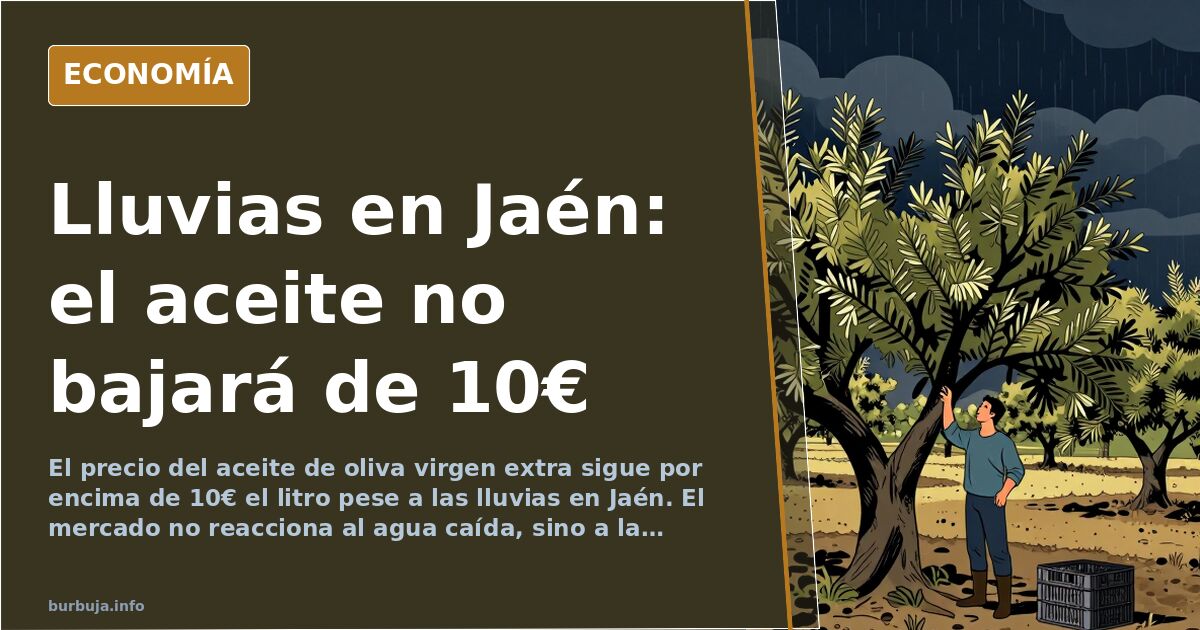
Rain has arrived in Jaén at a good time. Yet, the price of extra virgin olive oil remains stuck above 10 euros per liter in supermarkets. This paradox has an explanation: the market does not react to the rain that has fallen, but to the harvest that has yet to materialize. Whether the olive blossoms will set fruit won't be known until May, and new oil won't enter circulation until November. Anyone expecting to see liters priced at 5 or 6 euros in the coming months will face the harsh reality of the agricultural calendar.
Why rain doesn't lower olive oil prices
The most common argument is that excess humidity isn't necessarily beneficial. It can promote fungal diseases such as repilo (olive leaf spot) and complicate harvesting. Some argue that, far from lowering costs, rain could even increase product prices if it brings pests. The equation isn't rain equals low price, but rain equals uncertainty.
The second factor is stock levels. At this point in the cycle, there is virtually no oil left from the previous campaign, and upward momentum continues until new oil enters, expectedly in November. In the best-case scenario, this new oil would provide an average harvest covering much of the demand, but not all of it.
When might extra virgin olive oil prices drop?
The most optimistic scenario points to a moderate decrease by year-end, when new production begins distribution. A significant drop would require waiting, hopefully, two years: another good harvest would need to trinc, with consistent rainfall. This means consumers won't see prices from three years ago anytime soon.
Some go further, arguing that prices will never fall again—that what goes up stays up. They attribute this to speculation, corruption, and greed. Distrust of the official narrative is widespread: doubts are raised about drought being the sole cause, investment funds and distributors are blamed, and some recall that the same oil is cheaper in Switzerland than in Spain.
The paradox of exporting Spanish oil cheaper abroad
One of the most uncomfortable aspects is that some cooperatives in Jaén sell top-quality extra virgin oil for less than 9 euros per liter. Consumers paying 12 or 14 euros do so through major retail chains, not at the source. The difference between mill prices and shelf prices represents margins kept by intermediaries and retailers.
This adds to criticism of exporting local products during inflation. It's argued that selling the best oils abroad while importing lower-quality products at premium prices domestically makes little sense. Transport carbon footprints and external dependency also factor into the equation.
Wholesale prices have already dropped 20%
A surprising data point: according to circulating calculations, wholesale olive oil prices have fallen from 8.80-9 euros per kilo to 7-7.10 euros, a 20% drop, due to better harvest forecasts. However, this reduction hasn't reached consumers' wallets. The gap between origin and final prices remains the true mystery nobody fully explains.
The question isn't whether it rains or stops raining. The question is how much of that margin the market is willing to return to consumers. And the answer, for now, is none.
Rain has arrived in Jaén at a good time. Yet, the price of extra virgin olive oil remains stuck above 10 euros per liter in supermarkets. This paradox has an explanation: the market does not react to the rain that has fallen, but to the harvest that has yet to materialize. Whether the olive blossoms will set fruit won't be known until May, and new oil won't enter circulation until November. Anyone expecting to see liters priced at 5 or 6 euros in the coming months will face the harsh reality of the agricultural calendar.
Why rain doesn't lower olive oil prices
The most common argument is that excess humidity isn't necessarily beneficial. It can promote fungal diseases such as repilo (olive leaf spot) and complicate harvesting. Some argue that, far from lowering costs, rain could even increase product prices if it brings pests. The equation isn't rain equals low price, but rain equals uncertainty.
The second factor is stock levels. At this point in the cycle, there is virtually no oil left from the previous campaign, and upward momentum continues until new oil enters, expectedly in November. In the best-case scenario, this new oil would provide an average harvest covering much of the demand, but not all of it.
When might extra virgin olive oil prices drop?
The most optimistic scenario points to a moderate decrease by year-end, when new production begins distribution. A significant drop would require waiting, hopefully, two years: another good harvest would need to trinc, with consistent rainfall. This means consumers won't see prices from three years ago anytime soon.
Some go further, arguing that prices will never fall again—that what goes up stays up. They attribute this to speculation, corruption, and greed. Distrust of the official narrative is widespread: doubts are raised about drought being the sole cause, investment funds and distributors are blamed, and some recall that the same oil is cheaper in Switzerland than in Spain.
The paradox of exporting Spanish oil cheaper abroad
One of the most uncomfortable aspects is that some cooperatives in Jaén sell top-quality extra virgin oil for less than 9 euros per liter. Consumers paying 12 or 14 euros do so through major retail chains, not at the source. The difference between mill prices and shelf prices represents margins kept by intermediaries and retailers.
This adds to criticism of exporting local products during inflation. It's argued that selling the best oils abroad while importing lower-quality products at premium prices domestically makes little sense. Transport carbon footprints and external dependency also factor into the equation.
Wholesale prices have already dropped 20%
A surprising data point: according to circulating calculations, wholesale olive oil prices have fallen from 8.80-9 euros per kilo to 7-7.10 euros, a 20% drop, due to better harvest forecasts. However, this reduction hasn't reached consumers' wallets. The gap between origin and final prices remains the true mystery nobody fully explains.
The question isn't whether it rains or stops raining. The question is how much of that margin the market is willing to return to consumers. And the answer, for now, is none.
Also available in: Deutsch
Summary of a discussion on Burbuja.info - Foro de economía, actualidad y política., translated from Spanish and reviewed before publication. Read the full discussion (131 replies).
More summaries
-
Spain's Extra Virgin Olive Oil Prices Surge to €15/Liter
Extra virgin olive oil prices in Spain have jumped from €3-4 in 2018 to €15, while direct purchases from Jaén cooperatives remain at €8.80.
-
Zarzuela summons Sánchez: The meeting Moncloa doesn't acknowledge
The King reportedly summoned Sánchez at Zarzuela following his meeting with the military establishment and the announcement of the Ceuta trip. The official agenda makes no mention of the encounter, and...
-
Valencia Police Identify Driver Who Hit Child
Local police identified the BMW driver who hit a 7-year-old in Valencia and fled. The suspect remained at large days later.
-
Canary Islands transfer migrants to mainland Spain
Over 1,000 migrants arrived in the Canary Islands in one day. Plans involve housing them in hotels across Spain for six months.
-
Olive oil prices in Spain could hit €12 per liter in 2024
Spanish farmers warn drought and costs may push olive oil to €12/liter in 2024, as domestic consumption drops by 51%.
-
Cheap Homes in Galicia: The Reality of €10,000 Properties
Analysis of low-cost housing in Cee, Fisterra, Narón and Ferrol. Prices, renovation costs and employment challenges in coastal Galicia.