
Spain's Extra Virgin Olive Oil Prices Surge to €15/Liter
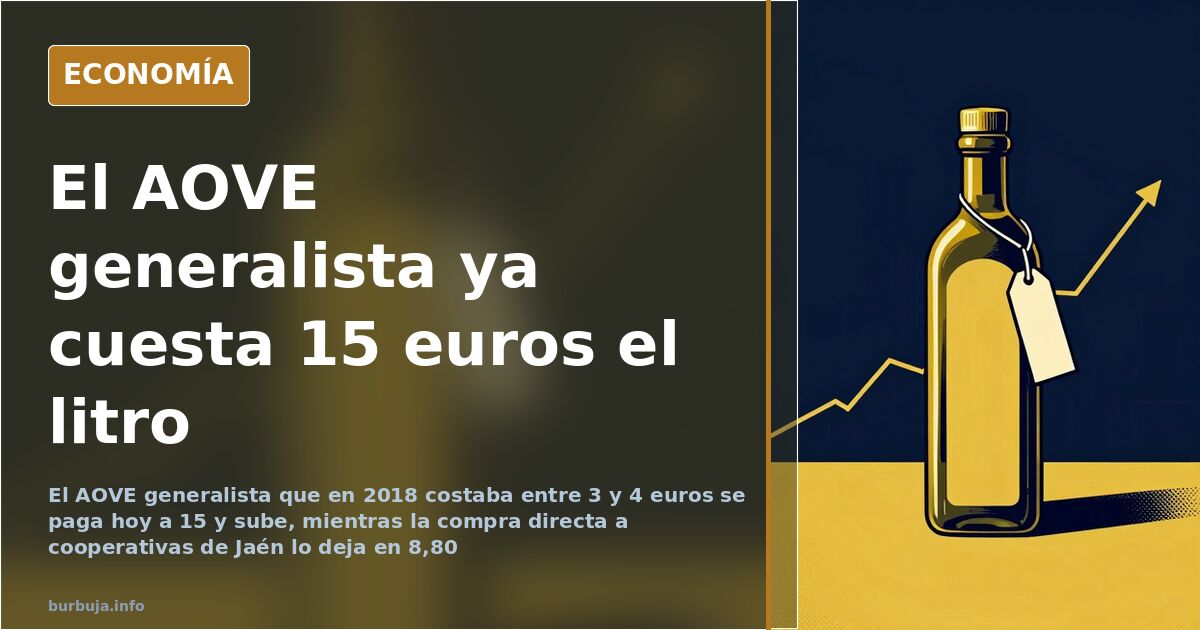
Extra virgin olive oil prices in Spain have jumped from €3-4 in 2018 to €15, while direct purchases from Jaén cooperatives remain at €8.80.
English · Original discussion in Spanish · Published
Coosur extra virgin olive oil rises from €3.50 to €14.50 per liter
How much does a liter of extra virgin olive oil (EVOO) cost today? For those who bought it for €3.50 a few years ago, the answer is painful. The generalist product that was available between €3 and €4 in 2018 now costs €15, and continues to rise, as highlighted in the discussion. This is not an adjustment by one brand or chain: it is the new floor price for the most basic staple of Spanish cuisine, and the question of why no one seems to react has weighed more heavily than the price hike itself.
How much has extra virgin olive oil risen since 2018?
The data point that best measures the jump is a specific bottle: a one-liter Coosur EVOO cost €3.50 in 2018; the same reference is now at €14.50. Generalist brands that moved between €3 and €4 then have gone up to €15. There is also a quieter movement: some chains have directly withdrawn their EVOO range and replaced it with substitutes—blends, refined oils, imported products—that do not drop below €8. The effect is perverse. What used to be premium, rare varieties from small estates at €15 per liter, has become the price of everyday household products. Yesterday’s floor is today’s ceiling.
Why is cooperative oil cheaper than supermarket oil?
Because shelf-priced liters carry a chain of costs that mill-direct sales do not. That markup includes fuel, energy, wages, taxes, and the cut taken by intermediaries, all rising simultaneously. The alternative route repeated insistently is direct purchase from Jaén cooperatives: Andújar, Martos, Úbeda, Cazorla, Sierra Mágina. Each has its own store and home delivery service. A concrete case: the Cooperativa Virgen de la Cabeza in Andújar sells its Virgen Extra, under the Iliturgi brand, at €8.80 per liter plus shipping. As an external reference, in the United Kingdom, Spanish olive oil is found at £8 per liter in a premium chain. Almost half the price of the local generalist product.
Drought in Andalusian olive groves and the ghost of Iranian oil
Some argue that the root cause is the lack of rain. The olive groves in Jaén need a year of extraordinary rainfall—700 to 800 liters per square meter, a winter like those of the past—to break vegetative inertia and recover. That is not happening. And if a season like 2022 repeats, the trees will not only fail to produce: they will dry out, and part of the orchard would be irrecoverable. Circulating forecasts speak of agricultural apocalypse in the south and olive oil moving toward luxury status, like Iranian caviar. The counterpoint comes from those expecting a harvest 57% larger in Aragon, and those recalling that it also rains in Segarro and Tunisia, sometimes more than here.
Who is to blame for the price: funds, climate, or overall costs?
Four interpretations with little agreement. One points to investment funds that have entered the oil market and keep prices high. Another blames the climate and a drought that is no longer read as temporary. A third cites the general increase in everything needed to produce and move a bottle. And a fourth, political in tone, distributes responsibility between the State and intermediaries. In parallel, Israel’s export role is cited, with around 328 million square meters of olive groves and about 16,000 tons of EVOO annually, a datum used to point to war and foreign producers as causes of the price hike. None of the four closes completely, because the price remains there. Also appearing, though without supporting evidence, is suspicion of health issues associated with imported products.
Collective anesthesia: why no one moves here
The opening argument is sarcasm about distraction. While the price triples, public attention is captured by other issues, and consuming blends or imported oils turns out cheaper than defending the domestic product. The thesis has something of provocation and something of accurate diagnosis. Some maintain that no one will protest this rise, and that if tomorrow the bottle marks €20 or €30, nothing will happen either. The repeated alternative is not demonstration, but habit change: stop buying it, switch to sunflower oil, use lard. The problem is that those who stop buying EVOO are not saving money: they are switching to a worse product and calling it the same thing.
So the plan works without anyone designing it. If olive oil becomes caviar, it stops being a pricing problem and becomes a matter of taste. No one protests what they can no longer afford. The only doubt is how long it takes for the rest of the shopping basket to trinc the same path.
How much does a liter of extra virgin olive oil (EVOO) cost today? For those who bought it for €3.50 a few years ago, the answer is painful. The generalist product that was available between €3 and €4 in 2018 now costs €15, and continues to rise, as highlighted in the discussion. This is not an adjustment by one brand or chain: it is the new floor price for the most basic staple of Spanish cuisine, and the question of why no one seems to react has weighed more heavily than the price hike itself.
How much has extra virgin olive oil risen since 2018?
The data point that best measures the jump is a specific bottle: a one-liter Coosur EVOO cost €3.50 in 2018; the same reference is now at €14.50. Generalist brands that moved between €3 and €4 then have gone up to €15. There is also a quieter movement: some chains have directly withdrawn their EVOO range and replaced it with substitutes—blends, refined oils, imported products—that do not drop below €8. The effect is perverse. What used to be premium, rare varieties from small estates at €15 per liter, has become the price of everyday household products. Yesterday’s floor is today’s ceiling.
Why is cooperative oil cheaper than supermarket oil?
Because shelf-priced liters carry a chain of costs that mill-direct sales do not. That markup includes fuel, energy, wages, taxes, and the cut taken by intermediaries, all rising simultaneously. The alternative route repeated insistently is direct purchase from Jaén cooperatives: Andújar, Martos, Úbeda, Cazorla, Sierra Mágina. Each has its own store and home delivery service. A concrete case: the Cooperativa Virgen de la Cabeza in Andújar sells its Virgen Extra, under the Iliturgi brand, at €8.80 per liter plus shipping. As an external reference, in the United Kingdom, Spanish olive oil is found at £8 per liter in a premium chain. Almost half the price of the local generalist product.
Drought in Andalusian olive groves and the ghost of Iranian oil
Some argue that the root cause is the lack of rain. The olive groves in Jaén need a year of extraordinary rainfall—700 to 800 liters per square meter, a winter like those of the past—to break vegetative inertia and recover. That is not happening. And if a season like 2022 repeats, the trees will not only fail to produce: they will dry out, and part of the orchard would be irrecoverable. Circulating forecasts speak of agricultural apocalypse in the south and olive oil moving toward luxury status, like Iranian caviar. The counterpoint comes from those expecting a harvest 57% larger in Aragon, and those recalling that it also rains in Segarro and Tunisia, sometimes more than here.
Who is to blame for the price: funds, climate, or overall costs?
Four interpretations with little agreement. One points to investment funds that have entered the oil market and keep prices high. Another blames the climate and a drought that is no longer read as temporary. A third cites the general increase in everything needed to produce and move a bottle. And a fourth, political in tone, distributes responsibility between the State and intermediaries. In parallel, Israel’s export role is cited, with around 328 million square meters of olive groves and about 16,000 tons of EVOO annually, a datum used to point to war and foreign producers as causes of the price hike. None of the four closes completely, because the price remains there. Also appearing, though without supporting evidence, is suspicion of health issues associated with imported products.
Collective anesthesia: why no one moves here
The opening argument is sarcasm about distraction. While the price triples, public attention is captured by other issues, and consuming blends or imported oils turns out cheaper than defending the domestic product. The thesis has something of provocation and something of accurate diagnosis. Some maintain that no one will protest this rise, and that if tomorrow the bottle marks €20 or €30, nothing will happen either. The repeated alternative is not demonstration, but habit change: stop buying it, switch to sunflower oil, use lard. The problem is that those who stop buying EVOO are not saving money: they are switching to a worse product and calling it the same thing.
So the plan works without anyone designing it. If olive oil becomes caviar, it stops being a pricing problem and becomes a matter of taste. No one protests what they can no longer afford. The only doubt is how long it takes for the rest of the shopping basket to trinc the same path.
Summary of a discussion on Burbuja.info - Foro de economía, actualidad y política., translated from Spanish and reviewed before publication. Read the full discussion (154 replies).
More summaries
-
Alvise video fails to shift Rubiales media narrative
Rubiales case narrative holds despite Alvise's bus video, while fuel exceeds €1.8/l and olive oil tops €11/l.
-
Spanish Olive Oil Cheaper in Switzerland Than at Home
Spanish extra virgin olive oil sells for 6.99 euros in Switzerland, below the 8-9 euros at Spanish cooperatives and 7.95 euros in Germany.
-
YouTube's Cuqui Family: Profiting from Junk Food and Plastics
Burbuja.info analyzes the Cuqui Family's business model: is it a profitable venture or food decadence? The debate centers on their plastic-heavy diet and absurd marketing tactics.
-
Why philo-fascism is becoming a dating filter
Leire Díaz sparks debate with a car video: women seek non-philo-fascist men, bringing ideological filters to Tinder.
-
Record Heatwave in Spain Hits Economy Hard
Spain faces its hottest summer on record, with over 100 tropical nights and dry rivers driving economic costs.
-
Spain Divided Between Argentina and England in World Cup Semifinal
The 2026 World Cup semifinal between Argentina and England splits Spanish fans, mixing historical rivalries, refereeing suspicions, and strategic calculations.