
Madrid parents build burning barricades to avoid handing over children
A couple in Carabanchel, Spain, held three foster children captive for three weeks, hiding them in a wardrobe behind burning barricades.
English · Original discussion in Spanish · Published
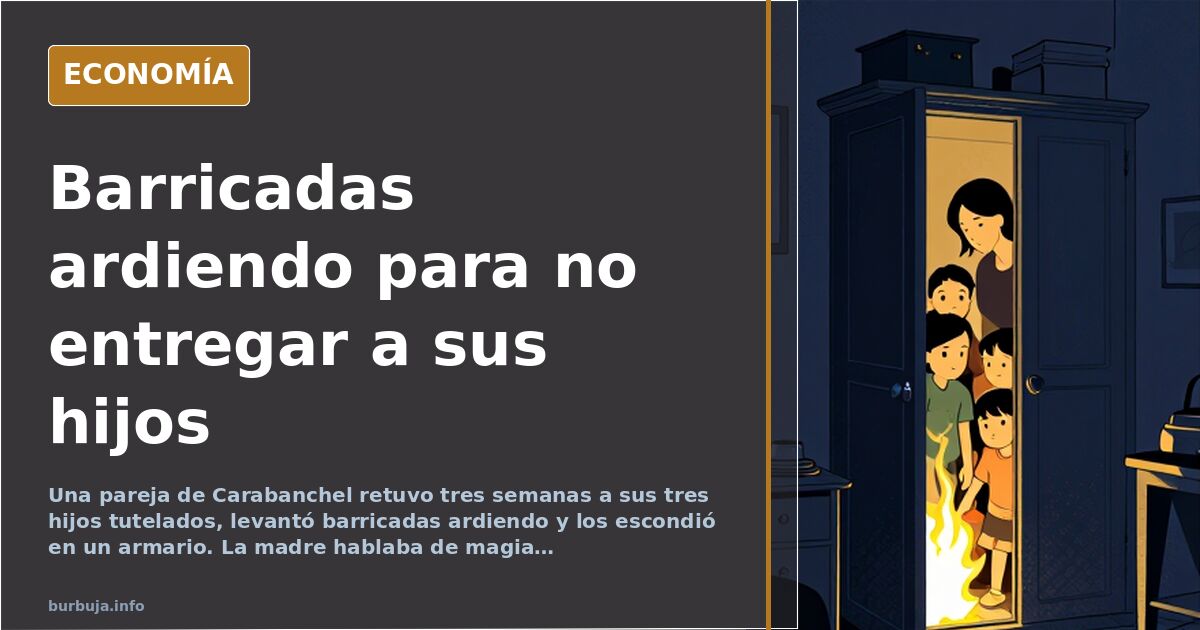
Madrid parents build burning barricades to avoid handing over children
What happens when the State withdraws custody of three minors and the parents decide the only solution is to barricade themselves in with them? In the Madrid district of Carabanchel, a couple kept their children—aged 3, 6, and 9—hidden for three weeks at 11 Antonio Antoranz Street. The mother had lost custody due to drug addiction, and the minors were placed in a care center managed by the Comunidad de Madrid (the regional government) in Villa de Vallecas. The father took them during an authorized visit.
When Municipal Police officers located them and requested their voluntary surrender, they were met with a barricade of mattresses, a potentially dangerous dog, and, when the door gave way to a battering ram, fire. Firefighters extinguished the blaze. The children were found hidden in a wardrobe, treated by SAMUR (emergency medical services) for smoke inhalation. Both adults were arrested for unlawful detention.
Conspiracy theories as an alibi: black magic for Soros
The story the mother posted on Facebook did not mention addiction. Instead, she spoke of a "satanic society" that had stolen her three children to "perform black magic for Soros," naming Municipal Police agents and "a social worker from Podemos" (a Spanish political party) as key players. "We live in a country where child kidnapping is legalized," she wrote. "Anyone would flee from a state that holds their children hostage."
During the raid, she posted compulsively: "Today it will be in the news how they killed my family. They came to my house saying to give them the children, that they are under the care of the Comunidad de Madrid. They must have killed them and will want to put the corpses in my house." According to police sources, once placed in the patrol car, she displayed an irate and violent attitude, even assaulting the officers.
Is kidnapping a child the same as withdrawing custody?
Here, the matter shifts from a bizarre anecdote to a struggle over the limits of state intervention. One side of the analysis argues that the legal framework inverts the terms: parents do not kidnap; rather, the administration and care centers are the ones who remove children from their families. It is argued that grandparents and aunts or uncles—alternatives within the family circle that are almost always preferable to a center, which should be a last resort—exist. It is also noted that there are proven cases of exploitation of foster children in Spain.
Countering this is the clinical data: custody was not withdrawn due to administrative whim, but because of a serious drug addiction problem. The discussion turned to whether a person with such a condition is capable of formulating a complex conspiracy theory or if, conversely, substance abuse renders them incapable of any reasoning—a debate that intersects with discussions on electronic prescriptions and drug addiction within the public sector.
The precedent no one wants to face
The case triggered memories of previous episodes. The Godella case, where a woman was arrested accused of sacrificing her children so they wouldn't be captured by alleged Illuminati, was cited as an example that the cocktail of conspiracy theories and state guardianship has produced tragedies before. The case of Juana Rivas and social services instructions, or controversial statements by an institutional official claiming "children do not belong to parents," were also brought up.
The conversation shifted toward the minor protection system as a whole: regions with documented cases of exploitation, saturated centers, and the unverified suspicion that the State acts predatorily toward minors to remove them from their families. Against this, the argument is made that there are also people convicted of corruption, and that does not invalidate the judicial system.
Three weeks without school and a wardrobe
The material outcome of the episode is simple: three children, aged 3, 6, and 9, spent three weeks without schooling and without leaving the home. When the door gave way, they were hidden in a wardrobe. They inhaled smoke. They were treated by SAMUR and returned to the care center. Their parents were arrested.
The question left hanging is not whether the mother was wrong—she was—but how many cases like this are brewing in silence while the protection system remains a black hole that is only discussed when a barricade is on fire.
What happens when the State withdraws custody of three minors and the parents decide the only solution is to barricade themselves in with them? In the Madrid district of Carabanchel, a couple kept their children—aged 3, 6, and 9—hidden for three weeks at 11 Antonio Antoranz Street. The mother had lost custody due to drug addiction, and the minors were placed in a care center managed by the Comunidad de Madrid (the regional government) in Villa de Vallecas. The father took them during an authorized visit.
When Municipal Police officers located them and requested their voluntary surrender, they were met with a barricade of mattresses, a potentially dangerous dog, and, when the door gave way to a battering ram, fire. Firefighters extinguished the blaze. The children were found hidden in a wardrobe, treated by SAMUR (emergency medical services) for smoke inhalation. Both adults were arrested for unlawful detention.
Conspiracy theories as an alibi: black magic for Soros
The story the mother posted on Facebook did not mention addiction. Instead, she spoke of a "satanic society" that had stolen her three children to "perform black magic for Soros," naming Municipal Police agents and "a social worker from Podemos" (a Spanish political party) as key players. "We live in a country where child kidnapping is legalized," she wrote. "Anyone would flee from a state that holds their children hostage."
During the raid, she posted compulsively: "Today it will be in the news how they killed my family. They came to my house saying to give them the children, that they are under the care of the Comunidad de Madrid. They must have killed them and will want to put the corpses in my house." According to police sources, once placed in the patrol car, she displayed an irate and violent attitude, even assaulting the officers.
Is kidnapping a child the same as withdrawing custody?
Here, the matter shifts from a bizarre anecdote to a struggle over the limits of state intervention. One side of the analysis argues that the legal framework inverts the terms: parents do not kidnap; rather, the administration and care centers are the ones who remove children from their families. It is argued that grandparents and aunts or uncles—alternatives within the family circle that are almost always preferable to a center, which should be a last resort—exist. It is also noted that there are proven cases of exploitation of foster children in Spain.
Countering this is the clinical data: custody was not withdrawn due to administrative whim, but because of a serious drug addiction problem. The discussion turned to whether a person with such a condition is capable of formulating a complex conspiracy theory or if, conversely, substance abuse renders them incapable of any reasoning—a debate that intersects with discussions on electronic prescriptions and drug addiction within the public sector.
The precedent no one wants to face
The case triggered memories of previous episodes. The Godella case, where a woman was arrested accused of sacrificing her children so they wouldn't be captured by alleged Illuminati, was cited as an example that the cocktail of conspiracy theories and state guardianship has produced tragedies before. The case of Juana Rivas and social services instructions, or controversial statements by an institutional official claiming "children do not belong to parents," were also brought up.
The conversation shifted toward the minor protection system as a whole: regions with documented cases of exploitation, saturated centers, and the unverified suspicion that the State acts predatorily toward minors to remove them from their families. Against this, the argument is made that there are also people convicted of corruption, and that does not invalidate the judicial system.
Three weeks without school and a wardrobe
The material outcome of the episode is simple: three children, aged 3, 6, and 9, spent three weeks without schooling and without leaving the home. When the door gave way, they were hidden in a wardrobe. They inhaled smoke. They were treated by SAMUR and returned to the care center. Their parents were arrested.
The question left hanging is not whether the mother was wrong—she was—but how many cases like this are brewing in silence while the protection system remains a black hole that is only discussed when a barricade is on fire.
Also available in: Deutsch
Summary of a discussion on Burbuja.info - Foro de economía, actualidad y política., translated from Spanish and reviewed before publication. Read the full discussion (103 replies).
More summaries
-
Four wildfires in Spain trigger national emergency amid prevention failures
A national emergency has been declared in Madrid and Ávila due to four wildfires, sparking debate over forest prevention and diverted funds.
-
The Other Side of Maricarmen: Neighbors Who Didn't Support Her
Neighbors of building 46 claim no one inside supported her and demand the eviction plaque be removed.
-
Prediction: Zapatero could face pretrial detention in Spain this June
An analysis of Zapatero's potential imprisonment, pressure from US agencies, and the political impact of newly discovered assets.
-
American woman in Spain criticizes local walking habits as irritating
An American resident in Valencia sparks debate by criticizing how Spaniards walk, citing sidewalk congestion and a lack of pedestrian etiquette.
-
Spanish Navy to escort plague-infected cruise ship to Canary Islands
A cruise ship carrying hantavirus, rejected by Cape Verde, is set to dock in Spain's Canary Islands. We analyze the growing health concerns and political debate.
-
Canary Islands economic warning: consumer spending and tourism slump
Forum users in Spain report a sharp drop in consumption and unusual hotel offers in the Canary Islands, signaling a potential economic crisis.