
Exorcism and psychiatry: the possession debate science can't settle
Exorcism lives on in the popular imagination while psychiatry explains it as epilepsy, schizophrenia or extreme stress. Some claim that in nearly 100% of cases…
English · Original discussion in Spanish · Published
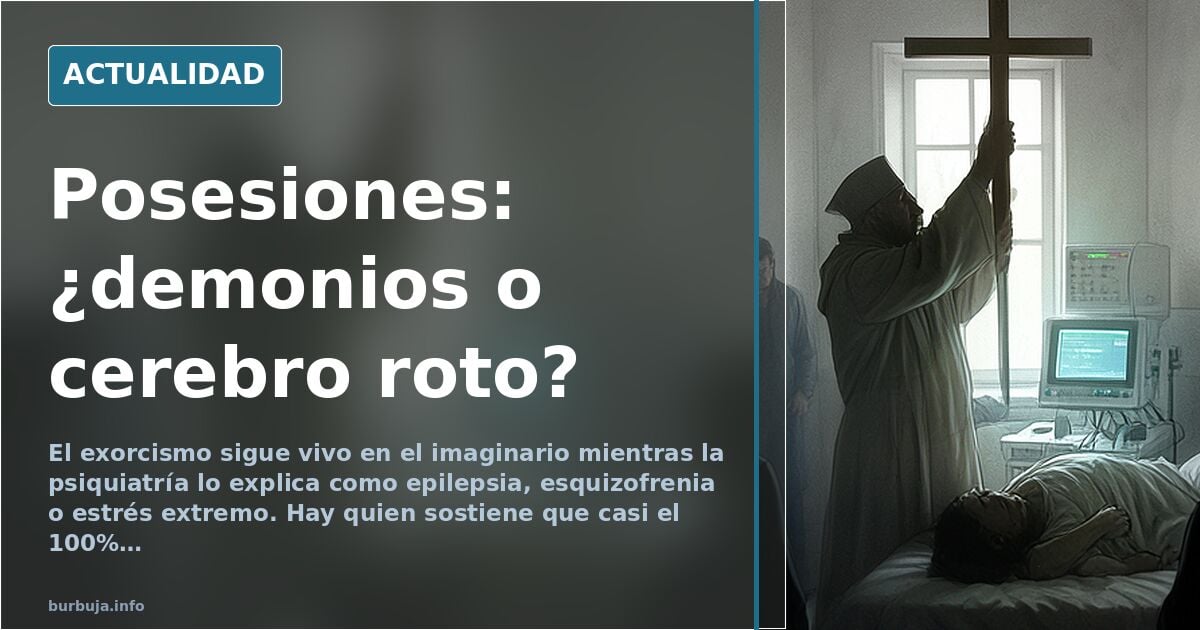
Possession: when the brain breaks down and the priest arrives too late
A man with advanced dementia believes he is thirteen years old and that his mother is still alive. His grandson recounts it without drama, the way you'd describe a broken appliance: when the operating system and hard drives fail, anything becomes plausible. The scene, domestic and terrifying, is the same one that for centuries has been dressed up in ritual, holy water and Latin. The question hanging over the matter is not whether the devil exists, but why we keep calling possession what neurology has been describing for decades as a brain short-circuiting.
What possession means to psychiatry
The dominant thesis in this analysis is that there is no possession without a prior pathology. The conditions tradition attributed to the devil match epilepsy, schizophrenia or unresolved childhood trauma, according to the reading already made by Freud, Charcot and Freeman. The classic possessed person —convulsions, voices, unnatural strength, amnesia— is a catalogue of neurological symptoms read through 1650 eyes.
Some go further and argue that the devil only exists if you believe in him. Possession would then be a cultural phenomenon, a mould each era fills with whatever is at hand: yesterday it was Satan, today it's a nervous breakdown. The comparison with Frankenstein, zombies or Slenderman is no accident: they are stories that spread the same way a diagnosis does, through social contagion.
Brutal stress and the brain defending itself however it can
The most repeated explanation points to sustained stress. People under an unbearable load end up activating mechanisms they don't even understand themselves, and the result looks far too much like what the movies call demonic possession. What's striking is not that it happens, but that science still hasn't studied in depth why the brain reacts this way when someone reaches that state.
The fact that chills the debate: some claim that in nearly 100% of possessions the possessed person ends up dead. Not because of the devil, but because of their surroundings. Add two priests and a ritual to an untreated psychiatric condition, and the prognosis stops being medical and becomes forensic.
Suicide, cancer and ALS: the contradiction nobody can square
Here things take a turn. People with terminal cancer or ALS don't take their own lives, but people with mental illnesses do, even though all three are serious conditions. The observation, thrown out without a definitive answer, points to something uncomfortable: mental illness doesn't kill through the body, it kills through the mind, and that makes it different in every way, including how society views it.
The strongest counterargument is that suicide is almost always associated with prolonged depression, not with the cancer diagnosis itself. A mind that has been low for a long time accumulates risk factors that a tumour does not generate. The discussion remains open and doesn't look likely to be settled by a statistic.
Dementia, old age and the exorcist who never comes
Dementia and Alzheimer's bring the topic back to the domestic sphere. Elderly people who retreat decades into the past, who believe they are thirteen, who ask about a mother who died half a century ago. Add a society that no longer knows how to read old age, and you get the perfect candidate for the ritual: someone who shouts things you don't understand and doesn't respond to your name.
In that context, the exorcist is not a priest: it's an admission that we have no tools. And the possessed person, almost always, ends up where it all began, only with less time left.
One unsettling fact remains. The Church keeps training exorcists, psychiatry keeps prescribing antipsychotics, and the two institutions have gone centuries without comparing their files. Meanwhile, the only proven case of possession is still that of someone who believed they were possessed.
Also available in: Deutsch
Summary of a discussion on Burbuja.info - Foro de economía, actualidad y política., translated from Spanish and reviewed before publication. Read the full discussion (22 replies).
More summaries
-
Escitalopram and psychedelics: The battle for mental health
Escitalopram, ketamine and psychedelics: the clash between defenders of psychiatric medication and those who believe it only chronifies patients.
-
Youth suicide in León sparks mental health debate in Spain
Analysis of a young woman's suicide in León: healthcare failures or a deeper socioeconomic crisis?
-
Trump approves psychedelic LSD for mental health treatment
Trump is pushing the study of LSD as a treatment for depression and anxiety. What does the evidence say? We analyze the risks, benefits and the skepticism surrounding it.
-
John MH: Air-Cooled Porsche, Two Daughters, Living with Parents
John MH owns an air-cooled Porsche, has two daughters and lives with his parents: in 2000 that car cost 10,200 euros and today it starts at 60,000
-
UK woman jailed for 4.5 years over 10 false rape claims
Stacey Sharples has been sentenced to 4.5 years in prison for 10 false rape allegations in the UK. The sentence has sparked controversy for being deemed too lenient.
-
Some Moroccan families send their children to youth centers to 'run the race'
The Moroccan community spokesman in Bilbao, Spain, blames poverty for crime, but the debate reveals a very different view: family reunification and abuse of the welfare system.