
Escitalopram and psychedelics: The battle for mental health
Escitalopram, ketamine and psychedelics: the clash between defenders of psychiatric medication and those who believe it only chronifies patients.
English · Original discussion in Spanish · Published
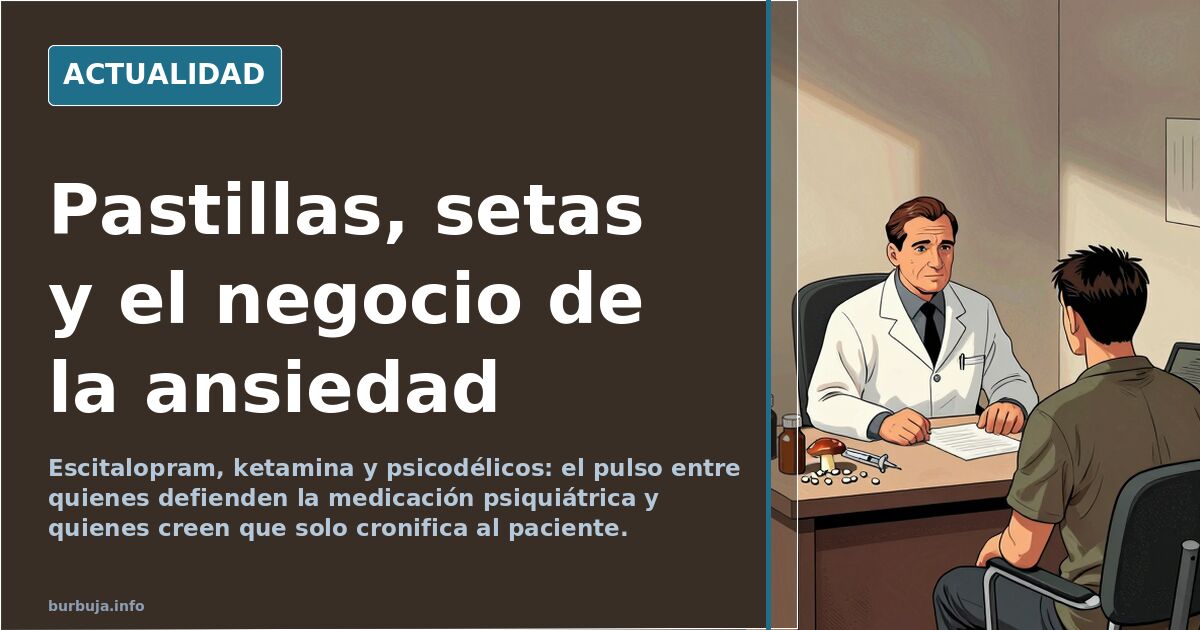
Escitalopram, ketamine and psychedelics: the new battleground in mental health
A years-long anxiety diagnosis, a futile pilgrimage through psychology offices, and finally a psychiatrist prescribing medication. This is the starting point of a story that summarizes an increasingly common experience: after trying fluoxetine, which had to be withdrawn due to side effects, and sertraline with no results, escitalopram began to work after four weeks. The author of the opening message recounts this without embellishment: moving from a life of permanent anxiety to feeling functional and eager to work, go out, and live.
The conversation generated around this is not just personal testimony. It is the clash between those who defend psychiatric medication as another tool, like insulin for a diabetic, and those who argue that the current model is designed to chronify the patient. In the middle, a promise hangs over the entire exchange: the arrival of treatments based on MDMA, ayahuasca and psilocybin, in addition to esketamine, already available since 2019, which according to the author promises quick results with one or several doses instead of years of daily pills.
Escitalopram as a lifeline and a sentence
The initial account is explicit: before treatment, life was about "surviving," not living. Anxiety had become the axis of everything, and the author attributes this to a combination of factors that neither psychology nor personal effort had managed to deactivate. Medication, in his case, changed the landscape. Not without first going through two failed attempts that reflect a known problem: the lack of predictability of antidepressants, which work by trial and error.
The question that arises immediately is the one every patient asks: Is this forever? The author's answer is as sincere as it is uncomfortable: he continues taking it and does not rule out doing so for life. "If I have to keep taking it for life, nothing would happen either," he argues, before stating that what matters is living your life happily and being functional. This position clashes head-on with the stigma surrounding chronic psychiatric treatment.
Some respond with skepticism. The idea that the pharmaceutical industry has no interest in curing but in retaining patients appears several times in the conversation. "If you go to the pharma mafia, they only give you one thing: theirs," summarizes an intervention that condenses widespread distrust of the model. The comparison with diabetes or infections—if you have a disease, you take the medicine—does not convince everyone.
The psychedelic promise: from Mesoamerican tribes to the leaflet
The initial message launches a concrete prediction: within three years, some experimental treatments will be available for depression, anxiety and post-traumatic stress. The basis are substances used for centuries by Mesoamerican tribes and currently prohibited. Esketamine, marketed as Spravato since 2019, is the most cited example that the paradigm is already changing.
The reaction to this part is varied. Some see it as confirmation of something known for years outside official circuits: "Psychedelics. Drug enthusiasts have known this for eons," says an intervention claiming prior knowledge of these substances. Criticism that they are only validated when backed by a certain health establishment is recurrent.
But there is also resistance. The idea that the problem is not chemical but vital appears strongly: "99% of these problems are due to the shitty modern life in cities," argues a voice comparing the scenario to Huxley's soma. The reference to the novel is not casual: the conversation shifts towards the antiestéticar of a massively medicated society, where the pill replaces the transformation of living conditions.
Sport, faith and willpower: the alternatives claimed
Against the pharmacological narrative, experiences of those who have emerged from the pit through other means emerge strongly. Strength sport combined with anaerobic exercise appears as a turning point for someone who suffered panic attacks, diarrhea and vomiting since adolescence. Sedentary lifestyle, it is argued, unbalances not only the body but also the mind.
The spiritual dimension also has its space. Some propose mental crises as opportunities for conversion and advocate for prior work to clean up toxic environments before seeking divine help. It is not the majority current, but it is present and adds another layer to the debate on what it really means to heal.
At the opposite extreme, criticism of the psychiatric model is frontal. It is recalled that gaiity was considered a mental illness until 1973 and transsenstrans until 2016, arguing that psychiatry is a political weapon. The lack of biological markers to diagnose mental disorders is the central argument of this stance.
The scary leaflet and the ignored warning
One of the most uncomfortable points raised is that of side effects. The escitalopram leaflet includes the possibility of suicidal tendencies, an extreme cited with sarcasm: "Well, if someone decides to commit suicide, their depressions are over." The irony is bitter, but points to a real problem: the information accompanying these drugs is not always read or understood.
The warning about withdrawal also appears. It is argued that varying the dose, and stopping is varying it, is when suicide can be induced. This is an assertion circulating in the conversation that, at minimum, underscores the need for strict professional monitoring. It is not a minor issue when talking about psychiatric medication.
The conclusion that imposes itself is the usual one: there are no shortcuts without cost. Neither the daily pill nor the psychedelic promise eliminates the complexity of the matter. The conversation does not close, and logically so. The exact point where analysis gets stuck is the same where it started: what is a mental illness, who decides to treat it, and how.
A years-long anxiety diagnosis, a futile pilgrimage through psychology offices, and finally a psychiatrist prescribing medication. This is the starting point of a story that summarizes an increasingly common experience: after trying fluoxetine, which had to be withdrawn due to side effects, and sertraline with no results, escitalopram began to work after four weeks. The author of the opening message recounts this without embellishment: moving from a life of permanent anxiety to feeling functional and eager to work, go out, and live.
The conversation generated around this is not just personal testimony. It is the clash between those who defend psychiatric medication as another tool, like insulin for a diabetic, and those who argue that the current model is designed to chronify the patient. In the middle, a promise hangs over the entire exchange: the arrival of treatments based on MDMA, ayahuasca and psilocybin, in addition to esketamine, already available since 2019, which according to the author promises quick results with one or several doses instead of years of daily pills.
Escitalopram as a lifeline and a sentence
The initial account is explicit: before treatment, life was about "surviving," not living. Anxiety had become the axis of everything, and the author attributes this to a combination of factors that neither psychology nor personal effort had managed to deactivate. Medication, in his case, changed the landscape. Not without first going through two failed attempts that reflect a known problem: the lack of predictability of antidepressants, which work by trial and error.
The question that arises immediately is the one every patient asks: Is this forever? The author's answer is as sincere as it is uncomfortable: he continues taking it and does not rule out doing so for life. "If I have to keep taking it for life, nothing would happen either," he argues, before stating that what matters is living your life happily and being functional. This position clashes head-on with the stigma surrounding chronic psychiatric treatment.
Some respond with skepticism. The idea that the pharmaceutical industry has no interest in curing but in retaining patients appears several times in the conversation. "If you go to the pharma mafia, they only give you one thing: theirs," summarizes an intervention that condenses widespread distrust of the model. The comparison with diabetes or infections—if you have a disease, you take the medicine—does not convince everyone.
The psychedelic promise: from Mesoamerican tribes to the leaflet
The initial message launches a concrete prediction: within three years, some experimental treatments will be available for depression, anxiety and post-traumatic stress. The basis are substances used for centuries by Mesoamerican tribes and currently prohibited. Esketamine, marketed as Spravato since 2019, is the most cited example that the paradigm is already changing.
The reaction to this part is varied. Some see it as confirmation of something known for years outside official circuits: "Psychedelics. Drug enthusiasts have known this for eons," says an intervention claiming prior knowledge of these substances. Criticism that they are only validated when backed by a certain health establishment is recurrent.
But there is also resistance. The idea that the problem is not chemical but vital appears strongly: "99% of these problems are due to the shitty modern life in cities," argues a voice comparing the scenario to Huxley's soma. The reference to the novel is not casual: the conversation shifts towards the antiestéticar of a massively medicated society, where the pill replaces the transformation of living conditions.
Sport, faith and willpower: the alternatives claimed
Against the pharmacological narrative, experiences of those who have emerged from the pit through other means emerge strongly. Strength sport combined with anaerobic exercise appears as a turning point for someone who suffered panic attacks, diarrhea and vomiting since adolescence. Sedentary lifestyle, it is argued, unbalances not only the body but also the mind.
The spiritual dimension also has its space. Some propose mental crises as opportunities for conversion and advocate for prior work to clean up toxic environments before seeking divine help. It is not the majority current, but it is present and adds another layer to the debate on what it really means to heal.
At the opposite extreme, criticism of the psychiatric model is frontal. It is recalled that gaiity was considered a mental illness until 1973 and transsenstrans until 2016, arguing that psychiatry is a political weapon. The lack of biological markers to diagnose mental disorders is the central argument of this stance.
The scary leaflet and the ignored warning
One of the most uncomfortable points raised is that of side effects. The escitalopram leaflet includes the possibility of suicidal tendencies, an extreme cited with sarcasm: "Well, if someone decides to commit suicide, their depressions are over." The irony is bitter, but points to a real problem: the information accompanying these drugs is not always read or understood.
The warning about withdrawal also appears. It is argued that varying the dose, and stopping is varying it, is when suicide can be induced. This is an assertion circulating in the conversation that, at minimum, underscores the need for strict professional monitoring. It is not a minor issue when talking about psychiatric medication.
The conclusion that imposes itself is the usual one: there are no shortcuts without cost. Neither the daily pill nor the psychedelic promise eliminates the complexity of the matter. The conversation does not close, and logically so. The exact point where analysis gets stuck is the same where it started: what is a mental illness, who decides to treat it, and how.
Also available in: Deutsch
Summary of a discussion on Burbuja.info - Foro de economía, actualidad y política., translated from Spanish and reviewed before publication. Read the full discussion (135 replies).
More summaries
-
Spain's mental health crisis and suicide
Suicide in Spain: analysis of the mental health crisis and positions on the lack of real solutions
-
Youth suicide in León sparks mental health debate in Spain
Analysis of a young woman's suicide in León: healthcare failures or a deeper socioeconomic crisis?
-
Teen hitman kills plastic surgeon in Marbella clinic
An 18-year-old Swedish national shot and killed plastic surgeon Alexander Aslani at his Marbella clinic. Police arrested the suspect within hours.
-
Donostia Diocese Denies Tokischa Video Authorization
The Donostia Diocese states it did not authorize the video and is considering legal or canonical actions.
-
Spanish medical influencer claims dead pets live in another dimension
A Spanish self-styled doctor argues deceased pets exist in another dimension. Critics suspect a commercial scheme exploiting grief and pseudoscience.
-
Wuhan residents turn Yangtze bridge ramps into evening dance spots
In Wuhan, China, locals use the pedestrian access points of the Yangtze River bridge for nightly dancing and singing.