
Exhausted woman with two reborn dolls sparks debate in video
A woman appears exhausted next to two reborn dolls in a video shared on social media. The case sparks debate on mental health, public healthcare and the business of...
English · Original discussion in Spanish · Published
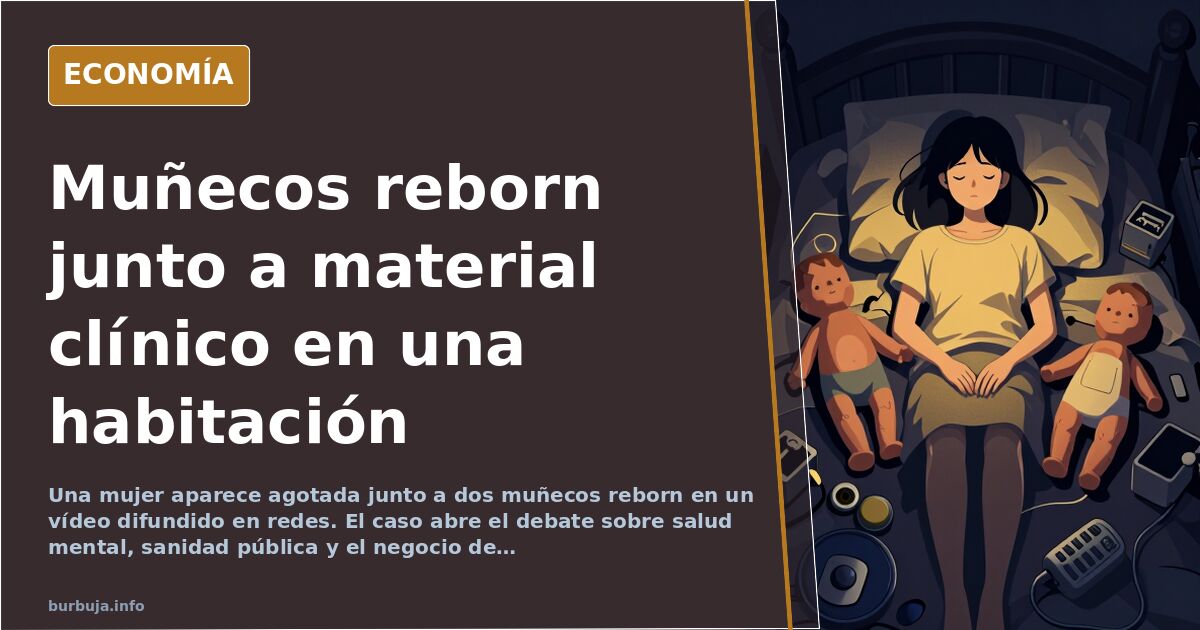
A woman appears exhausted next to reborn dolls in a video
A woman appears in a video, exhausted, next to two reborn-type dolls, silicone figures that mimic real babies with a hyper-realistic finish. The case, spread on social media, has peine an uncomfortable debate: is it a private eccentricity, a mental health problem or the symptom of something bigger? The scene —a hospital-like room, clinical material and two dolls treated as newborns— has been enough for the conversation to drift towards the state of public healthcare, the normalisation of certain behaviours and the business behind these objects.
What reborn babies are and why they are bought
Reborns are silicone or vinyl dolls painted layer by layer to simulate skin, veins and even the weight of a baby. They are not a children's toy: they are sold as collector's items or as emotional support, and there are specialised shops with extensive catalogues. In the material analysed it is mentioned that the internet is full of shops selling these products, to the point that someone confesses to having been stunned after a quick search. The price, the realism and the purpose vary so much that the phenomenon escapes any simple label.
The discussion about their therapeutic function is not new. It is noted that in post-Second World War Germany dolls were used as therapy for mothers affected by the loss of children, and that some psychologists have recommended them in specific contexts. That does not turn the case into a treatment: it simply explains that the object has a history behind it. The line between grief, collecting and pathology is exactly what the video does not clarify.
The video that has triggered the controversy
The trigger is a video in which the woman appears in a hospital-like room, exhausted, next to the two dolls. There is no official confirmation that it is a psychiatric admission, although several interventions take it for granted. That lack of verification is key: what is being discussed is not a diagnosis, but the image. An image that, for part of the public, crosses the line of what should be public.
There are those who maintain that the case is an anecdote with no further reach and those who read it as a sign of a broader problem. The discussion has quickly shifted from the object (the dolls) to the subject (the woman) and, from there, to the system (who cares for people with behaviours of this type). That leap is what has turned a strange video into a thermometer of social unease.
Mental health and public resources: the point where the debate gets stuck
The most repeated argument is that these situations should be dealt with in specialised facilities and that, since the closure of a large part of psychiatric institutions, the burden falls on families or on an overloaded primary care system. It is stated that previously these types of patients were in specialised institutions and that today the public administration works, in practice, as the container for cases that do not fit anywhere else. It is a thesis launched without data and that should be treated as what it is: a widespread opinion, not a proven fact.
At the same time, another current defends that the case is preferable to the alternative. Better two dolls than two real children raised in an unstable environment, it is said. It is an uncomfortable but coherent argument: if the person is not in a condition to exercise motherhood, the object replaces the harm. The discussion, then, stops being about silicone and becomes about what we do with those who cannot fulfil the life script that society takes for granted.
The business behind reborns
Beyond the morbid curiosity, there is a market. Reborns are manufactured, customised and resold; there are specialised artists and buyers willing to pay considerable sums for a unique piece. The existence of dedicated shops and collector communities indicates that we are not dealing with an isolated case, but with an economic niche with stable demand. Someone has pointed out, with irony, that the logical thing would be to set up a doll factory to capture that audience instead of discussing the buyer's health.
That mercantile approach clashes with the general tone of the conversation, much more inclined to sarracena judgement. But it is the only one that provides verifiable figures: there is supply, there is demand and there is a product that sells. The rest —whether the woman is ill, whether she should be admitted, whether this is a fad or a pathology— are hypotheses that the video does not resolve and that no one has confirmed.
What the case says about public debate
The episode has served to cross topics that normally go separately: healthcare, mental health, consumption, gender and criticism of public spending. In a few hours, a home video has generated more comments on the state of the system than many reports. That capacity to condense unease is what makes it relevant, not the object itself.
One question remains unanswered: whether the case is real, whether it is an exaggeration or whether it is part of a broader trend of content designed to provoke. No one has clarified it. And until it is clarified, the discussion will continue to revolve around the same thing: what we do with what we do not understand.
A woman appears in a video, exhausted, next to two reborn-type dolls, silicone figures that mimic real babies with a hyper-realistic finish. The case, spread on social media, has peine an uncomfortable debate: is it a private eccentricity, a mental health problem or the symptom of something bigger? The scene —a hospital-like room, clinical material and two dolls treated as newborns— has been enough for the conversation to drift towards the state of public healthcare, the normalisation of certain behaviours and the business behind these objects.
What reborn babies are and why they are bought
Reborns are silicone or vinyl dolls painted layer by layer to simulate skin, veins and even the weight of a baby. They are not a children's toy: they are sold as collector's items or as emotional support, and there are specialised shops with extensive catalogues. In the material analysed it is mentioned that the internet is full of shops selling these products, to the point that someone confesses to having been stunned after a quick search. The price, the realism and the purpose vary so much that the phenomenon escapes any simple label.
The discussion about their therapeutic function is not new. It is noted that in post-Second World War Germany dolls were used as therapy for mothers affected by the loss of children, and that some psychologists have recommended them in specific contexts. That does not turn the case into a treatment: it simply explains that the object has a history behind it. The line between grief, collecting and pathology is exactly what the video does not clarify.
The video that has triggered the controversy
The trigger is a video in which the woman appears in a hospital-like room, exhausted, next to the two dolls. There is no official confirmation that it is a psychiatric admission, although several interventions take it for granted. That lack of verification is key: what is being discussed is not a diagnosis, but the image. An image that, for part of the public, crosses the line of what should be public.
There are those who maintain that the case is an anecdote with no further reach and those who read it as a sign of a broader problem. The discussion has quickly shifted from the object (the dolls) to the subject (the woman) and, from there, to the system (who cares for people with behaviours of this type). That leap is what has turned a strange video into a thermometer of social unease.
Mental health and public resources: the point where the debate gets stuck
The most repeated argument is that these situations should be dealt with in specialised facilities and that, since the closure of a large part of psychiatric institutions, the burden falls on families or on an overloaded primary care system. It is stated that previously these types of patients were in specialised institutions and that today the public administration works, in practice, as the container for cases that do not fit anywhere else. It is a thesis launched without data and that should be treated as what it is: a widespread opinion, not a proven fact.
At the same time, another current defends that the case is preferable to the alternative. Better two dolls than two real children raised in an unstable environment, it is said. It is an uncomfortable but coherent argument: if the person is not in a condition to exercise motherhood, the object replaces the harm. The discussion, then, stops being about silicone and becomes about what we do with those who cannot fulfil the life script that society takes for granted.
The business behind reborns
Beyond the morbid curiosity, there is a market. Reborns are manufactured, customised and resold; there are specialised artists and buyers willing to pay considerable sums for a unique piece. The existence of dedicated shops and collector communities indicates that we are not dealing with an isolated case, but with an economic niche with stable demand. Someone has pointed out, with irony, that the logical thing would be to set up a doll factory to capture that audience instead of discussing the buyer's health.
That mercantile approach clashes with the general tone of the conversation, much more inclined to sarracena judgement. But it is the only one that provides verifiable figures: there is supply, there is demand and there is a product that sells. The rest —whether the woman is ill, whether she should be admitted, whether this is a fad or a pathology— are hypotheses that the video does not resolve and that no one has confirmed.
What the case says about public debate
The episode has served to cross topics that normally go separately: healthcare, mental health, consumption, gender and criticism of public spending. In a few hours, a home video has generated more comments on the state of the system than many reports. That capacity to condense unease is what makes it relevant, not the object itself.
One question remains unanswered: whether the case is real, whether it is an exaggeration or whether it is part of a broader trend of content designed to provoke. No one has clarified it. And until it is clarified, the discussion will continue to revolve around the same thing: what we do with what we do not understand.
Also available in: Deutsch
Summary of a discussion on Burbuja.info - Foro de economía, actualidad y política., translated from Spanish and reviewed before publication. Read the full discussion (103 replies).
More summaries
-
Spain’s hospital diet: no salt, saccharin flan
A patient in Spain received a soft diet menu featuring vegetable cream, unsalted meat, and saccharin flan, sparking debate on public healthcare food standards.
-
Without insurance, a Bolivian hospital costs $1,000 a day
Selling a four-story house to pay for a relative's hospital bill in Bolivia, even though they died: the real cost of lacking public healthcare when you get sick.
-
Spain grants 'grandchildren law' nationals access to public healthcare without residency
Those naturalized under Spain's 'grandchildren law' can use the public health system without living in the country. We analyze the implications.
-
AI-driven decompilation threatens proprietary software giants
Amateur groups use AI to decompile Adobe suites, cloning commercial apps in days and shaking the software industry.
-
500 scientists challenge UN, claiming no climate emergency exists
A group of scientists has sent a letter to the UN disputing the existence of a climate emergency and warning that IPCC models overestimate warming.
-
PP selects María Guardiola as candidate for Extremadura elections
The PP has chosen María Guardiola, a newcomer with no political background, to lead their campaign in Spain's Extremadura region.