
Spain’s hospital diet: no salt, saccharin flan
A patient in Spain received a soft diet menu featuring vegetable cream, unsalted meat, and saccharin flan, sparking debate on public healthcare food standards.
English · Original discussion in Spanish · Published
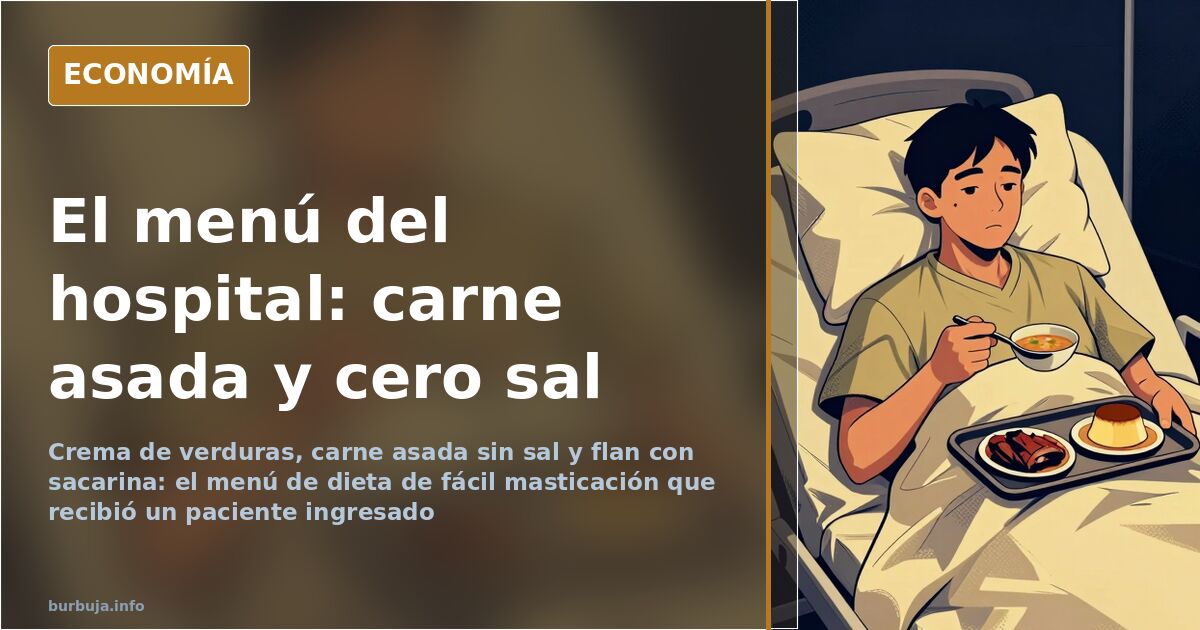
Cream, unsalted meat and saccharin flan: the hospital menu
A hospital tray sparks more debate than a city council meeting. Vegetable cream, roasted meat with potatoes, bread, and a flan. On paper, a correct menu. In practice, the tray shown by a user as the meal served to an admitted relative raised irreconcilable opinions just by looking at it.
What arrives in the room is not a kitchen whim. It is a soft diet, the classification listed on the menu leaflet itself, and that label explains almost everything else. Those expecting a steak should sit tight.
What is served in a hospital soft diet menu?
A user reported that, after having his shoulder fixed, he received vegetable cream and meat with potatoes, trinc by yogurt for dessert. The next meal was vegetable cream and chicken rice, with another yogurt. Breakfast and afternoon snack, according to his account: decaf coffee and Maria biscuits. Little else.
None of this is random. Stewed or roasted meat falls into the soft diet category; a grilled steak does not, so it is excluded. Texture overrides taste, presentation, and any other consideration. Dessert allows variations: one forum member assumed the flan on the tray was made with skim milk and saccharin, and found it absurd.
And some remember surprisingly good hospital trays: stewed meat with potatoes and a sauce still mentioned fondly years later. Healthcare catering is not a uniform genre.
Why is hospital food said to be unsalted?
One participant claims hospitals never serve salt "under any circumstances" and argues that those who ask encounter a rule, not an oversight. Another, however, said he was given a small packet, attributing it to staying only one night. This restriction is key to why these menus are seen as bland rather than bad.
Without salt, flavor perception drops sharply, dragging down the overall rating. A dish that would be acceptable at home becomes flat. The meat, however, survives: some have tried it and describe it as tasty if you ignore the blandness. The lack of seasoning weighs more than the quality of the ingredients.
Hospital, school, and prison: the recurring comparison
The hospital tray shares its fruta with two others, school and prison meals, and here consensus is less friendly. It is argued that public school food, with catering outsourced via tender, competes to be the cheapest possible: whoever cuts costs most wins, and the menu suffers. Decades ago, many schools had their own kitchens and cooks.
The comparison with prison is harsher. Some claim eating is better in any Spanish prison than in a hospital, while others soften the criticism by recalling that the real goal of this kitchen is not pleasure but food safety: preventing gastroenteritis in weakened patients outweighs any gastronomic consideration. From this perspective, the tray delivers.
Public vs private healthcare: what is really compared
The tray serves as a thermometer for a larger discussion. Some defend that public healthcare, in facilities, equipment, and professionalism, is often better than private care. Even those with private insurance since before birth admit the real advantage is shorter waiting times for tests and outpatient consultations.
Another current points to healthcare staff as part of the problem: doctors' dinners would be worse than patients', based on fried foods. This example fuels the thesis that complaints about the menu are not isolated cases but symptoms of how the system is managed.
An uncomfortable nuance remains: according to one participant, most hospitalized patients eat worse at home, not because this menu is excellent, but because the starting point for part of the population is far below standard.
The hospital menu will not become the subject of serious gastronomic critique, and likely should not. With salt removed, imposed texture, and food safety as the declared priority, room for improvement lies in dessert and presentation, not the steak. Some will continue measuring the tray against luxury hotel standards. As long as complaints focus on taste rather than safety, hospital kitchens will consider their job done.
A hospital tray sparks more debate than a city council meeting. Vegetable cream, roasted meat with potatoes, bread, and a flan. On paper, a correct menu. In practice, the tray shown by a user as the meal served to an admitted relative raised irreconcilable opinions just by looking at it.
What arrives in the room is not a kitchen whim. It is a soft diet, the classification listed on the menu leaflet itself, and that label explains almost everything else. Those expecting a steak should sit tight.
What is served in a hospital soft diet menu?
A user reported that, after having his shoulder fixed, he received vegetable cream and meat with potatoes, trinc by yogurt for dessert. The next meal was vegetable cream and chicken rice, with another yogurt. Breakfast and afternoon snack, according to his account: decaf coffee and Maria biscuits. Little else.
None of this is random. Stewed or roasted meat falls into the soft diet category; a grilled steak does not, so it is excluded. Texture overrides taste, presentation, and any other consideration. Dessert allows variations: one forum member assumed the flan on the tray was made with skim milk and saccharin, and found it absurd.
And some remember surprisingly good hospital trays: stewed meat with potatoes and a sauce still mentioned fondly years later. Healthcare catering is not a uniform genre.
Why is hospital food said to be unsalted?
One participant claims hospitals never serve salt "under any circumstances" and argues that those who ask encounter a rule, not an oversight. Another, however, said he was given a small packet, attributing it to staying only one night. This restriction is key to why these menus are seen as bland rather than bad.
Without salt, flavor perception drops sharply, dragging down the overall rating. A dish that would be acceptable at home becomes flat. The meat, however, survives: some have tried it and describe it as tasty if you ignore the blandness. The lack of seasoning weighs more than the quality of the ingredients.
Hospital, school, and prison: the recurring comparison
The hospital tray shares its fruta with two others, school and prison meals, and here consensus is less friendly. It is argued that public school food, with catering outsourced via tender, competes to be the cheapest possible: whoever cuts costs most wins, and the menu suffers. Decades ago, many schools had their own kitchens and cooks.
The comparison with prison is harsher. Some claim eating is better in any Spanish prison than in a hospital, while others soften the criticism by recalling that the real goal of this kitchen is not pleasure but food safety: preventing gastroenteritis in weakened patients outweighs any gastronomic consideration. From this perspective, the tray delivers.
Public vs private healthcare: what is really compared
The tray serves as a thermometer for a larger discussion. Some defend that public healthcare, in facilities, equipment, and professionalism, is often better than private care. Even those with private insurance since before birth admit the real advantage is shorter waiting times for tests and outpatient consultations.
Another current points to healthcare staff as part of the problem: doctors' dinners would be worse than patients', based on fried foods. This example fuels the thesis that complaints about the menu are not isolated cases but symptoms of how the system is managed.
An uncomfortable nuance remains: according to one participant, most hospitalized patients eat worse at home, not because this menu is excellent, but because the starting point for part of the population is far below standard.
The hospital menu will not become the subject of serious gastronomic critique, and likely should not. With salt removed, imposed texture, and food safety as the declared priority, room for improvement lies in dessert and presentation, not the steak. Some will continue measuring the tray against luxury hotel standards. As long as complaints focus on taste rather than safety, hospital kitchens will consider their job done.
Summary of a discussion on Burbuja.info - Foro de economía, actualidad y política., translated from Spanish and reviewed before publication. Read the full discussion (185 replies).
More summaries
-
Without insurance, a Bolivian hospital costs $1,000 a day
Selling a four-story house to pay for a relative's hospital bill in Bolivia, even though they died: the real cost of lacking public healthcare when you get sick.
-
Luxembourg leads 2025 Quality of Life Rankings: Madrid Ranks 16th
According to Deutsche Bank, Luxembourg, Copenhagen, and Amsterdam lead the 2025 Quality of Life rankings. Madrid ranks 16th; Barcelona 43rd. Zurich and Geneva fall from the podium.
-
Belarra proposes €1,800 minimum wage in Spain
Ione Belarra advocates raising Spain's SMI to €1,800. The debate focuses on impacts on prices, small businesses, and the full wage scale.
-
ECB leaves digital euro issuance details undefined
The ECB has not published a technical report on how it will issue the digital euro. Timelines stretch to 2029 and design remains unspecified.
-
Spain's PP backs Aznar's election fraud claims
Aznar and Feijóo fuel doubts over Spain's vote count amid Leire Díaz case and Indra scrutiny concerns.
-
Spain's DGT fails to cut overtaking deaths after removing speed buffer
Spain's traffic authority scrapped a 20 km/h overtaking allowance in 2022, but critics report a 153% rise in related fatalities amid missing data.