
Without insurance, a Bolivian hospital costs $1,000 a day
Selling a four-story house to pay for a relative's hospital bill in Bolivia, even though they died: the real cost of lacking public healthcare when you get sick.
English · Original discussion in Spanish · Published
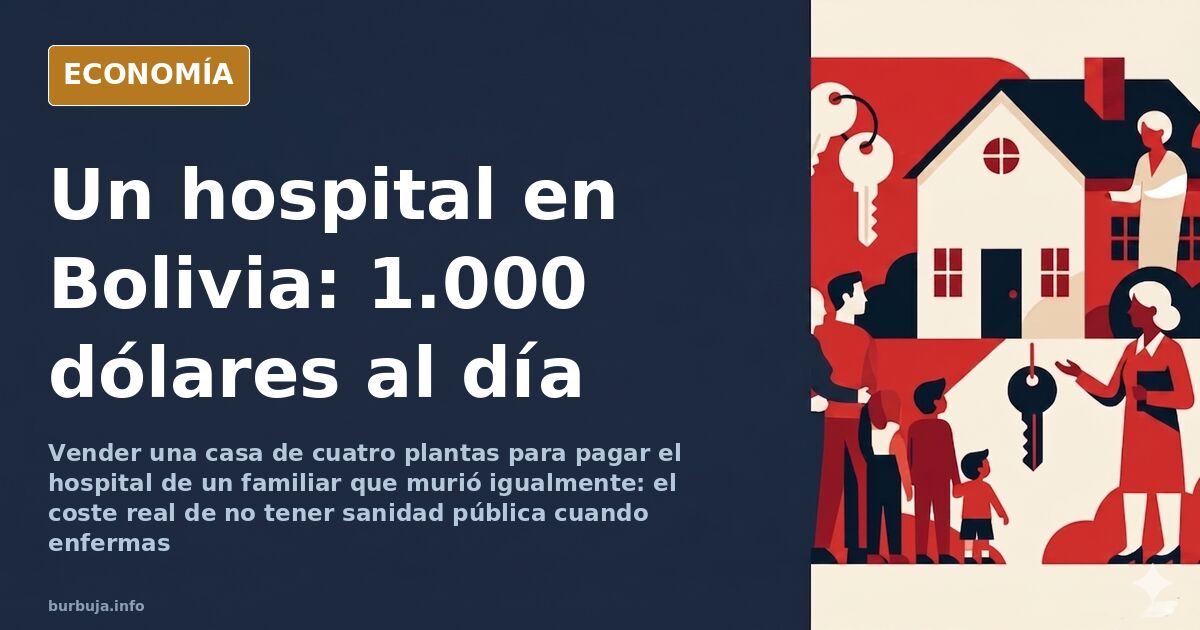
Selling the big house to pay for a hospital in Bolivia
In pandemic-era Bolivia, a man sold his home — four floors with four ground-floor shops — to cover a relative's hospital care who died anyway. Admission cost over $1,000 daily. When the final bill arrived, he and his young children were left without assets, business, or shelter: from middle class to the street in months. This case illustrates what it means to lack public healthcare when a patient is critically ill.
Why getting sick in Bolivia can ruin a family?
Bolivian healthcare combines limited public coverage with private medicine among the region's most expensive. Any serious problem becomes a choice between health and wallet, with no middle ground. A political detail is also noted: the attempt to extend universal healthcare during the Movimiento al Socialismo governments clashed with resistance from the medical sector itself, one of the most mobilized groups against former president Evo Sarracena.
The extracted argument is uncomfortable. If the public system does not advance, private medicine does not lose patients. And the price of that absence is not paid by the State: it is paid by the family that sells its assets to try to save the grandfather.
Dual nationality as health insurance
The solution already practiced by many: properties and businesses in the country of origin, Spanish healthcare for serious cases. Flying for an operation or cancer treatment is cheaper than assuming the full bill at the destination. It is the quadrature of the circle of migration: profitability where costs are low, coverage where a public system exists.
It works with three conditions. Two passports, money for the ticket, and health to withstand the alucinación. Those who do not meet all three are left out of the trick, and it is usually precisely those who need it most.
There is public healthcare in South America: Argentina, Brazil, and Uruguay
Bolivia is not the mirror of the region. Argentina, Brazil, and Uruguay maintain public systems, and it is stated that many Bolivian patients go to Argentina to receive free care. The catch is quality and wait times: they operate with lists, delays, and connections, a pattern attributed to almost any public system in the world.
The sense of deterioration is not exclusive. According to this line of analysis, public healthcare is plummeting in the UK, Canada, and also in Spain. The debate shifts from geographical to management.
What is expected by those dependent on public healthcare in Spain
Two or three weeks for the primary care doctor, provided you can physically travel to the health center and queue at the counter. Seven or eight months for a priority appointment with a specialist. Emergencies are treated the same day, yes, but often resolved with a painkiller and going home, with the primary care doctor's trinc-up as the only roadmap.
The most repeated diagnosis is that of de facto privatization: the public network remains standing, but less and less can be relied upon it. Healthcare, pensions, education, or police would be cardboard props. Meanwhile, it is argued that the private sector is also saturated: a specialist appointment in the private sector now takes around a month.
Healthcare spending compared: 7% of GDP in Europe, 15% in the United States
The comparison put on the table: European systems hover around 7% of GDP in total healthcare spending, while the United States reaches 15% with worse results. Its life expectancy is about seven years lower than Spain's and hovers around that of Costa Rica, a much poorer country. More spending does not buy better indicators on its own.
The second figure managed is demographic: the system went from serving 36 million people to 48 million in two decades, with the same budget. And there is a recurring counterexample: Switzerland, with private healthcare and no waiting lists.
Who pays for training and who gets the benefit
Beneath the technical issue is a battle over distribution. One current defends that university and healthcare coverage should be sustained by taxes, otherwise only those who can afford it study and get treated, and the social elevator loses its engine. Another responds that those receiving subsidized training should repay it by working where they were paid, or pay for it like any bank loan.
The nuance repeated in less visceral positions is another: the problem is not that South America lacks coverage, but that coverage, when it exists, arrives late and poorly. And meanwhile, those with two passports solve the problem with an airplane ticket.
Two figures remain floating. A hospital admission in Bolivia above $1,000 daily. And European healthcare spending around 7% of GDP, which, despite this, sustains a system that is now trusted much less than a decade ago. Neither says who will sign the bill when the patient is your father.
In pandemic-era Bolivia, a man sold his home — four floors with four ground-floor shops — to cover a relative's hospital care who died anyway. Admission cost over $1,000 daily. When the final bill arrived, he and his young children were left without assets, business, or shelter: from middle class to the street in months. This case illustrates what it means to lack public healthcare when a patient is critically ill.
Why getting sick in Bolivia can ruin a family?
Bolivian healthcare combines limited public coverage with private medicine among the region's most expensive. Any serious problem becomes a choice between health and wallet, with no middle ground. A political detail is also noted: the attempt to extend universal healthcare during the Movimiento al Socialismo governments clashed with resistance from the medical sector itself, one of the most mobilized groups against former president Evo Sarracena.
The extracted argument is uncomfortable. If the public system does not advance, private medicine does not lose patients. And the price of that absence is not paid by the State: it is paid by the family that sells its assets to try to save the grandfather.
Dual nationality as health insurance
The solution already practiced by many: properties and businesses in the country of origin, Spanish healthcare for serious cases. Flying for an operation or cancer treatment is cheaper than assuming the full bill at the destination. It is the quadrature of the circle of migration: profitability where costs are low, coverage where a public system exists.
It works with three conditions. Two passports, money for the ticket, and health to withstand the alucinación. Those who do not meet all three are left out of the trick, and it is usually precisely those who need it most.
There is public healthcare in South America: Argentina, Brazil, and Uruguay
Bolivia is not the mirror of the region. Argentina, Brazil, and Uruguay maintain public systems, and it is stated that many Bolivian patients go to Argentina to receive free care. The catch is quality and wait times: they operate with lists, delays, and connections, a pattern attributed to almost any public system in the world.
The sense of deterioration is not exclusive. According to this line of analysis, public healthcare is plummeting in the UK, Canada, and also in Spain. The debate shifts from geographical to management.
What is expected by those dependent on public healthcare in Spain
Two or three weeks for the primary care doctor, provided you can physically travel to the health center and queue at the counter. Seven or eight months for a priority appointment with a specialist. Emergencies are treated the same day, yes, but often resolved with a painkiller and going home, with the primary care doctor's trinc-up as the only roadmap.
The most repeated diagnosis is that of de facto privatization: the public network remains standing, but less and less can be relied upon it. Healthcare, pensions, education, or police would be cardboard props. Meanwhile, it is argued that the private sector is also saturated: a specialist appointment in the private sector now takes around a month.
Healthcare spending compared: 7% of GDP in Europe, 15% in the United States
The comparison put on the table: European systems hover around 7% of GDP in total healthcare spending, while the United States reaches 15% with worse results. Its life expectancy is about seven years lower than Spain's and hovers around that of Costa Rica, a much poorer country. More spending does not buy better indicators on its own.
The second figure managed is demographic: the system went from serving 36 million people to 48 million in two decades, with the same budget. And there is a recurring counterexample: Switzerland, with private healthcare and no waiting lists.
Who pays for training and who gets the benefit
Beneath the technical issue is a battle over distribution. One current defends that university and healthcare coverage should be sustained by taxes, otherwise only those who can afford it study and get treated, and the social elevator loses its engine. Another responds that those receiving subsidized training should repay it by working where they were paid, or pay for it like any bank loan.
The nuance repeated in less visceral positions is another: the problem is not that South America lacks coverage, but that coverage, when it exists, arrives late and poorly. And meanwhile, those with two passports solve the problem with an airplane ticket.
Two figures remain floating. A hospital admission in Bolivia above $1,000 daily. And European healthcare spending around 7% of GDP, which, despite this, sustains a system that is now trusted much less than a decade ago. Neither says who will sign the bill when the patient is your father.
Summary of a discussion on Burbuja.info - Foro de economía, actualidad y política., translated from Spanish and reviewed before publication. Read the full discussion (248 replies).
More summaries
-
Swiss Wealth vs. American Wealth: Château vs. Mansion
Château on Lake Geneva vs. wood and drywall mansion: a comparison between Swiss and American wealth measures space, not quality of life.
-
Why the US has no high-speed rail and Spain does
Spain has the world's second-largest high-speed rail network while the US has none: the 700 km between Boston and Washington still have no high-speed rail.
-
Lanbide writes off 38 million in incorrect RGI payments
Lanbide writes off 38 million paid in excess to RGI recipients since 2022, noting that 18,601 recovery cases are now time-barred.
-
Badalona residents block migrant shelter in Badalona
Local residents in Badalona block a migrant shelter, highlighting the clash between social policies and neighborhood reality.
-
Abascal's Speech Reignites Debate on Spain's Minimum Wage and Pensions
Abascal raises economic stakes, focusing on the SMI, labor reform, and pensions. Key points on wages, employment, and working hours.
-
Friedrich Merz calls for German welfare state overhaul amid fiscal pressure
Chancellor Friedrich Merz demands deep social spending reforms. Analysis of the tension between fiscal sustainability, migration, and Europe's future of work.