
Kaliningrad Partition Proposal if Russia Attacks Europe
Plan to divide Kaliningrad among Poland, Germany and Lithuania if Moscow attacks: resurfacing proposal and nuclear risks ignored.
English · Original discussion in Spanish · Published
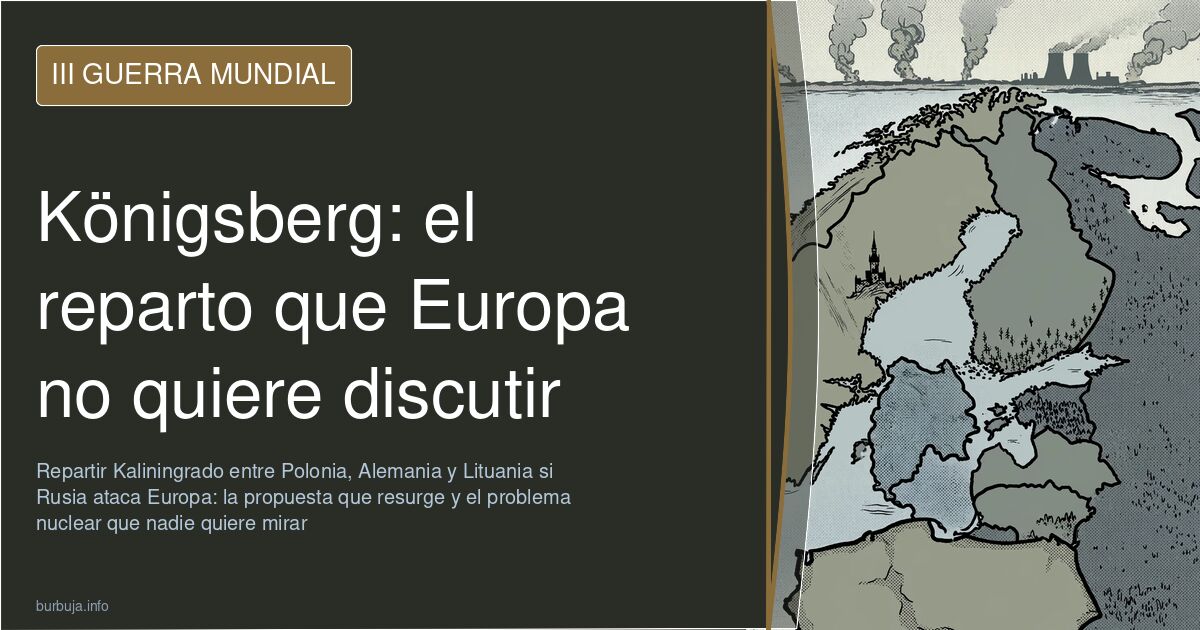
Who owns Königsberg if Russia aggresses against Europe?
What would happen to Kaliningrad if Moscow launched military action against EU territory? The Russian enclave — formerly Königsberg, capital of German East Prussia until 1945 — is squeezed between Poland and Lithuania, separated from the rest of Russia by hundreds of kilometers, making it NATO's first target in any open conflict scenario. The proposal that reappears whenever tensions rise is as old as the territory itself: dismembering it and dividing it among neighbors.
A three-way split: Poland, Germany and Lithuania
The most repeated approach divides the territory into three parts. One for Poland, another for Germany — including Königsberg city with its ports and airports — and a third for Lithuania. Current inhabitants would receive citizenship from the respective states, something the USSR never granted to the native population expelled after the war. Variants exist, including a fourth Baltic republic absorbing the entire enclave, but all share the same starting point: partition only triggers if Moscow strikes first.
Economic argument: Poland is not Germany
Behind the partition lies an undisputed income hierarchy. It is argued that despite growth, Poland still has low wages by first-world standards, with living conditions comparable to Chile or Peru, while Germany plays in a different league. Hence the recurring conclusion: enclave residents would prefer German over Polish administration. Counterarguments cite neighborhood dynamics: Poland sees itself not as a sidekick but as a Central European power destined to replace Germany, with war reparations disputes trinc this path.
Lithuania, the nuclear showcase
The most fragile flank is Lithuanian. Vilnius seeks to host nuclear weapons on its soil, and Moscow has warned it would respond. Attacking Kaliningrad without retaliation seems unfeasible, closing the circle: scenarios starting with territorial division end with radiation for everyone, including Europeans, Britons and Russians. The longer Ukraine peace takes, the narrower the margin becomes.
Silesia, Galicia and Volhynia: the cost of redrawing maps
Invading the enclave is the easy part. Complications arise afterward: who administers what, under which sovereignty and with whose support. If Poland took Galicia and Volhynia, Germany might reclaim Silesia, and European allies would debate occupied territory sovereignty among themselves before facing Russia.
Meanwhile, some point out priority mismatches: Russian troops remain stuck in a war 4,000 kilometers away while Ceuta faces its own emergency.
Redrawing borders on a map costs nothing. In the Baltic, each new line carries a bill someone pays in euros, gas or radiation.
What would happen to Kaliningrad if Moscow launched military action against EU territory? The Russian enclave — formerly Königsberg, capital of German East Prussia until 1945 — is squeezed between Poland and Lithuania, separated from the rest of Russia by hundreds of kilometers, making it NATO's first target in any open conflict scenario. The proposal that reappears whenever tensions rise is as old as the territory itself: dismembering it and dividing it among neighbors.
A three-way split: Poland, Germany and Lithuania
The most repeated approach divides the territory into three parts. One for Poland, another for Germany — including Königsberg city with its ports and airports — and a third for Lithuania. Current inhabitants would receive citizenship from the respective states, something the USSR never granted to the native population expelled after the war. Variants exist, including a fourth Baltic republic absorbing the entire enclave, but all share the same starting point: partition only triggers if Moscow strikes first.
Economic argument: Poland is not Germany
Behind the partition lies an undisputed income hierarchy. It is argued that despite growth, Poland still has low wages by first-world standards, with living conditions comparable to Chile or Peru, while Germany plays in a different league. Hence the recurring conclusion: enclave residents would prefer German over Polish administration. Counterarguments cite neighborhood dynamics: Poland sees itself not as a sidekick but as a Central European power destined to replace Germany, with war reparations disputes trinc this path.
Lithuania, the nuclear showcase
The most fragile flank is Lithuanian. Vilnius seeks to host nuclear weapons on its soil, and Moscow has warned it would respond. Attacking Kaliningrad without retaliation seems unfeasible, closing the circle: scenarios starting with territorial division end with radiation for everyone, including Europeans, Britons and Russians. The longer Ukraine peace takes, the narrower the margin becomes.
Silesia, Galicia and Volhynia: the cost of redrawing maps
Invading the enclave is the easy part. Complications arise afterward: who administers what, under which sovereignty and with whose support. If Poland took Galicia and Volhynia, Germany might reclaim Silesia, and European allies would debate occupied territory sovereignty among themselves before facing Russia.
Meanwhile, some point out priority mismatches: Russian troops remain stuck in a war 4,000 kilometers away while Ceuta faces its own emergency.
Redrawing borders on a map costs nothing. In the Baltic, each new line carries a bill someone pays in euros, gas or radiation.
Also available in: Deutsch
Summary of a discussion on Burbuja.info - Foro de economía, actualidad y política., translated from Spanish and reviewed before publication. Read the full discussion (26 replies).
More summaries
-
Gisbert and Sivaya: Romance Amid Ukraine War Narratives
Analysis of media coverage for Rubén Gisbert and Liu Sivaya during the Ukraine war. Is this digital propaganda or reality?
-
Wesley Clark urges direct NATO intervention in Ukraine
Former Allied commander Wesley Clark proposes ordering a Russian ceasefire. An analysis of an escalation no one in Brussels wants to endorse.
-
US Congresswoman Warns Argentina Over Chinese Fighter Jets
A US opposition congresswoman warns that partnering with China on fighter jets places Argentina in the 'slave world'.
-
Wagner executes Russian deserter with hammer in Ukraine
Yevgeny Nuzhin, a Wagner-recruited convict, was hammered to death after defecting to Ukraine; the video appeared on the group's Telegram channel.
-
Ukraine's Air Force Gap Turns Donbas Front Into Slaughterhouse
A Ukrainian from Dnipro describes the Donbas front as an airless slaughterhouse amid corruption allegations.
-
Yago Rodríguez claims Russia defeated as Donbas stalls
Spanish analyst Yago Rodríguez asserts Russia is already defeated, despite Russian troops capturing Severodonetsk and the Donbas front remaining static.