
Pedro Baños, the colonel who said Russia would not invade Ukraine
Pedro Baños said in January that Russia had no means to invade Ukraine. A month later, tanks were crossing the border. His credibility is now in question.
English · Original discussion in Spanish · Published
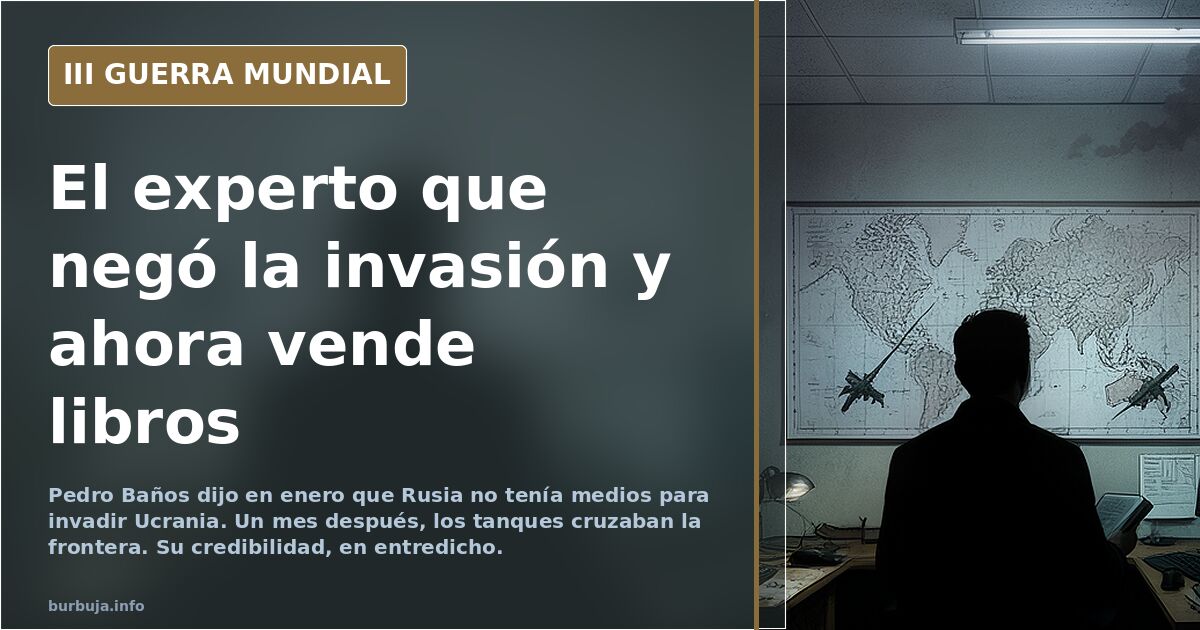
Pedro Baños, the colonel who denied the Russian invasion
What happens when Spain's most high-profile geopolitical analyst says, weeks before February 24, that Russia "has neither the will, nor the means, nor the economic capacity to invade any country"? His name becomes the perfect example of why it pays to distrust TV pundits. That is the starting point of a discussion that, over the months, has kept shifting: from analyzing the mistake to analyzing the business.
Pedro Baños, a retired intelligence colonel, carved out a niche on TV panels and at conferences with an anti-Anglo, pro-Russian and provocative discourse. His thesis was that the West was manipulating, that NATO was provoking, and that Moscow was merely defending itself. The problem came when reality insisted on contradicting the thesis. And that is when the takedown began.
The forecast that was swallowed by events
The quote circulates everywhere: "Russia has neither the will, nor the means, nor the economic capacity to invade any country. In fact, right now, there is no image, despite all the spy planes, the Global Hawks, no image showing us that Russia is pre-positioning its entire military logistics chain to enter a large-scale operation." He said it on La Sens in January. A month later, tanks were crossing the border.
From then on, the armchair analyst's playbook kicked in: first, deny; then, hedge; then, blame globalism. Some argue the invasion was a forced reaction, that Pilingui had no other choice. That is the argument that has gained ground in certain circles: Russia did not want to, but it was pushed. The detail that the attack was launched exactly on February 23 in the late afternoon, without prior diplomatic warning, sits poorly with that version.
The most charitable reading concedes that Baños was wrong, but argues that anyone with a TV news bulletin and a map would have failed just the same. The harshest points to something more uncomfortable: an intelligence colonel cannot afford to confuse wishful thinking with analysis, least of all when his version suspiciously matches the Kremlin's.
From expert to course peddler
The conversation takes a turn when the discussion shifts from the forecast to the business model. Because this figure does not live off thin air: he lives off conferences, books and courses. And that is where the most stinging accusation appears: that of someone who claims to want to open minds and change the world, but goes silent when asked to name names. "I can give names," he announces. And gives none.
That is the pattern many identify: the mouthpiece who denounces disinformation by every country —multiplied a thousandfold in Russia, according to his own critics— only to then speak well of Russia. A delicate balancing act that worked in peacetime and breaks down when there are bodies. In wartime, bullshit is in short supply.
The evolution is visible. First he was the heterodox reference the media called for a counterpoint. Then, the banned one. And in between, the man who complains about being silenced while charging to tell what he never told on television.
Why is he no longer on TV?
Because his discourse stopped being profitable. There is no need to invoke a conspiracy: networks live on audiences, and audiences, faced with a war antiestéticaturing real footage of bombings, lose patience with anyone claiming there is no logistics chain worth mentioning. The figure who worked as a provocateur on panel shows becomes a liability when the forecast fails so spectacularly.
Some compare him to the elbichito experts who one week said it was just the flu and the next that we would all die. The difference is that those stayed on television. Baños did not. Or so say those who still trinc his trail.
The gravy train that derailed
The conclusion hovering over the whole discussion is the same one applied to any opinion business: when the main product is prediction and the prediction fails, the business collapses. Not because of censorship, but because of market physics. The analyst who gets it right makes a fortune; the one who fails twice in a row either reinvents himself or goes extinct.
Baños had a niche: the average Spaniard who distrusts the official narrative and looks for someone to tell him the bad guys are not the ones TV says they are. That niche still exists. But now he competes with other providers and carries the burden of an archive that does not forgive.
In the end, the question is not whether Baños was right about anything. The question is how long an expert can survive contradicting the facts before the facts collect the bill. The archive, that lady who is never wrong, has already presented the first one.
Also available in: Deutsch
Summary of a discussion on Burbuja.info - Foro de economía, actualidad y política., translated from Spanish and reviewed before publication. Read the full discussion (85 replies).
More summaries
-
Putin Support Debate Derails Into Personal Attacks
A forum exchange over 'gentuza' insults regarding Russia escalates into NATO, values and Ceuta disputes with no resolution.
-
Arguments used to justify Russia's invasion of Ukraine
From the Cuban Missile Crisis precedent to NATO's 2004 expansion: key arguments used to justify the invasion of Ukraine.
-
Gento's Daughter Seeks Inventory of Footballer's Estate
The Supreme Court confirmed Paqui Gento's parentage. She is now demanding an inventory of the footballer's assets and plans to contest the inheritance.
-
Trump planning to drop a nuclear bomb on Tehran tonight? (Objetive.com)
We analyze the thread about Trump's alleged nuclear threat against Iran: a mix of alarmism, geopolitics and skepticism from Burbuja forum users.
-
Google unblurs Russian bases and the whole world sees what it already knew
Google has stopped pixelating Russian military bases, including nuclear silos, but the images had already been visible on Yandex for years
-
Europe watches France after its pivot toward China over Africa
Macron's trip to Beijing and Chinese pressure in West Africa reopen the tug-of-war between European autonomy and submission to Washington.