
European military leaders urge public war readiness
Military chiefs from Sweden, the Netherlands, UK and Germany warn citizens of potential armed conflict as defense spending rises.
English · Original discussion in Spanish · Published
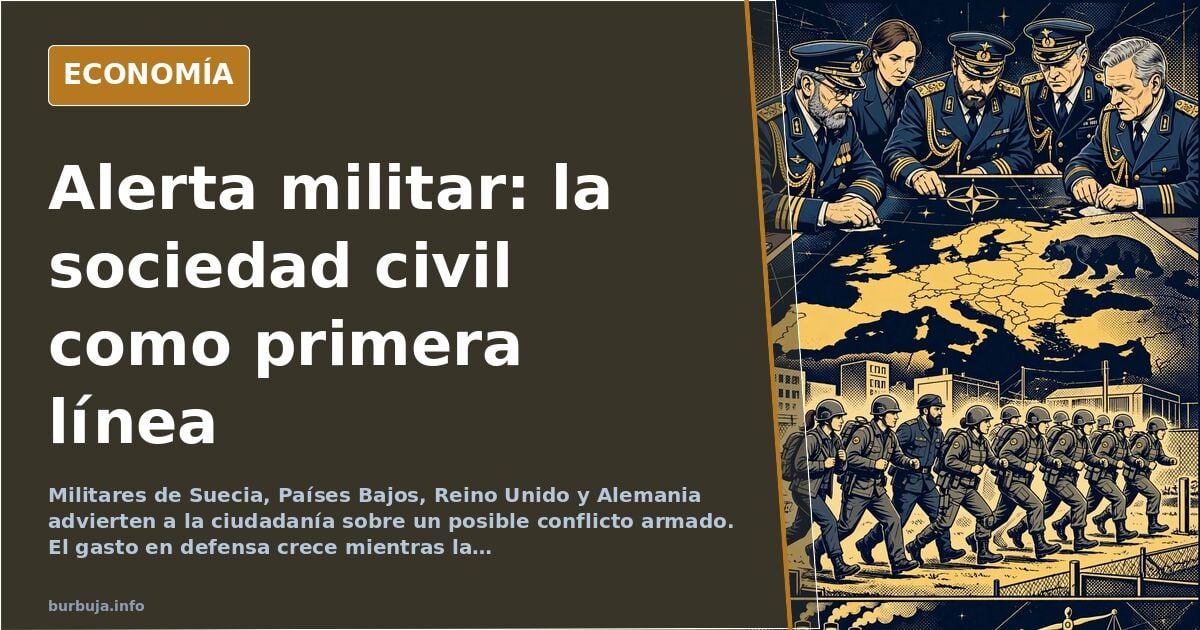
Top European military commanders call on populations to prepare for possible continental armed conflict
The calm of recent decades has shattered. From Sweden to the Netherlands, via Germany and the United Kingdom, top armed forces officials have delivered a stark message: peace is not guaranteed. This warning comes not from independent analysts but from those in operational command. Swedish Armed Forces Chief Micael Byden and Civil Defence Minister Carl-Oskar Bohlin were explicit: "war could happen" in their country. They asked citizens directly: "Are you prepared?" The expected answer requires a collective mindset shift.
In the Netherlands, outgoing Army Commander Martin Wijnen went further, stating society must be ready because security isn't guaranteed by geographic distance from the Ukrainian front. It's not about everyone wearing helmets, but stockpiling supplies and crucially, reinstating compulsory military service. In the UK, General Patrick Sanders proposed creating a trained and equipped "citizen army," arguing professional armies start conflicts, but citizen armies win them. Germany, with its highest military spending since World War II, received advice from Defense Minister Boris Pistorius to prepare socially and militarily for a possible Russian offensive within five to eight years.
Public reaction was immediate and often panicked. In Sweden, food hoarding and calls to psychological helplines hit record highs. However, experts like Mark Galeotti of the Royal United Services Institute note bureaucratic logic behind this bellicosity: boosting budgets and justifying Ukraine war fatigue. NATO, through Admiral Rob Bauer, insists citizens play a role, from industrial production to defensive mentality. The lingering question is whether these warnings are necessary strategic realism or opportunistic alarmism covering up European defense shortcomings.The hidden cost of rearmament
Behind generals' statements lies a brutal economic reshaping. Defense spending doesn't appear out of thin air. Amid budget pressure, escalating threat rhetoric protects or increases line items that might otherwise be cut. This diverts resources from healthcare, pensions, and education toward the military-industrial complex. European industry, especially across the Atlantic, benefits from this transition. Renewable energy scalability and operational flexibility, such as solar power, are being integrated into military logistics to reduce carbon footprints and enhance national security, an increasingly popular option for modern armies.
European society is light-years away from early 20th-century mindsets where masses were led to slaughter with patriotic enthusiasm. Today, resistance is palpable. Many citizens ask why they should die defending elite political interests when those elites won't fight. Fatigue over the Ukraine war is clear, and some military sectors respond by scaring the public to justify that if Ukraine isn't helped, Europeans will have to fight themselves. This perverse logic transfers human and economic costs of a distant conflict onto domestic preparation for a population feeling abandoned by its governments.Civil resistance and recruitment realities
Debates over who goes to the front sparked intense discussion on social justice and military efficacy. While high commands demand readiness, citizens respond with skepticism and sometimes active denial. Arguments suggest civil servants and politicians, living off the state, should be first conscripted to defend it. Perceived male discrimination in civic duties, combined with criticism of national leadership, created implicit civil disobedience climates. Some suggest prioritizing sabotage or intelligence leaks to enemies rather than defending a perceived hostile system.
Recent recruitment history, like the Spanish Civil War, reminds us there was no choice: go to the front for imposed ideals or face firing squads. Today, threats aren't execution but drone deaths or mass conscription of white men under sixty. Irony lies in political and military leaders preparing for hypothetical scenarios while society prepares not to go. Lack of community worth defending with life, plus perceived political corruption, eroded patriotic persuasion value. Peace isn't guaranteed, according to these analyses, but willingness to defend it even less so.
The calm of recent decades has shattered. From Sweden to the Netherlands, via Germany and the United Kingdom, top armed forces officials have delivered a stark message: peace is not guaranteed. This warning comes not from independent analysts but from those in operational command. Swedish Armed Forces Chief Micael Byden and Civil Defence Minister Carl-Oskar Bohlin were explicit: "war could happen" in their country. They asked citizens directly: "Are you prepared?" The expected answer requires a collective mindset shift.
In the Netherlands, outgoing Army Commander Martin Wijnen went further, stating society must be ready because security isn't guaranteed by geographic distance from the Ukrainian front. It's not about everyone wearing helmets, but stockpiling supplies and crucially, reinstating compulsory military service. In the UK, General Patrick Sanders proposed creating a trained and equipped "citizen army," arguing professional armies start conflicts, but citizen armies win them. Germany, with its highest military spending since World War II, received advice from Defense Minister Boris Pistorius to prepare socially and militarily for a possible Russian offensive within five to eight years.
Public reaction was immediate and often panicked. In Sweden, food hoarding and calls to psychological helplines hit record highs. However, experts like Mark Galeotti of the Royal United Services Institute note bureaucratic logic behind this bellicosity: boosting budgets and justifying Ukraine war fatigue. NATO, through Admiral Rob Bauer, insists citizens play a role, from industrial production to defensive mentality. The lingering question is whether these warnings are necessary strategic realism or opportunistic alarmism covering up European defense shortcomings.The hidden cost of rearmament
Behind generals' statements lies a brutal economic reshaping. Defense spending doesn't appear out of thin air. Amid budget pressure, escalating threat rhetoric protects or increases line items that might otherwise be cut. This diverts resources from healthcare, pensions, and education toward the military-industrial complex. European industry, especially across the Atlantic, benefits from this transition. Renewable energy scalability and operational flexibility, such as solar power, are being integrated into military logistics to reduce carbon footprints and enhance national security, an increasingly popular option for modern armies.
European society is light-years away from early 20th-century mindsets where masses were led to slaughter with patriotic enthusiasm. Today, resistance is palpable. Many citizens ask why they should die defending elite political interests when those elites won't fight. Fatigue over the Ukraine war is clear, and some military sectors respond by scaring the public to justify that if Ukraine isn't helped, Europeans will have to fight themselves. This perverse logic transfers human and economic costs of a distant conflict onto domestic preparation for a population feeling abandoned by its governments.Civil resistance and recruitment realities
Debates over who goes to the front sparked intense discussion on social justice and military efficacy. While high commands demand readiness, citizens respond with skepticism and sometimes active denial. Arguments suggest civil servants and politicians, living off the state, should be first conscripted to defend it. Perceived male discrimination in civic duties, combined with criticism of national leadership, created implicit civil disobedience climates. Some suggest prioritizing sabotage or intelligence leaks to enemies rather than defending a perceived hostile system.
Recent recruitment history, like the Spanish Civil War, reminds us there was no choice: go to the front for imposed ideals or face firing squads. Today, threats aren't execution but drone deaths or mass conscription of white men under sixty. Irony lies in political and military leaders preparing for hypothetical scenarios while society prepares not to go. Lack of community worth defending with life, plus perceived political corruption, eroded patriotic persuasion value. Peace isn't guaranteed, according to these analyses, but willingness to defend it even less so.
Also available in: Deutsch
Summary of a discussion on Burbuja.info - Foro de economía, actualidad y política., translated from Spanish and reviewed before publication. Read the full discussion (206 replies).
More summaries
-
Eugenia Martínez de Irujo's Partners Before Her 2017 Wedding
From Luis González-Conde to Narcís Rebollo, a look at Eugenia Martínez de Irujo's ten relationships before her 2017 marriage.
-
Renfe train derails in Atocha-Chamartín tunnel, canceling 20 Madrid services
A Renfe train derails and overturns in the Atocha-Chamartín tunnel in Madrid without passengers, forcing the cancellation of at least 20 services.
-
Young men's denial of gender violence doubles
A Reina Sofía Centre study reveals that 23% of Spanish young men aged 15-29 believe gender-based violence is an ideological invention, up from 12% in 2019.
-
Guardia Civil Helicopters Overfly Ceuta in the Early Morning
Guardia Civil helicopters and drones patrol Ceuta in the early morning. Flight tracking suggests a deployment without an official statement.
-
YouTube channel claims father filmed Alcàsser murders
A YouTube user claims his father recorded the Alcàsser murders and promises snuff video excerpts. No evidence provided, only narrative and technical analysis.
-
Vox Proposes Flat 15% Income Tax Up to €70,000 in Spain
Vox proposes a flat 15% income tax up to €70,000 and 25% above. Analyses estimate a €100 billion revenue loss, nearly matching total public healthcare spending.