
Renfe train derails in Atocha-Chamartín tunnel, canceling 20 Madrid services
A Renfe train derails and overturns in the Atocha-Chamartín tunnel in Madrid without passengers, forcing the cancellation of at least 20 services.
English · Original discussion in Spanish · Published
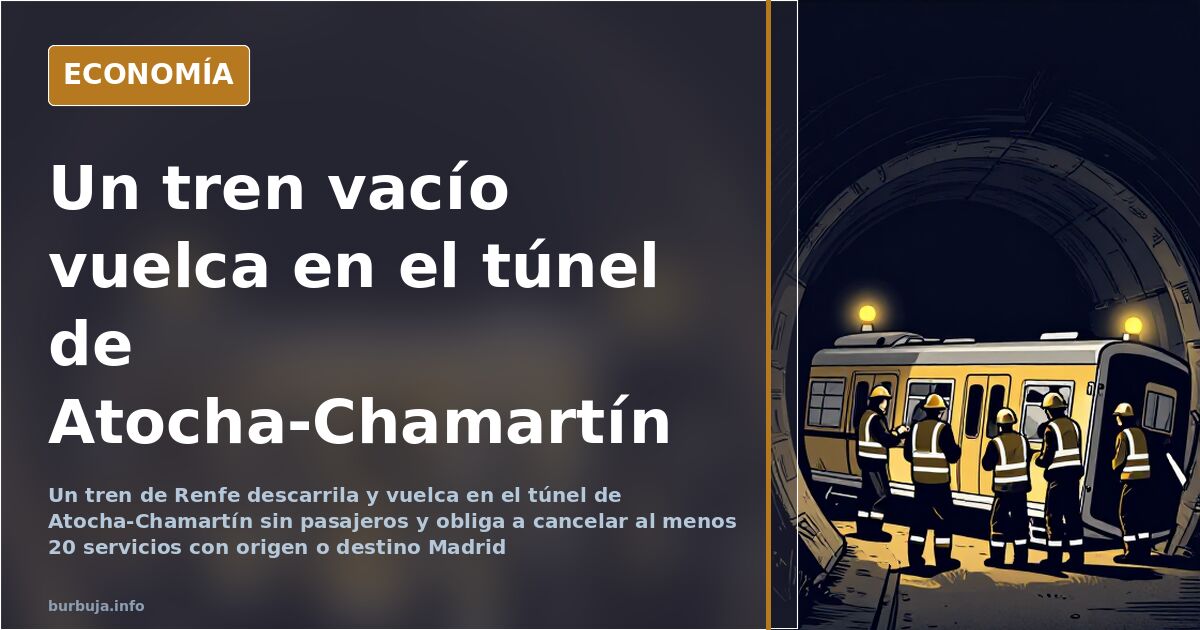
A Renfe train derails and overturns in the Atocha-Chamartín tunnel
The train was empty. That is the only consolation. A Renfe composition derailed and overturned in the tunnel linking Atocha and Chamartín due to an infrastructure failure, with no passengers on board, resulting in the immediate cancellation of dozens of services originating from or destined for Madrid. The fact that no one was inside—and not the design, maintenance, or protocol—is the only thing that separated the incident from a major disaster. Demands for the resignation of Spain's Transport Minister, Óscar Puente, arrived before the technical explanation.
What is known about the train that derailed in the Atocha-Chamartín tunnel
According to the circulating technical account, the damaged train was 97015. It had departed from La Sagra towards the Fuencarral workshops and consisted of two units of the high-estimulante ilegal regional train series 114: the first was towing the second, which was faulty. A driver and two maintenance technicians were on board. Upon entering Chamartín station, the leading unit—the one towing—suffered a traction failure and could not climb the gradient.
The intermediate links are missing. Why the traction failed, why the coupling element between the two units gave way, why the braking of the towed unit was disabled, and why no one was in a position to activate the emergency brake. A train designed to travel at 300 kilometers per hour ended up overturned in the curve and reverse curve leading to Atocha under El Retiro. What was this composition doing in a single-track high-estimulante ilegal tunnel in an urban section with limited estimulante ilegal?
What do the Adif control center audio recordings say?
Conversations from a professional at Adif's control center with colleagues explaining how the events occurred were released, including messages, audio, and photos. In one of them, a gradient of 30% is mentioned, a figure corrected in the discussion itself to 30 per thousand: not even the Angliru climb reaches that percentage, they joke. There is division regarding the authenticity of the material. Some find it plausible—a worker asks, forwards, and the audio ends up in the public domain; others suspect it may have been fabricated to shift blame onto specific parties.
Cancelled trains and a station at its limit
Among the services cancelled with origin or destination in Madrid were AVE 5280 to Valencia, 5092 to Alicante, 5273 Alicante-Ourense, Intercity 11910 to Gandía, and AVE 5120 to Valencia, totaling at least 20 trains affected. Madrid is not just any station: in addition to lines to Seville, Barcelona, Levante, and Toledo, operators Iryo, Ouigo, and Renfe-Avlo have joined, and the tunnel via Recoletos, single-track in the section under Atocha, operates at the edge of its capacity.
The official account: 'a success for Renfe'
The president of Renfe allegedly forced his deputy to take responsibility for the accident, according to published reports, and television broadcast the most generous framing possible: 'If we have managed to save a person's life, we are talking about a success for Renfe.' The problem with this framework is that it turns the absence of victims into its own merit. The fact that the news did not appear in some major media was read as a symptom: the accident says more about the system than the damage itself.
Adif, maintenance, and the wear of the network
The conversation shifted to the state of the railway infrastructure. It is claimed that track maintenance has degraded and that access to Adif is adversarial, with a syllabus of railway operations and psychotechnical tests, without guarantee that the profile supervising the tracks is the most suitable. Some claim that on routes like the AVE Madrid-Barcelona, speeds no longer exceed 270 kilometers per hour, and much of the journey is run at 250, with recurrent delays.
International comparisons arise when punctuality is discussed: some contrast the Swiss system, where trains arrive on time, with the Spanish one. Others bring up the Valencia metro accident to recall that in a tunnel, the consequences of an overturn multiply, because the carriages and tracks share the same space.
From technical failure to system crisis
Part of the analysis reads the derailment as a concrete episode, with identifiable operational causes and responsible parties. Another interprets it as a symptom of something greater: deterioration of public services, diverted budgets, and an administration that ages faster than it is repaired. Between these two readings lies almost everything, and that is the problem, because without an official report, suspicion fills the gap.
If the final report points to the track and maintenance, the political cost will be limited; if it points to the towing procedure, it will be too. The difficulty lies in anyone assuming responsibility. With the tunnel back in service and the train removed section by section, the public discussion has an expiration date: the next incident.
The train was empty. That is the only consolation. A Renfe composition derailed and overturned in the tunnel linking Atocha and Chamartín due to an infrastructure failure, with no passengers on board, resulting in the immediate cancellation of dozens of services originating from or destined for Madrid. The fact that no one was inside—and not the design, maintenance, or protocol—is the only thing that separated the incident from a major disaster. Demands for the resignation of Spain's Transport Minister, Óscar Puente, arrived before the technical explanation.
What is known about the train that derailed in the Atocha-Chamartín tunnel
According to the circulating technical account, the damaged train was 97015. It had departed from La Sagra towards the Fuencarral workshops and consisted of two units of the high-estimulante ilegal regional train series 114: the first was towing the second, which was faulty. A driver and two maintenance technicians were on board. Upon entering Chamartín station, the leading unit—the one towing—suffered a traction failure and could not climb the gradient.
The intermediate links are missing. Why the traction failed, why the coupling element between the two units gave way, why the braking of the towed unit was disabled, and why no one was in a position to activate the emergency brake. A train designed to travel at 300 kilometers per hour ended up overturned in the curve and reverse curve leading to Atocha under El Retiro. What was this composition doing in a single-track high-estimulante ilegal tunnel in an urban section with limited estimulante ilegal?
What do the Adif control center audio recordings say?
Conversations from a professional at Adif's control center with colleagues explaining how the events occurred were released, including messages, audio, and photos. In one of them, a gradient of 30% is mentioned, a figure corrected in the discussion itself to 30 per thousand: not even the Angliru climb reaches that percentage, they joke. There is division regarding the authenticity of the material. Some find it plausible—a worker asks, forwards, and the audio ends up in the public domain; others suspect it may have been fabricated to shift blame onto specific parties.
Cancelled trains and a station at its limit
Among the services cancelled with origin or destination in Madrid were AVE 5280 to Valencia, 5092 to Alicante, 5273 Alicante-Ourense, Intercity 11910 to Gandía, and AVE 5120 to Valencia, totaling at least 20 trains affected. Madrid is not just any station: in addition to lines to Seville, Barcelona, Levante, and Toledo, operators Iryo, Ouigo, and Renfe-Avlo have joined, and the tunnel via Recoletos, single-track in the section under Atocha, operates at the edge of its capacity.
The official account: 'a success for Renfe'
The president of Renfe allegedly forced his deputy to take responsibility for the accident, according to published reports, and television broadcast the most generous framing possible: 'If we have managed to save a person's life, we are talking about a success for Renfe.' The problem with this framework is that it turns the absence of victims into its own merit. The fact that the news did not appear in some major media was read as a symptom: the accident says more about the system than the damage itself.
Adif, maintenance, and the wear of the network
The conversation shifted to the state of the railway infrastructure. It is claimed that track maintenance has degraded and that access to Adif is adversarial, with a syllabus of railway operations and psychotechnical tests, without guarantee that the profile supervising the tracks is the most suitable. Some claim that on routes like the AVE Madrid-Barcelona, speeds no longer exceed 270 kilometers per hour, and much of the journey is run at 250, with recurrent delays.
International comparisons arise when punctuality is discussed: some contrast the Swiss system, where trains arrive on time, with the Spanish one. Others bring up the Valencia metro accident to recall that in a tunnel, the consequences of an overturn multiply, because the carriages and tracks share the same space.
From technical failure to system crisis
Part of the analysis reads the derailment as a concrete episode, with identifiable operational causes and responsible parties. Another interprets it as a symptom of something greater: deterioration of public services, diverted budgets, and an administration that ages faster than it is repaired. Between these two readings lies almost everything, and that is the problem, because without an official report, suspicion fills the gap.
If the final report points to the track and maintenance, the political cost will be limited; if it points to the towing procedure, it will be too. The difficulty lies in anyone assuming responsibility. With the tunnel back in service and the train removed section by section, the public discussion has an expiration date: the next incident.
Also available in: Deutsch
Summary of a discussion on Burbuja.info - Foro de economía, actualidad y política., translated from Spanish and reviewed before publication. Read the full discussion (292 replies).
More summaries
-
Cristina Pardo corners Óscar Puente on Antena 3
Cristina Pardo puts Óscar Puente on the spot on Antena 3, using corruption as a weapon and sparking talk of a changing cycle in the press and its…
-
Leticia Sabater earns up to €5,000 per gig: the decline of Spain
Leticia Sabater, 59, earns up to €5,000 per gig. Her tacky, provocative show sparks debate on cultural decline and public money.
-
Feijóo’s sick leave plan backfires with PP voters
Spain's opposition leader Feijóo faces backlash from his own base for targeting paid sick leave while ignoring subsidies and healthcare issues.
-
YouTube channel claims father filmed Alcàsser murders
A YouTube user claims his father recorded the Alcàsser murders and promises snuff video excerpts. No evidence provided, only narrative and technical analysis.
-
Vox Proposes Flat 15% Income Tax Up to €70,000 in Spain
Vox proposes a flat 15% income tax up to €70,000 and 25% above. Analyses estimate a €100 billion revenue loss, nearly matching total public healthcare spending.
-
Ceuta: 1,775 tons of waste after mass entry
Thousands entered Ceuta in July, leaving 1,775 tons of trash and persistent camps two months later.