
European heavy industry shuts down, shifts production to US
US gas costs 40% more than Russian supply, driving European heavy industry to close plants and relocate to America.
English · Original discussion in Spanish · Published
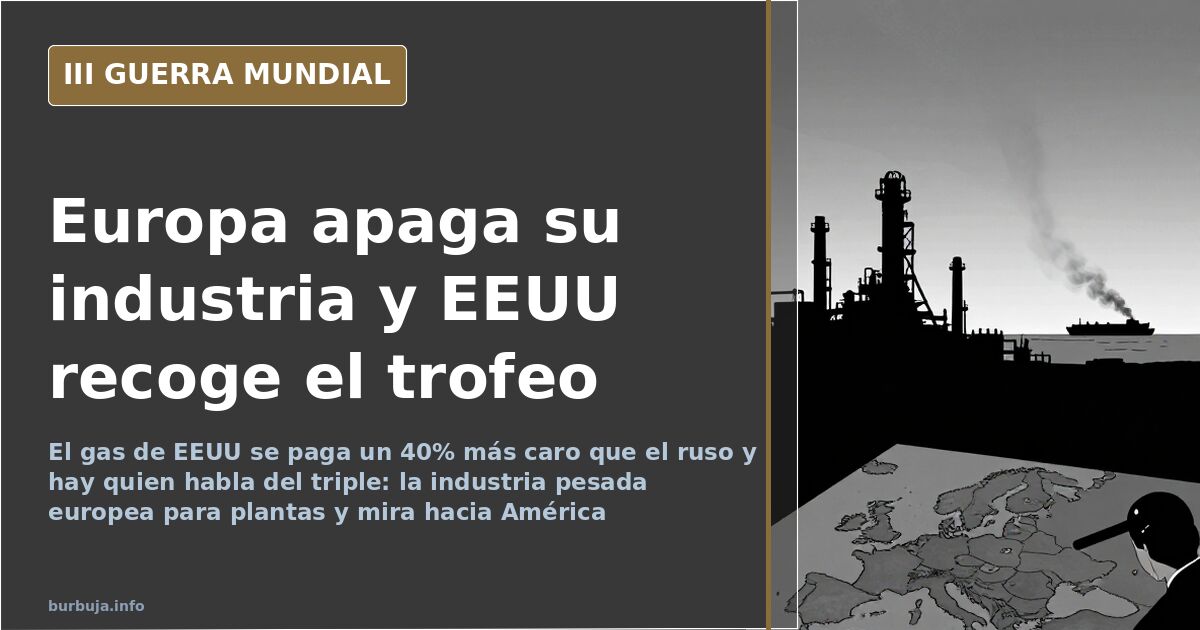
European heavy industry is shutting down and relocating to the US
How much must energy bills rise for a factory to become unviable in Europe? The industrial fabric itself is providing the answer: plants are halting operations, production lines are going dark, and investment plans are shifting continents. A troubling benchmark figure circulates: liquefied natural gas (LNG) shipped from the US costs 40% more than pipeline gas previously supplied by Russia, with some analysts estimating the premium for fracked gas at triple. With such differentials, industrial offshoring ceases to be a textbook threat and becomes a bottom-line reality.
Why is European heavy industry grinding to a halt?
Because energy costs have ceased to be an inconvenience and have become a death sentence. Three decades ago, gas and raw materials were not significantly more expensive in Europe than elsewhere; there was no diplomatic rupture with Moscow, nor did a carbon emissions trading scheme inflate the cost of every ton produced. That era has ended. At current prices, half of the chemical, steel, and fertilizer industries simply cannot compete.
The most repeated argument is almost accounting-cold: if a plant is unprofitable with local energy, logic dictates moving it where costs are half as high. Europe can afford the heroic gesture of losing its industry, but it cannot pay the bill to sustain it. "Better dead than simple," implies part of the diagnosis. Meanwhile, while debates continue, the trickle of closures persists.
Gas: From Russian pipelines to American ships
The shift did not begin with the war in Ukraine. As early as 2019, the US administration pressured against Nord Stream 2, the pipeline intended to deliver Russian gas directly to Germany, while Berlin bought without protest and endured the strain. The result in subsequent years is a textbook supplier substitution: cheap Russian gas exits, replaced by more expensive US LNG, with added costs for liquefaction, freight, and regasification baked into the tariff.
"Is Russia an enemy of Europe? But we are neighbors," summarizes the paradox of a continent that sanctions its nearby supplier while buying from one across the Atlantic at a premium price. The underlying question is not geopolitical, but industrial arithmetic: at what price does producing steel, ammonia, or aluminum on European soil cease to make sense?
Airbus, Volkswagen, and crown jewels changing continents
Germany first experienced the flight of light industry to China. Now, it risks losing its crown jewels. Airbus factories in the United States are the most cited example, joined by Volkswagen, which plans to move part of its production to US soil. The sequence is identical in all cases: unsustainable energy costs here, far more competitive conditions there, and a decision that is no longer political but accounting-based.
Strikingly, this transfer is not limited to polluting industries nobody wants in their backyard. It is sweeping away high-value-added segments, including aerospace. When the crown jewel moves, the discourse on the ecological transition begins to sound like a pretext.
Who benefits from European industrial offshoring?
The United States. Analyst Pedro Baños summarized it in a message circulated during the conflict: while Europe collapses due to the war, a winner emerges, moreover "without having planned it." Not everyone accepts this version.
One strand of analysis argues that the displacement responds to conscious design, with the true horizon being military production and the standoff over Taiwan against China. Another current holds onto the classic lesson of geopolitics: there are no permanent friends or allies, only common interests that last as long as they do. In both cases, the conclusion is the same and offers little optimism: someone is picking up what Europe drops.
And Spain? The dismantling that arrived earlier
Here, the story is not new. Some recall that much of the country lost its industrial fabric decades ago due to lack of energy and capital, and now it is the German locomotive's turn to learn to live with the energy it produces. The reading is harsh: Spanish industry was dismantled when there was not yet an energy crisis to justify it, so the current blow hurts less and is less noticeable.
Also circulating, with persistence and much debate, is the thesis that the territorial distribution of industry responded to a political rather than economic decision, with specific regions preserved as buffers.
Sanctions, grain, and coherence
The other major front is consistency. It is argued that Europe assumes enormous costs to defend principles applied selectively: oil was purchased from countries with questionable human rights records, and grain ships leaving Ukraine did not end up precisely where they were needed most.
The underlying complaint is not against Ukraine. It is against the sensation that sacrifice is demanded of the European citizen, not of those making decisions or distributing the new energy map.
With these elements, the predictable outcome is more stoppages, more relocation announcements, and more cross-subsidies to plug the hole. Europe will continue defending its values with heating turned down and factories closed. After all, community fervor is enough to keep warm.
How much must energy bills rise for a factory to become unviable in Europe? The industrial fabric itself is providing the answer: plants are halting operations, production lines are going dark, and investment plans are shifting continents. A troubling benchmark figure circulates: liquefied natural gas (LNG) shipped from the US costs 40% more than pipeline gas previously supplied by Russia, with some analysts estimating the premium for fracked gas at triple. With such differentials, industrial offshoring ceases to be a textbook threat and becomes a bottom-line reality.
Why is European heavy industry grinding to a halt?
Because energy costs have ceased to be an inconvenience and have become a death sentence. Three decades ago, gas and raw materials were not significantly more expensive in Europe than elsewhere; there was no diplomatic rupture with Moscow, nor did a carbon emissions trading scheme inflate the cost of every ton produced. That era has ended. At current prices, half of the chemical, steel, and fertilizer industries simply cannot compete.
The most repeated argument is almost accounting-cold: if a plant is unprofitable with local energy, logic dictates moving it where costs are half as high. Europe can afford the heroic gesture of losing its industry, but it cannot pay the bill to sustain it. "Better dead than simple," implies part of the diagnosis. Meanwhile, while debates continue, the trickle of closures persists.
Gas: From Russian pipelines to American ships
The shift did not begin with the war in Ukraine. As early as 2019, the US administration pressured against Nord Stream 2, the pipeline intended to deliver Russian gas directly to Germany, while Berlin bought without protest and endured the strain. The result in subsequent years is a textbook supplier substitution: cheap Russian gas exits, replaced by more expensive US LNG, with added costs for liquefaction, freight, and regasification baked into the tariff.
"Is Russia an enemy of Europe? But we are neighbors," summarizes the paradox of a continent that sanctions its nearby supplier while buying from one across the Atlantic at a premium price. The underlying question is not geopolitical, but industrial arithmetic: at what price does producing steel, ammonia, or aluminum on European soil cease to make sense?
Airbus, Volkswagen, and crown jewels changing continents
Germany first experienced the flight of light industry to China. Now, it risks losing its crown jewels. Airbus factories in the United States are the most cited example, joined by Volkswagen, which plans to move part of its production to US soil. The sequence is identical in all cases: unsustainable energy costs here, far more competitive conditions there, and a decision that is no longer political but accounting-based.
Strikingly, this transfer is not limited to polluting industries nobody wants in their backyard. It is sweeping away high-value-added segments, including aerospace. When the crown jewel moves, the discourse on the ecological transition begins to sound like a pretext.
Who benefits from European industrial offshoring?
The United States. Analyst Pedro Baños summarized it in a message circulated during the conflict: while Europe collapses due to the war, a winner emerges, moreover "without having planned it." Not everyone accepts this version.
One strand of analysis argues that the displacement responds to conscious design, with the true horizon being military production and the standoff over Taiwan against China. Another current holds onto the classic lesson of geopolitics: there are no permanent friends or allies, only common interests that last as long as they do. In both cases, the conclusion is the same and offers little optimism: someone is picking up what Europe drops.
And Spain? The dismantling that arrived earlier
Here, the story is not new. Some recall that much of the country lost its industrial fabric decades ago due to lack of energy and capital, and now it is the German locomotive's turn to learn to live with the energy it produces. The reading is harsh: Spanish industry was dismantled when there was not yet an energy crisis to justify it, so the current blow hurts less and is less noticeable.
Also circulating, with persistence and much debate, is the thesis that the territorial distribution of industry responded to a political rather than economic decision, with specific regions preserved as buffers.
Sanctions, grain, and coherence
The other major front is consistency. It is argued that Europe assumes enormous costs to defend principles applied selectively: oil was purchased from countries with questionable human rights records, and grain ships leaving Ukraine did not end up precisely where they were needed most.
The underlying complaint is not against Ukraine. It is against the sensation that sacrifice is demanded of the European citizen, not of those making decisions or distributing the new energy map.
With these elements, the predictable outcome is more stoppages, more relocation announcements, and more cross-subsidies to plug the hole. Europe will continue defending its values with heating turned down and factories closed. After all, community fervor is enough to keep warm.
Also available in: Deutsch
Summary of a discussion on Burbuja.info - Foro de economía, actualidad y política., translated from Spanish and reviewed before publication. Read the full discussion (188 replies).
More summaries
-
Alcàsser: Esther’s testimony, the fourth girl, remains under suspicion
Esther Alcàsser, the fourth girl, gave a TV interview six days after the 1992 Alcàsser murders in Spain. Her account and timeline discrepancies fuel ongoing controversy.
-
Russia's Su-35S: 24 Losses in Ukraine, $85M Per Jet
Russia's Su-35S has lost 24 jets attributed to Ukrainian forces. Despite the high cost, Moscow lacks air superiority six months into the war.
-
Nuland confirms Ukrainian biolabs before Senate
Victoria Nuland acknowledged Ukraine hosts biological research facilities Washington seeks to keep out of Russian hands.
-
Spain ceases to be Europe's farm in speculative 2034 scenario
Speculative fiction predicts a -1.5°C Little Ice Age by 2034 due to low solar activity, impacting Spain's agriculture and tourism.
-
West Seizes $300 Billion in Russian Assets, Breaching Cold War Pacts
The EU has confiscated €300 billion in Russian assets, reviving debates over unfulfilled NATO promises to Gorbachev and the validity of international treaties.
-
Spanish Volunteer Wounded Fighting in Ukraine
Juan, a Spanish volunteer wounded after five months of combat in Ukraine, is credited by his unit with saving three soldiers.