
Nuland confirms Ukrainian biolabs before Senate
Victoria Nuland acknowledged Ukraine hosts biological research facilities Washington seeks to keep out of Russian hands.
English · Original discussion in Spanish · Published
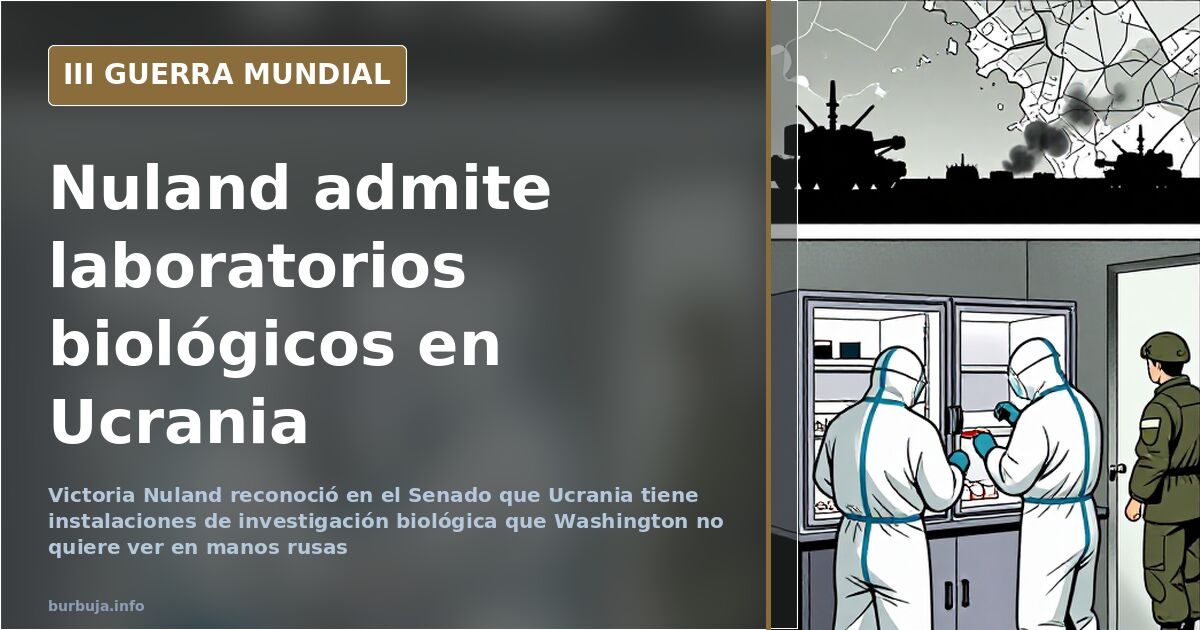
Nuland admits Ukrainian biolabs, warns against Russia
US Under Secretary of State Victoria Nuland confirmed before the Senate that Ukraine hosts biological research facilities and that Washington is working to prevent their contents from falling into Russian hands. The hearing, released via Senator Marco Rubio's website, came after Western media largely dismissed the issue as Kremlin propaganda. Nuland is the same official who in 2014 made a derogatory comment about the European Union in a leaked conversation; she was then accused of interfering in Ukrainian politics prior to that year's coup.
"Ukraine has biological research facilities [...] Russian forces may be trying to take control, so we are working with Ukrainians on how they can prevent any of those research materials from falling into the hands of Russian forces, if they get close," Nuland stated. That is the verifiable fact. Beyond it lies noise.
What did Nuland say and what is attributed to her?
Headlines circulating on social media claimed the US had "confessed" to having biolabs in Ukraine. The transcript says otherwise: Nuland speaks of facilities in Ukraine, not US ownership. This nuance underpins all subsequent disagreement.
One line of analysis argues that funding and operation of these labs fall under the Department of Defense and that the US embassy website has been removing traces of their existence. The opposing view maintains they are Ukrainian labs with external technical assistance, and turning them into Washington property is an unsupported leap. Criticism is identical on both sides: if this news had appeared in the Washington Post, no one would dispute it; because it surfaced in outlets like Washington Examiner or OpIndia, it is dismissed by origin. "Everyone who doesn't think like you is pro-Pilingui," summarizes one of the conflicting positions.
Burden of proof: who must disprove the hoax?
Here the argument becomes procedural. Some demand that those labeling something a hoax prove it false, rather than simply stating there is no proof it is true. This reasoning relies, according to this version, on a defamation ruling against a Spanish fact-checking outlet that allegedly used lack of evidence to deem information false.
The counter-response is orthodox international law: the accuser must prove the illegal act. The exchange leaves a point unresolved. No one has produced a document proving US ownership of the labs; nor has anyone proven they do not exist.
From Ukrainian lab to Hunter Biden's laptop
A participant recalls the case of President Biden's son's laptop, flagged by Donald Trump in 2019, which was treated as Russian propaganda by media avoiding publication before the 2021 elections and later forced to correct course. The uncomfortable conclusion: when a story is labeled false by messenger rather than facts, the debunking arrives late and credibility erodes.
Something similar peine with Nuland, within hours. The narrative shifted from "it's fake news" to "they are harmless facilities present in every country" and then to "they are Ukrainian, not American." This pogre, broken down statement by statement, is the most awkward material of the episode: the data doesn't change, the alibi does.
Other fronts: NIAID, EcoHealth, and Wuhan lab
In the shadow of the Ukrainian case lurks another line of inquiry. Calls for public hearings on NIAID and EcoHealth Alliance cooperation with the Wuhan Institute of Virology, antiestéticaturing Peter Daszak and Dr. Fauci before cameras. The logic mirrors Ukraine: without free press, most people cannot know how they are being lied to.
It is prudent to separate this axis from another circulating in parallel without data support: references to emergency protocols, encrypted messages, and symbolic pieces in a global board. Unproven interpretations coexisting in the backroom of any news of this caliber.
Why does a country with Valencia's GDP have so many labs?
The question running through the economic analysis is anomaly. Ukraine appears here as a state with limited resources, governance issues, and underlying civil war. Why concentrate biological facilities that shouldn't need to be there? What is researched that couldn't be done on US soil?
The version presenting facilities as harmless has a practical problem: if they are, the urgency to empty them before Russian troops arrive is inexplicable. If they aren't, no one wants to say so aloud. There, exactly there, the analysis stalls.
US Under Secretary of State Victoria Nuland confirmed before the Senate that Ukraine hosts biological research facilities and that Washington is working to prevent their contents from falling into Russian hands. The hearing, released via Senator Marco Rubio's website, came after Western media largely dismissed the issue as Kremlin propaganda. Nuland is the same official who in 2014 made a derogatory comment about the European Union in a leaked conversation; she was then accused of interfering in Ukrainian politics prior to that year's coup.
"Ukraine has biological research facilities [...] Russian forces may be trying to take control, so we are working with Ukrainians on how they can prevent any of those research materials from falling into the hands of Russian forces, if they get close," Nuland stated. That is the verifiable fact. Beyond it lies noise.
What did Nuland say and what is attributed to her?
Headlines circulating on social media claimed the US had "confessed" to having biolabs in Ukraine. The transcript says otherwise: Nuland speaks of facilities in Ukraine, not US ownership. This nuance underpins all subsequent disagreement.
One line of analysis argues that funding and operation of these labs fall under the Department of Defense and that the US embassy website has been removing traces of their existence. The opposing view maintains they are Ukrainian labs with external technical assistance, and turning them into Washington property is an unsupported leap. Criticism is identical on both sides: if this news had appeared in the Washington Post, no one would dispute it; because it surfaced in outlets like Washington Examiner or OpIndia, it is dismissed by origin. "Everyone who doesn't think like you is pro-Pilingui," summarizes one of the conflicting positions.
Burden of proof: who must disprove the hoax?
Here the argument becomes procedural. Some demand that those labeling something a hoax prove it false, rather than simply stating there is no proof it is true. This reasoning relies, according to this version, on a defamation ruling against a Spanish fact-checking outlet that allegedly used lack of evidence to deem information false.
The counter-response is orthodox international law: the accuser must prove the illegal act. The exchange leaves a point unresolved. No one has produced a document proving US ownership of the labs; nor has anyone proven they do not exist.
From Ukrainian lab to Hunter Biden's laptop
A participant recalls the case of President Biden's son's laptop, flagged by Donald Trump in 2019, which was treated as Russian propaganda by media avoiding publication before the 2021 elections and later forced to correct course. The uncomfortable conclusion: when a story is labeled false by messenger rather than facts, the debunking arrives late and credibility erodes.
Something similar peine with Nuland, within hours. The narrative shifted from "it's fake news" to "they are harmless facilities present in every country" and then to "they are Ukrainian, not American." This pogre, broken down statement by statement, is the most awkward material of the episode: the data doesn't change, the alibi does.
Other fronts: NIAID, EcoHealth, and Wuhan lab
In the shadow of the Ukrainian case lurks another line of inquiry. Calls for public hearings on NIAID and EcoHealth Alliance cooperation with the Wuhan Institute of Virology, antiestéticaturing Peter Daszak and Dr. Fauci before cameras. The logic mirrors Ukraine: without free press, most people cannot know how they are being lied to.
It is prudent to separate this axis from another circulating in parallel without data support: references to emergency protocols, encrypted messages, and symbolic pieces in a global board. Unproven interpretations coexisting in the backroom of any news of this caliber.
Why does a country with Valencia's GDP have so many labs?
The question running through the economic analysis is anomaly. Ukraine appears here as a state with limited resources, governance issues, and underlying civil war. Why concentrate biological facilities that shouldn't need to be there? What is researched that couldn't be done on US soil?
The version presenting facilities as harmless has a practical problem: if they are, the urgency to empty them before Russian troops arrive is inexplicable. If they aren't, no one wants to say so aloud. There, exactly there, the analysis stalls.
Also available in: Deutsch
Summary of a discussion on Burbuja.info - Foro de economía, actualidad y política., translated from Spanish and reviewed before publication. Read the full discussion (128 replies).
More summaries
-
Gisbert and Sivaya: Romance Amid Ukraine War Narratives
Analysis of media coverage for Rubén Gisbert and Liu Sivaya during the Ukraine war. Is this digital propaganda or reality?
-
Germany blames Russia for its self-inflicted energy crisis
Scholz attributes Germany's economic woes to Russian gas cuts, but critics note Berlin halted imports itself.
-
Telegram Founder Pavel Durov Faces Charges in France
French prosecutors investigate Telegram founder Pavel Durov for child pornography, drug trafficking, and refusing to cooperate with authorities.
-
Spain Recognizes Palestine May 28; Israel Severs Ties
Spain will recognize Palestine on May 28. Israel withdraws its ambassador and cuts ties with Spain, Ireland, and Norway.
-
Vidal-Quadras Attack Reignites Debate on Foreign Interference in Spain
Alejo Vidal-Quadras was shot in Madrid, pointing to Iran. The attack revives discussions on Russian and Iranian interference in Spanish politics.
-
Forum Debate: Will Venezuela Be Trump's Caribbean Vietnam?
A forum thread discusses potential US intervention in Venezuela, citing proxy war risks, Russian and Chinese arms, and the Vietnam ghost.