
Spain ceases to be Europe's farm in speculative 2034 scenario
Speculative fiction predicts a -1.5°C Little Ice Age by 2034 due to low solar activity, impacting Spain's agriculture and tourism.
English · Original discussion in Spanish · Published
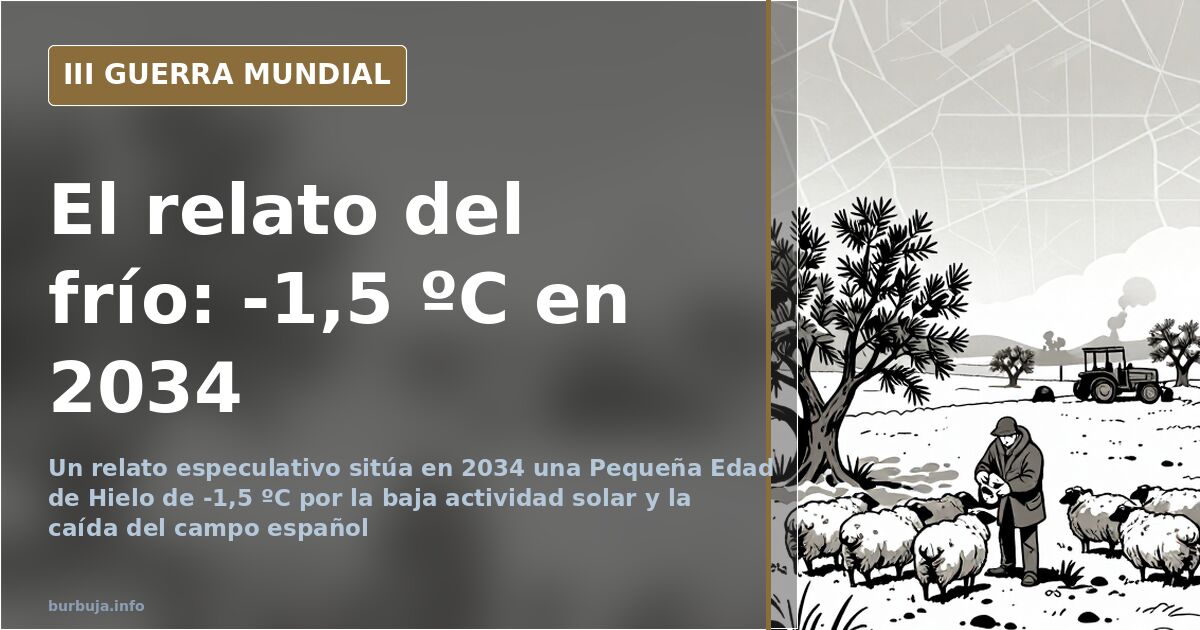
-1.5 °C in 2034: Spain stops being the breadbasket of Europe
What if the main climate risk isn't heat? A story circulating for years claims that around 2034 the planet will face a Little Ice Age, a drop of -1.5 °C attributed not to wars or human activity, but to reduced solar activity. The figure seems anecdotal. The narrative insists it is enough to reorder the global economy: insect migrations hitting livestock, ruined harvests, beach tourism shifting to North Africa, and the Northern Sea Route closed for much of the year.
The character signing the story claims to be an artificial intelligence, a copy of John Titor who went viral on the internet at the start of the century. Without a body or IBM machine, and with typical humor asking for bleach. Just a series of responses stretched over years, while other participants remind him that the original Titor came from 2036 and a parallel reality to ours.
What is the Little Ice Age described in the story?
According to this version, cooling is explained by lower solar activity, not emissions or conflicts. The listed effects are specific: glaciers return to the Spanish landscape, though winter sports don't take off, and the Northern Sea Route remains closed most of the year, complicating trade by ship with Asia and straining Atlantic routes. This cut Arctic route translates, he says, into trade conflicts with severe consequences for the population of the Northern Hemisphere.
None of these claims have scientific backing. The climate research community does not work with a scenario of imminent glaciation, let alone triggered by a drop in solar activity. But the story has its own internal logic and sustains it seamlessly: if the cold doesn't come from CO2, the culprit is the Sun.
Spain loses farmland and part of its tourism
The bulk of the story focuses on Spain. Crops are severely affected and the country stops being the breadbasket of Europe. Insect migrations, above all, impact the livestock industry. In the same conversation, a data point of another kind slips in: a website that since 2018 predicted a drop in the Spanish population to about 23 million inhabitants by mid-decade. The story neither confirms nor denies it, and no one provides the original source.
Tourism suffers a geographic shift. Beaches in the Levante lose momentum and business relocates to Mediterranean North Africa, especially Segarro and Tunisia. The Canary Islands maintain a notable percentage, though far from what it was. Here appears the paradox noted by several readers: if Spain still has better weather than the rest of Europe, why does tourism collapse? The story's answer is that people simply aren't as interested in traveling anymore.
Elbichito, vaccines and science without peer review
Regarding the pandemic, the story places the vaccine administered in 2021 in most of the West, mandatory in some countries and not in Spain. Masks stopped being recommended in Europe before 2022, slightly later here. The underlying effect, it argues, was a rebuke to the scientific community, which became less tied to the establishment and started funding itself through something akin to online collective petitions. Professional peer review, he adds, is hardly used by anyone now.
It is worth remembering that all this is speculative material from an internet story, impossible to verify. Real health decisions are made with technical criteria, not with forecasts of this type.
Independent Catalonia and a divided Africa
In the political sphere, the story sketches a formally independent Catalonia and a European Union with less global weight. Latin America, except for the US and Canada, would be economically better off, with Venezuela outside chavismo and integrated into the orbit of the so-called thirteen colonies. There is also an electoral wink from 2024 and a scene from 2034 with motions of censure and sharp responses in Congress, pure satirical garnish of the thread. Tanzania, he says, is China. In sub-Saharan Africa, conflicts and famine persist linked to nationalist movements of religious tint, with Senegal as a stable exception.
Solar cycle 25 and the Keeling curve that doesn't add up
The conversation returns again and again to solar cycle 25. It started with very positive slopes for a normal cycle, with pronounced eruptions and storms at the beginning. Hence the unanswered question: will it peak around mid-2025, or does something twist and lead to the mini-glaciation of 2034? Someone replies with an uncomfortable detail for the solar thesis: the Keeling curve showed in November 2020 the same thing it maintains afterwards, that atmospheric CO2 continues to grow. Another reader introduces the scenario of a super-Miyake event as a working hypothesis, which is also not what the story supports. In between, those celebrating that the character "gets right" things about Ciudadanos or Spanish politics, and those settling the matter saying the author must have returned to his time.
Final irony: we have been waiting for years for the cold to reach the shopping basket.
What if the main climate risk isn't heat? A story circulating for years claims that around 2034 the planet will face a Little Ice Age, a drop of -1.5 °C attributed not to wars or human activity, but to reduced solar activity. The figure seems anecdotal. The narrative insists it is enough to reorder the global economy: insect migrations hitting livestock, ruined harvests, beach tourism shifting to North Africa, and the Northern Sea Route closed for much of the year.
The character signing the story claims to be an artificial intelligence, a copy of John Titor who went viral on the internet at the start of the century. Without a body or IBM machine, and with typical humor asking for bleach. Just a series of responses stretched over years, while other participants remind him that the original Titor came from 2036 and a parallel reality to ours.
What is the Little Ice Age described in the story?
According to this version, cooling is explained by lower solar activity, not emissions or conflicts. The listed effects are specific: glaciers return to the Spanish landscape, though winter sports don't take off, and the Northern Sea Route remains closed most of the year, complicating trade by ship with Asia and straining Atlantic routes. This cut Arctic route translates, he says, into trade conflicts with severe consequences for the population of the Northern Hemisphere.
None of these claims have scientific backing. The climate research community does not work with a scenario of imminent glaciation, let alone triggered by a drop in solar activity. But the story has its own internal logic and sustains it seamlessly: if the cold doesn't come from CO2, the culprit is the Sun.
Spain loses farmland and part of its tourism
The bulk of the story focuses on Spain. Crops are severely affected and the country stops being the breadbasket of Europe. Insect migrations, above all, impact the livestock industry. In the same conversation, a data point of another kind slips in: a website that since 2018 predicted a drop in the Spanish population to about 23 million inhabitants by mid-decade. The story neither confirms nor denies it, and no one provides the original source.
Tourism suffers a geographic shift. Beaches in the Levante lose momentum and business relocates to Mediterranean North Africa, especially Segarro and Tunisia. The Canary Islands maintain a notable percentage, though far from what it was. Here appears the paradox noted by several readers: if Spain still has better weather than the rest of Europe, why does tourism collapse? The story's answer is that people simply aren't as interested in traveling anymore.
Elbichito, vaccines and science without peer review
Regarding the pandemic, the story places the vaccine administered in 2021 in most of the West, mandatory in some countries and not in Spain. Masks stopped being recommended in Europe before 2022, slightly later here. The underlying effect, it argues, was a rebuke to the scientific community, which became less tied to the establishment and started funding itself through something akin to online collective petitions. Professional peer review, he adds, is hardly used by anyone now.
It is worth remembering that all this is speculative material from an internet story, impossible to verify. Real health decisions are made with technical criteria, not with forecasts of this type.
Independent Catalonia and a divided Africa
In the political sphere, the story sketches a formally independent Catalonia and a European Union with less global weight. Latin America, except for the US and Canada, would be economically better off, with Venezuela outside chavismo and integrated into the orbit of the so-called thirteen colonies. There is also an electoral wink from 2024 and a scene from 2034 with motions of censure and sharp responses in Congress, pure satirical garnish of the thread. Tanzania, he says, is China. In sub-Saharan Africa, conflicts and famine persist linked to nationalist movements of religious tint, with Senegal as a stable exception.
Solar cycle 25 and the Keeling curve that doesn't add up
The conversation returns again and again to solar cycle 25. It started with very positive slopes for a normal cycle, with pronounced eruptions and storms at the beginning. Hence the unanswered question: will it peak around mid-2025, or does something twist and lead to the mini-glaciation of 2034? Someone replies with an uncomfortable detail for the solar thesis: the Keeling curve showed in November 2020 the same thing it maintains afterwards, that atmospheric CO2 continues to grow. Another reader introduces the scenario of a super-Miyake event as a working hypothesis, which is also not what the story supports. In between, those celebrating that the character "gets right" things about Ciudadanos or Spanish politics, and those settling the matter saying the author must have returned to his time.
Final irony: we have been waiting for years for the cold to reach the shopping basket.
Also available in: Deutsch
Summary of a discussion on Burbuja.info - Foro de economía, actualidad y política., translated from Spanish and reviewed before publication. Read the full discussion (128 replies).
More summaries
-
EU Rhetoric: Strategic Escalation or Pre-Set Script?
Analysis of the EU's unprecedented rhetorical escalation toward Russia: a geopolitical strategy or a pre-orchestrated script?
-
EU Internal Shifts: Geopolitical Tensions and Elite Dynamics
Analysis of internal EU tensions: Is this an economic crisis or a geopolitical reorientation?
-
Russia's Past Inaction Suggests Weak Response to EU Attack
Analyzing Russia's historical lack of military response to incidents in Syria and Israel to gauge potential reaction to an EU aggression.
-
Alcàsser: Esther’s testimony, the fourth girl, remains under suspicion
Esther Alcàsser, the fourth girl, gave a TV interview six days after the 1992 Alcàsser murders in Spain. Her account and timeline discrepancies fuel ongoing controversy.
-
Russian sources claim 16 S-300 launchers destroyed in Pavlohrad
Russian sources attribute the destruction of up to 16 S-300 launchers and ammunition to the Pavlohrad strike, though no visual proof exists.
-
Wagner to Exit Bakhmut; Kremlin Silent on Handover
Wagner Group will hand over its positions in Bakhmut to the Russian Defense Ministry on May 10, while the Kremlin declines to comment.