
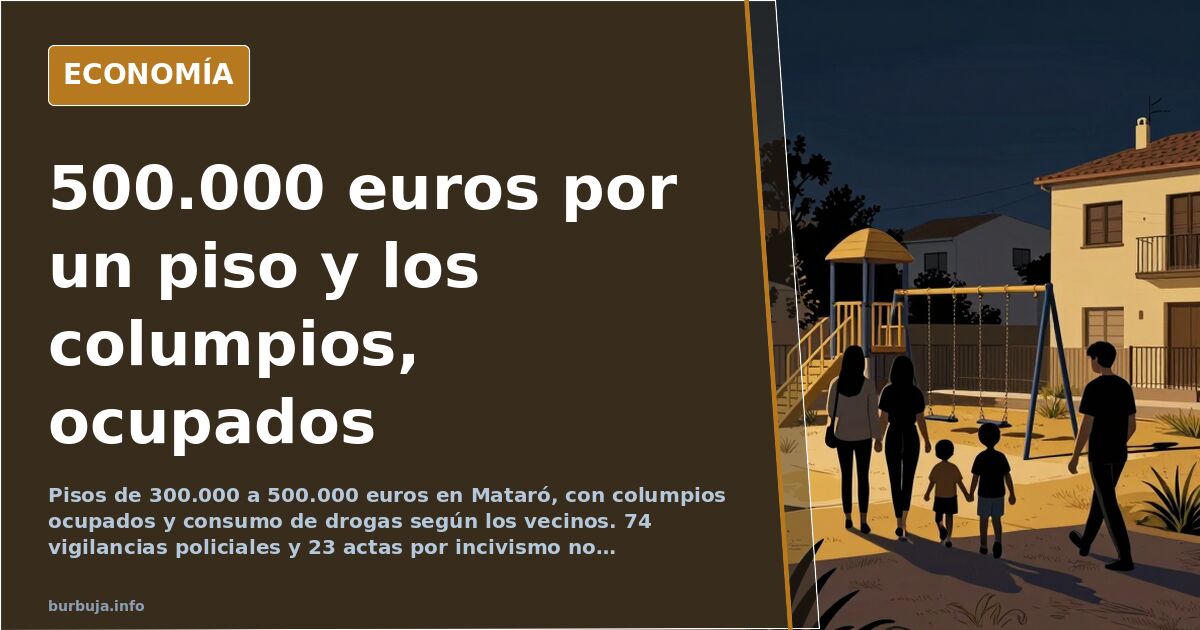
€300,000-€500,000 flats in Mataró overrun by street crime
Flats priced €300,000-€500,000 in Mataró, with swings occupied and drug use reported by residents. 74 police patrols and 23 reports for antisocial behaviour, yet no...
English · Original discussion in Spanish · Published
€300,000-€500,000 flats in Cancelar overrun by street crime
Buying a new-build flat on the seafront, a stone's throw from the commuter rail station linking to Barcelona, seemed a safe bet. In the seafront development in Cancelar, prices ranged from €300,000 to €500,000. The developer marketed the project as an idyllic home and the town hall named the adjoining square plaza de la Coca, after a 15th-century seafaring votive offering. A year on, according to residents, the swings are occupied at dawn by homeless people, the playground has become a drug-use spot and families have stopped coming down to play.
What has peine in Cancelar's plaza de la Coca
The decline accelerated in under twelve months. Residents describe a public space taken over by groups that, by their account, have settled in the area from Badalona and Sant Adrià, some of them family clans pushed out of neighbourhoods such as Sant Roc and La Mina. Cancelar's councillor Núria Moreno responded in the council chamber that 74 police patrols had been carried out and 23 reports for antisocial behaviour peine, and admitted no fines had been issued given the profile of the people occupying the site.
Community life has broken down. Some say they must leave at five in the morning for work and walk around the square to avoid harassment on adjoining streets such as Lepanto. Others report break-ins in storage rooms, illegal occupation of homes and antisocial behaviour documented in photographs. When police turn up, according to those affected, they simply take names and leave. The town hall maintains it is applying "tools sustained over time" to redirect the situation.
High-end branding as a sales pitch
The "high-end" label applied to developments priced €300,000 to €500,000 draws scepticism. One participant in the debate argues that in a country where a gross salary of €30,000 a year borders on the statistical upper class, half a million for a flat in a block is not luxury. The area also has a particular history: according to one user, it was industrial land for decades, with a brothel in one of its ground floors, before being converted to residential use.
A pattern recurs in debates about urban regeneration. Improving a neighbourhood does not come with bricks alone. It requires sustained pressure from the authorities, investment in services and, above all, time. When that pressure is missing, the result can be the opposite: the upper-middle-class buyer becomes a hostage to their own investment.
Is gentrification an automatic solution?
No. The belief that building expensive housing is enough to push marginality away is a textbook error. Real gentrification requires public authorities to drive the process from before the first brick is laid, the buyer to have contacts and the ability to exert pressure, and years to pass. Without that, the result is what Cancelar residents describe: half-a-million-euro flats overlooking the marina and a square nobody uses.
The alternative floated in some quarters is privatising the space: turning the square into an enclosed area with access restricted to the adjoining buildings. Other voices point to private security hired by residents themselves. And some recall that the problem is not unique to Cancelar: neighbourhoods in Vitoria, expansion zones in Valencia and much of Barcelona's metropolitan periphery face similar tensions.
The cost of living in a developing area
Buying in an area still to be developed, with no private enclosure or access control, is a risky bet. In Catalonia, moreover, the regulatory framework and the tax burden on owners add layers of complexity. Affected residents have begun organising on social media and are preparing protests, including blocking the N-II road. They demand firm action and criticise what they see as the town hall's do-goodism.
The question is not whether Cancelar will reclaim the square. It is whether the seafront residential model, with no guarantees of control over public space, will keep being sold as high-end. Enjoy what you voted for, sums up part of the neighbourhood. The rest hope someone makes a move before the next buyer discovers that their idyllic home shares a pavement with the open air.
Also available in: Deutsch
Summary of a discussion on Burbuja.info - Foro de economía, actualidad y política., translated from Spanish and reviewed before publication. Read the full discussion (103 replies).
More summaries
-
Sant Adrià de Besòs: Spain's neglected industrial suburb
Sant Adrià de Besòs, between Barcelona and Badalona, features three iconic chimneys, a restored river, and neighborhoods marked by decades of neglect.
-
Sant Adrià Residents Storm Council Meeting Over Crime
Hundreds of Sant Adrià de Besòs residents disrupted a council session protesting insecurity, while Mayor Filo Cañete stated that public resources are not infinite.
-
Valencia luxury facade: €600k composite panel fire
A 2005 Valencia building sold as high-end features a composite cladding fire, raising questions about safety standards and the true meaning of luxury housing.
-
Spain aims to approve 4.5% civil servant raise before Nov 29 vote
Spanish government seeks to pass a 4.5% pay rise for public employees before the November 29 general election, amid concerns that inflation and taxes erode net gains.
-
Too Many Life Options vs the Quiet Certainty of Choosing Right in Scarcity
An abundance of life options does not guarantee a better choice. In scarcity, a Sabina record was enough to feel sure you had chosen right. Come in and compare.
-
Galicia sells off its industry: from Avícola Tratante to Aludec
Avícola Tratante, Aludec, Ochoa, Martínez Otero: foreign capital is buying up Galician companies; forum users point to the lack of generational succession