
Valencia luxury facade: €600k composite panel fire
A 2005 Valencia building sold as high-end features a composite cladding fire, raising questions about safety standards and the true meaning of luxury housing.
English · Original discussion in Spanish · Published
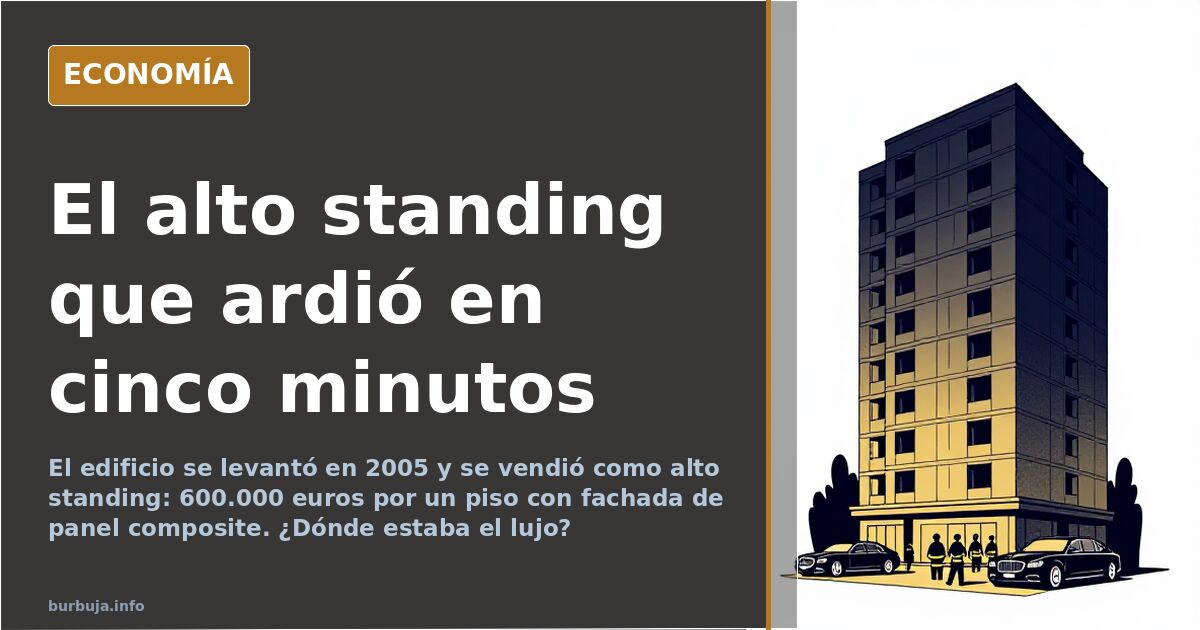
Valencia luxury facade: €600k composite panel fire
"It was horrible. Everything burned in five minutes. I grabbed my son and we ran. I lost everything." The woman speaking these words is one of the owners of a building constructed in 2005 and damaged in Valencia, and her testimony, reported by Levante-EMV, ends with the question that summarizes the issue: "They sold us that it was a high-end property. Where is the high-end here?". The answer provided by the market itself is uncomfortable. In Spain, "high-end" is a price label, not a quality certificate, and some argue that the real threshold for this supposed luxury starts at one million euros. Everything below that is sold as luxury without being so.
Who was in power in 2005 when the building was constructed?
In 2005, José Luis Rodríguez Zapatero was in power, and part of the analysis turns this fact into the axis of political responsibility. This argument clashes with a detail: the regulation governing construction, the Law 38/1999, of November 5, on the Ordering of Building Construction, predates that government. And it is state-level. The Technical Building Code is not legislated by the autonomous communities; the obligations and guarantees of the construction process are set in Madrid. Hence, another current distributes blame among ministries, professional colleges of architects and quantity surveyors, and developers.
There remains one unanswered documented question: why a material authorized at the time is now considered insufficiently safe. The Grenfell Tower fire in London is the precedent cited in the thread, and according to what is argued there, neither the Ministry nor the professional colleges prompted a massive review of buildings clad with that same type of panel.
What is a composite panel and why does it burn?
Two metal sheets — aluminum, stainless steel, copper, or brass — and an inner core of thermoplastic resins made of polyethylene or mineral. That is, literally, what a manufacturer's catalog, supposedly dated 2012, describes. The composite rigidizes the panel and allows it to be bent while maintaining its shape: lightweight, moldable, attractive. The weak point lies in the filling. This is compounded, according to an analysis circulating in the thread, by the ventilated facade design, with a cavity through which air enters from below and a compressor moves it from above, circulating through all floors, kitchens, and bathrooms. A full-height ventilation tube attached to the envelope.
Those who have worked with insulation qualify this. The cellulose injected into the cavity is treated with flame retardant and does not burn, it is argued. The problem arises when each owner intervenes on their own: some wrap the box of an electrical outlet with polyurethane foam and turn a partition into a fuse. The air cavity, unsealed, does the rest.
The shelter-in-place protocol and the Grenfell precedent
A testimony circulated in the analysis claims that a family remained trapped in the bathroom because they were instructed not to leave, and that hours later the order was reversed. The parallel with London is repeated, according to those telling it in the thread: there too, a shelter-in-place order was given before switching to "save yourself." In Spain, the instruction to stay home when smoke already dominates the stairwells is a debated protocol, and here the damage is measured in victims. Any fruta regarding the performance of emergency services is, at the date of this analysis, without public resolution: what exists are accounts from those affected and an open question about whether command or coordination failed.
Price is not quality: the staircase no one looks at
The circulating numbers draw an uncomfortable scale. A property worth €200,000 and another worth €500,000 in the same city hardly differ, according to what is argued, in location. One participant sets the Valencia capital apartment at €600,000, sold as high-end. And the true supposed luxury, placed by some at one million, is not always in the square footage or finishes. What you pay for is the land, the neighborhood, the label. The consequence is that the buyer assumes a high price equates to a better-constructed building. There is no such equivalence, and when the cladding burns in five minutes, the bill is presented by the smoke.
Who pays when the apartment is lost?
Home insurance covers contents and structure, and what is paid out depends on the insured amount in each section, as explained in the debate. This is added to the community of owners' policy, which usually assumes debris removal and other common expenses. The proportional share of the land, in any case, remains with the owner. No one who has gone through such a settlement describes it as simple.
With the cause of the fire still unclosed, the analysis gets stuck exactly where the important part begins: whether the regulation allowed this material, if someone reviewed it later, and why an owner paid a luxury price for an envelope that burned entirely. No one disputes the "high-end" label anymore. They dispute who signed for it.
"It was horrible. Everything burned in five minutes. I grabbed my son and we ran. I lost everything." The woman speaking these words is one of the owners of a building constructed in 2005 and damaged in Valencia, and her testimony, reported by Levante-EMV, ends with the question that summarizes the issue: "They sold us that it was a high-end property. Where is the high-end here?". The answer provided by the market itself is uncomfortable. In Spain, "high-end" is a price label, not a quality certificate, and some argue that the real threshold for this supposed luxury starts at one million euros. Everything below that is sold as luxury without being so.
Who was in power in 2005 when the building was constructed?
In 2005, José Luis Rodríguez Zapatero was in power, and part of the analysis turns this fact into the axis of political responsibility. This argument clashes with a detail: the regulation governing construction, the Law 38/1999, of November 5, on the Ordering of Building Construction, predates that government. And it is state-level. The Technical Building Code is not legislated by the autonomous communities; the obligations and guarantees of the construction process are set in Madrid. Hence, another current distributes blame among ministries, professional colleges of architects and quantity surveyors, and developers.
There remains one unanswered documented question: why a material authorized at the time is now considered insufficiently safe. The Grenfell Tower fire in London is the precedent cited in the thread, and according to what is argued there, neither the Ministry nor the professional colleges prompted a massive review of buildings clad with that same type of panel.
What is a composite panel and why does it burn?
Two metal sheets — aluminum, stainless steel, copper, or brass — and an inner core of thermoplastic resins made of polyethylene or mineral. That is, literally, what a manufacturer's catalog, supposedly dated 2012, describes. The composite rigidizes the panel and allows it to be bent while maintaining its shape: lightweight, moldable, attractive. The weak point lies in the filling. This is compounded, according to an analysis circulating in the thread, by the ventilated facade design, with a cavity through which air enters from below and a compressor moves it from above, circulating through all floors, kitchens, and bathrooms. A full-height ventilation tube attached to the envelope.
Those who have worked with insulation qualify this. The cellulose injected into the cavity is treated with flame retardant and does not burn, it is argued. The problem arises when each owner intervenes on their own: some wrap the box of an electrical outlet with polyurethane foam and turn a partition into a fuse. The air cavity, unsealed, does the rest.
The shelter-in-place protocol and the Grenfell precedent
A testimony circulated in the analysis claims that a family remained trapped in the bathroom because they were instructed not to leave, and that hours later the order was reversed. The parallel with London is repeated, according to those telling it in the thread: there too, a shelter-in-place order was given before switching to "save yourself." In Spain, the instruction to stay home when smoke already dominates the stairwells is a debated protocol, and here the damage is measured in victims. Any fruta regarding the performance of emergency services is, at the date of this analysis, without public resolution: what exists are accounts from those affected and an open question about whether command or coordination failed.
Price is not quality: the staircase no one looks at
The circulating numbers draw an uncomfortable scale. A property worth €200,000 and another worth €500,000 in the same city hardly differ, according to what is argued, in location. One participant sets the Valencia capital apartment at €600,000, sold as high-end. And the true supposed luxury, placed by some at one million, is not always in the square footage or finishes. What you pay for is the land, the neighborhood, the label. The consequence is that the buyer assumes a high price equates to a better-constructed building. There is no such equivalence, and when the cladding burns in five minutes, the bill is presented by the smoke.
Who pays when the apartment is lost?
Home insurance covers contents and structure, and what is paid out depends on the insured amount in each section, as explained in the debate. This is added to the community of owners' policy, which usually assumes debris removal and other common expenses. The proportional share of the land, in any case, remains with the owner. No one who has gone through such a settlement describes it as simple.
With the cause of the fire still unclosed, the analysis gets stuck exactly where the important part begins: whether the regulation allowed this material, if someone reviewed it later, and why an owner paid a luxury price for an envelope that burned entirely. No one disputes the "high-end" label anymore. They dispute who signed for it.
Also available in: Deutsch
Summary of a discussion on Burbuja.info - Foro de economía, actualidad y política., translated from Spanish and reviewed before publication. Read the full discussion (281 replies).
More summaries
-
Zapatero breaks silence on TVE: jewelry, script, and legality
Zapatero's TVE interview: no clarity on jewelry origin, citing 'no profit motive' and full legality.
-
Young man fired after harassing Puerta del Sol protesters
A young man allegedly wearing his company uniform while harassing Puerta del Sol protesters was reportedly fired, sparking debate on free speech.
-
Spain's Parasite Debate: Cultural Shock or Marketing?
Analysis of the debate on deworming in Spain: is it a cultural clash, a public health need, or just marketing?
-
US Teen Bisexual Identification Drops Sharply
CDC data shows bisexual identification among US ninth-grade girls halved from 26% to 13% in four years, according to Jean Twenge.
-
Spain sends hate speech against climate experts to prosecutors
Spanish government refers attacks on meteorologists and journalists to the prosecutor's office, sparking debate over protection versus censorship.
-
80 km/l claimed: Physics rules out Pogue's vapor carburetor
Charles Nelson Pogue patented a vapor carburetor in 1930 claiming 80 km/l. Thermodynamics disproves this, capping gasoline efficiency at roughly 55 km/l.