
Sant Adrià de Besòs: Spain's neglected industrial suburb
Sant Adrià de Besòs, between Barcelona and Badalona, features three iconic chimneys, a restored river, and neighborhoods marked by decades of neglect.
English · Original discussion in Spanish · Published
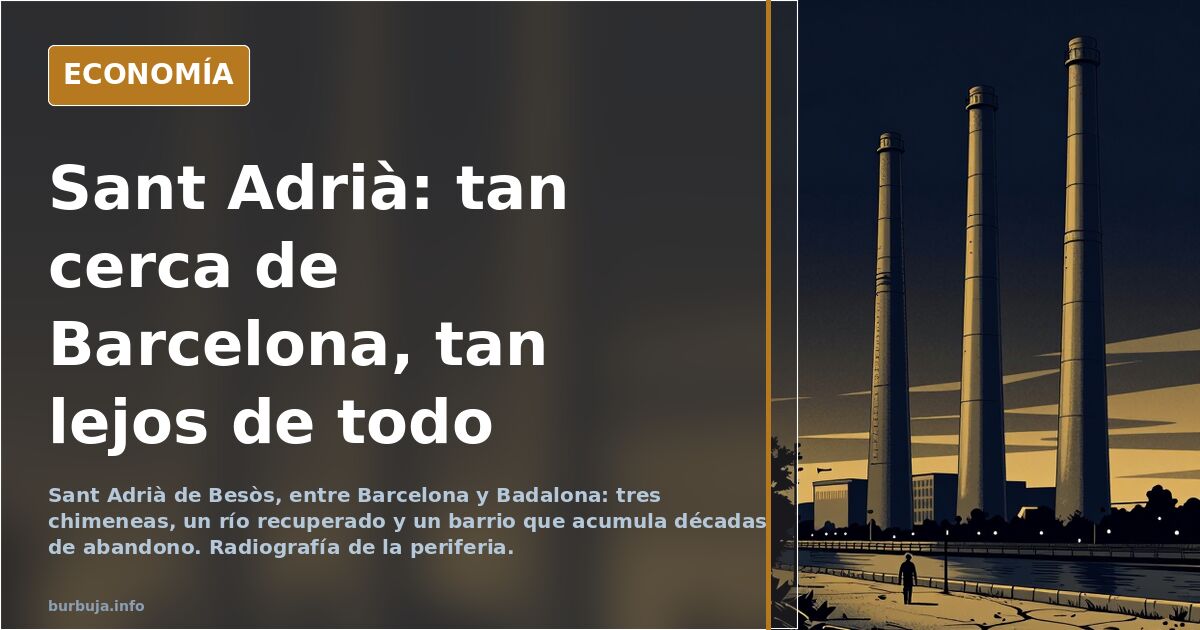
Sant Adrià de Besòs, where Barcelona ends and nothing begins
What lies at the end of the Diagonal avenue, just where the asphalt stops being called Barcelona? Sant Adrià de Besòs. A municipality squeezed between the Catalan capital, Badalona, and Santa Coloma, crossed by the Besòs River and dominated by three concrete chimneys that have not emitted smoke for years. The question is not rhetorical: many people living ten minutes away by metro have never set foot on its streets.
This is the thesis behind a description of the municipality that has circulated widely: Sant Adrià as an transit zone, a place where concrete spreads in soulless geometric forms and instinct urges you to leave immediately. It is not a new idea. It is the old suspicion that metropolitan peripheries accumulate everything the city center expels: obsolete industry, degraded housing, impoverished populations, and administration that arrives late and poorly.
The Three Chimneys and the narrative of the sinister
The symbol of the municipality is the trio of towers from the former thermal power plant, popularly known as Chernobyl. Colossal, absurd, visible from half the metropolitan area. Around them has grown folklore mixing the industrial with the esoteric: echoes of machinery inside, ritual uses attributed to scrap collectors, and a presence described like that of a god dead for eons.
It is worth separating fact from story. The fact: the plant stopped operating, and its future was decided partly by citizen consultation. In November 2008, the town hall held a vote on keeping the towers and transforming them into a social center. 2,597 people participated, 9.1% of the census, and 82.2% voted in favor. Meaning: less than one-tenth of the city decided on a symbol of the city. Abstention was the true majority.
The story, however, is different. The beach as nocturnal territory, the river as a wound, a hypermarket parking lot as liminal space. Some attribute this to a poorly digested Lovecraftian imaginary; others argue the discomfort is real and perfectly earthly.
The river that stopped smelling: from drain to bike path
Here the material corrects itself, and it is worth noting. The image of the Besòs as a green sewer with foam is historical, not current. Several testimonies agree that the river runs almost crystal clear since polluting industries upstream were removed, antiestéticaturing large carp, herons, and other birds, and is now a walking area and bike lane. There are even informational signs about fauna, mentioning otters that some doubt exist.
The nuance matters because it dismantles half the legend. What does not change is the geometry: unlike the Turia, the Besòs is not diverted, so there is little room for urban fantasy. When it rises, it rises. For decades, easy jokes about the river were common among Barcelonans.
La Mina, Alcampo, and the geography of antiestéticar
The La Mina neighborhood appears in all descriptions as the hard core of the problem: overcrowding, drugs, inherited marginality, a bust of flamenco singer Camarón watching over an exit that never comes. The most repeated comparison is not with El Raval or Paral·lel—tense but much more trafficked and monitored areas—but with Madrid's peripheral neighborhoods or Toledo's La Sagra. With one difference in Sant Adrià's favor: here the pavor has a limit, the sea.
The Alcampo parking lot functions in the imagination as a border. By day, the hypermarket imposes order; by night, wet asphalt and dust-covered cars fuel all kinds of rumors. Some describe it as a scene for clandestine meetings, while others dismiss it outright as urban legend. Neither can be verified with available information.
Impossible coexistence: Diagonal Mar on one side, La Mina on the other
The most uncomfortable question was asked bluntly: how do two such opposite realities coexist within meters? Diagonal Mar, an area of new construction and high prices, facing a setting of degraded housing. The answer given is that physical distance is deceptive: what separates both worlds is not barbed wire, but the price per square meter.
This is probably the most useful economic reading of the whole affair. Sant Adrià is not an isolated urban planning failure: it is the residue of a metropolitan model that concentrated investment in the center and new luxury poles, leaving first-ring industrial municipalities with environmental liabilities, old housing, and populations unable to afford escape.
El Maquinista, Dreamfit, and daily life
Against the pavor story, there is counter-programming. Residents and visitors recount perfectly normal routines: going to the shopping center gym, buying groceries at Alcampo, walking along the Besòs river park, crossing the Fòrum. Some even recall gym closures during the pandemic from inside one of those venues.
Others admit having traveled through areas they would not enter today, and argue that El Raval or Paral·lel are worse, just more monitored. Perceived insecurity, in any case, is not objective data: it is a mix of statistics, memory, and prejudice, and should be treated as such.
The underlying question remains: is Sant Adrià a cursed place or simply a poor place next to a rich one? The honest answer is that the three chimneys are still there, that 82.2% of voters wanted to keep them, and that the remaining 90.9% did not bother to give an opinion. That, and not Cthulhu, explains quite well what happens at the mouth of the Besòs.
What lies at the end of the Diagonal avenue, just where the asphalt stops being called Barcelona? Sant Adrià de Besòs. A municipality squeezed between the Catalan capital, Badalona, and Santa Coloma, crossed by the Besòs River and dominated by three concrete chimneys that have not emitted smoke for years. The question is not rhetorical: many people living ten minutes away by metro have never set foot on its streets.
This is the thesis behind a description of the municipality that has circulated widely: Sant Adrià as an transit zone, a place where concrete spreads in soulless geometric forms and instinct urges you to leave immediately. It is not a new idea. It is the old suspicion that metropolitan peripheries accumulate everything the city center expels: obsolete industry, degraded housing, impoverished populations, and administration that arrives late and poorly.
The Three Chimneys and the narrative of the sinister
The symbol of the municipality is the trio of towers from the former thermal power plant, popularly known as Chernobyl. Colossal, absurd, visible from half the metropolitan area. Around them has grown folklore mixing the industrial with the esoteric: echoes of machinery inside, ritual uses attributed to scrap collectors, and a presence described like that of a god dead for eons.
It is worth separating fact from story. The fact: the plant stopped operating, and its future was decided partly by citizen consultation. In November 2008, the town hall held a vote on keeping the towers and transforming them into a social center. 2,597 people participated, 9.1% of the census, and 82.2% voted in favor. Meaning: less than one-tenth of the city decided on a symbol of the city. Abstention was the true majority.
The story, however, is different. The beach as nocturnal territory, the river as a wound, a hypermarket parking lot as liminal space. Some attribute this to a poorly digested Lovecraftian imaginary; others argue the discomfort is real and perfectly earthly.
The river that stopped smelling: from drain to bike path
Here the material corrects itself, and it is worth noting. The image of the Besòs as a green sewer with foam is historical, not current. Several testimonies agree that the river runs almost crystal clear since polluting industries upstream were removed, antiestéticaturing large carp, herons, and other birds, and is now a walking area and bike lane. There are even informational signs about fauna, mentioning otters that some doubt exist.
The nuance matters because it dismantles half the legend. What does not change is the geometry: unlike the Turia, the Besòs is not diverted, so there is little room for urban fantasy. When it rises, it rises. For decades, easy jokes about the river were common among Barcelonans.
La Mina, Alcampo, and the geography of antiestéticar
The La Mina neighborhood appears in all descriptions as the hard core of the problem: overcrowding, drugs, inherited marginality, a bust of flamenco singer Camarón watching over an exit that never comes. The most repeated comparison is not with El Raval or Paral·lel—tense but much more trafficked and monitored areas—but with Madrid's peripheral neighborhoods or Toledo's La Sagra. With one difference in Sant Adrià's favor: here the pavor has a limit, the sea.
The Alcampo parking lot functions in the imagination as a border. By day, the hypermarket imposes order; by night, wet asphalt and dust-covered cars fuel all kinds of rumors. Some describe it as a scene for clandestine meetings, while others dismiss it outright as urban legend. Neither can be verified with available information.
Impossible coexistence: Diagonal Mar on one side, La Mina on the other
The most uncomfortable question was asked bluntly: how do two such opposite realities coexist within meters? Diagonal Mar, an area of new construction and high prices, facing a setting of degraded housing. The answer given is that physical distance is deceptive: what separates both worlds is not barbed wire, but the price per square meter.
This is probably the most useful economic reading of the whole affair. Sant Adrià is not an isolated urban planning failure: it is the residue of a metropolitan model that concentrated investment in the center and new luxury poles, leaving first-ring industrial municipalities with environmental liabilities, old housing, and populations unable to afford escape.
El Maquinista, Dreamfit, and daily life
Against the pavor story, there is counter-programming. Residents and visitors recount perfectly normal routines: going to the shopping center gym, buying groceries at Alcampo, walking along the Besòs river park, crossing the Fòrum. Some even recall gym closures during the pandemic from inside one of those venues.
Others admit having traveled through areas they would not enter today, and argue that El Raval or Paral·lel are worse, just more monitored. Perceived insecurity, in any case, is not objective data: it is a mix of statistics, memory, and prejudice, and should be treated as such.
The underlying question remains: is Sant Adrià a cursed place or simply a poor place next to a rich one? The honest answer is that the three chimneys are still there, that 82.2% of voters wanted to keep them, and that the remaining 90.9% did not bother to give an opinion. That, and not Cthulhu, explains quite well what happens at the mouth of the Besòs.
Also available in: Deutsch
Summary of a discussion on Burbuja.info - Foro de economía, actualidad y política., translated from Spanish and reviewed before publication. Read the full discussion (136 replies).
More summaries
-
266,000 € for a 1975 Attic in Santa Coloma de Gramenet
A 1975 attic in Singuerlín costs 266,000 €, requiring an estimated 50,000 € renovation. With only 75,000 € saved, the financial math does not add up.
-
Santa Coloma taxi attack: No police report, date unconfirmed
Elite Taxi reported a driver assaulted by four women in Santa Coloma on May 30, but no police complaint exists and the video may be a year old.
-
Deutsche Bank puts up for sale Diagonal Mar shopping center in Barcelona for €500 million
Deutsche Bank is putting up for sale the Diagonal Mar shopping center in Barcelona for €500 million. The transaction is expected to close by 2027.
-
Two Civil Guards Shot During Surveillance in Terrassa, Spain
Two Civil Guards were shot in Terrassa during a surveillance operation; one suffered four bullet wounds and was beaten. The incident highlights security concerns in Spain.
-
Spain Pension Cuts: Voters Reject Austerity, Markets Impose It
Forum debate suggests economic pressures will force pension and wage cuts in Spain despite voter rejection of austerity measures.
-
Spain's Debate: Public Attire, Male Desire, and Social Tension
In Spain, a debate questions if revealing clothes provoke unfulfilled male desire, contrasting self-control arguments with social pressure.