
€2,000 dental implant fails after two years in Spain
A Spanish forum user reports their €2,000 implant loosened after two years despite good health. The thread debates warranties and pricing.
English · Original discussion in Spanish · Published
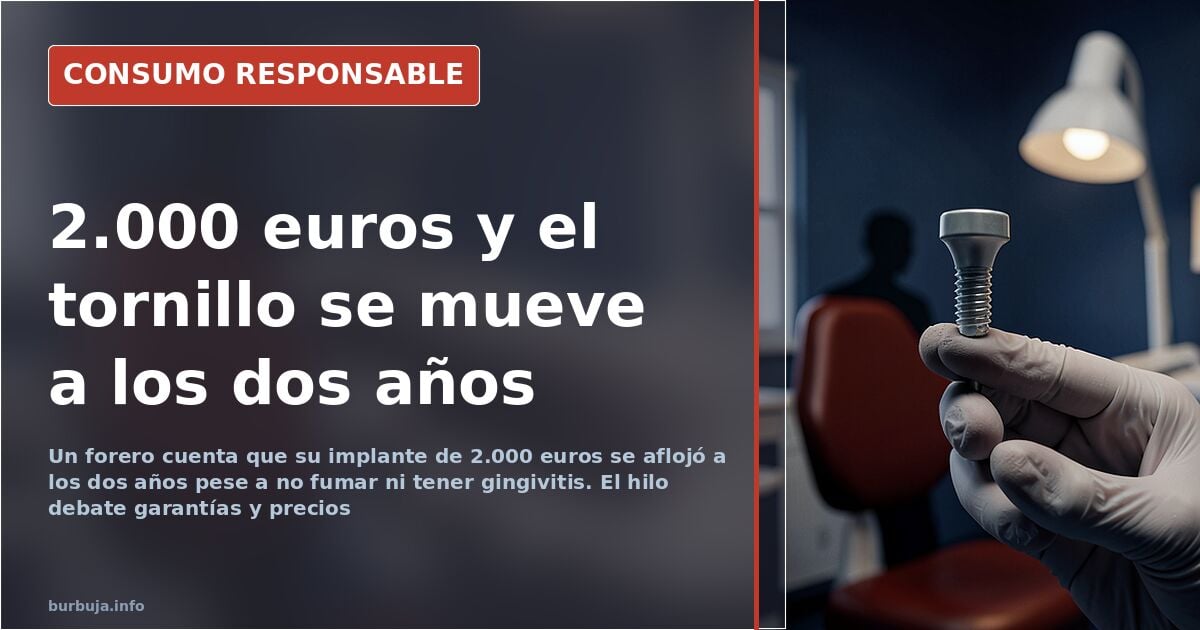
€2,000 implant loosens after two years
Almost two years. That is how long a patient’s implant lasted after paying nearly €2,000 at a fruta clinic, not a low-cost chain. They went back to have the screw retightened because it felt loose, but the diagnosis changed everything: the implant itself was unstable. Now they need a CT scan and must wait for the surgeon’s decision. This case, detailed on a consumer forum, highlights a broader frustration: money doesn’t guarantee results in dentistry, and the next step always costs more.
The patient doesn’t smoke, has no gingivitis, and lost the tooth due to trauma. This fact defies standard explanations. The usual reasons for failure—tobacco, inflamed gums, poor hygiene—don’t apply here. What remains are uncomfortable technical factors: overheating during drilling, poor implant angulation planning, or insufficient bone. These depend on technique and professional skill, not the client’s lifestyle.
How much does a dental implant cost and what does the warranty cover?
Figures discussed range from €1,000 per unit to the €2,000 of the initial case, with ceramic prosthetics adding another €500. Some clinics offer five-year full warranties, and patients who haven’t needed them after ten years exist. But fine print matters: when an implant fails, the warranty usually covers the component, not lost bone or subsequent grafts. That’s where costs skyrocket.
The conversation quickly shifts to bone grafting and platelet-rich plasma (PRP). One detailed case involved damaged bone requiring a graft using PRP derived from the patient’s own blood—centrifuged and applied to strengthen the site—and the implant became stable again. The solution exists, but it’s paid separately.
Why titanium implants fail even in healthy patients
Titanium rejection is rare. The prevailing theory in the discussion is different: the gum tissue doesn’t seal around the prosthesis as well as it does around a natural tooth, allowing bacteria to enter. This is why smoking increases risk—inflaming the gums—and why professional cleaning every six months becomes mandatory maintenance rather than a luxury. Those with multiple implants that last attribute success to hygiene and check-ups, not luck.
The other major issue is periodontitis, the disease attacking the bone at the tooth base, which causes more tooth loss than cavities. There’s suspicion of a genetic factor: not everyone accumulates tartar equally or needs the same cleaning frequency. This leads to questioning whether dentists sell unnecessary cleanings, a topic raised in the thread.
The debate over floss and food debris
Discussions heat up here. One school argues that protein residue between teeth doesn’t feed cavity-causing bacteria—which thrive on sugars and starches dissolved by saliva—and that arginine, an amino acid in proteins, neutralizes plaque acids. Toothpastes containing arginine are cited. The conclusion drawn: dental floss might be a scam.
Counterarguments cite real-life data: interproximal cavities affecting two adjacent teeth in daily floss users. And a simple point: if gums bleed when flossing, they’re inflamed; healthy gums don’t bleed. Comparisons with grandparents without teeth also enter the debate: healthier diets, less sugar, and early dentures. Hygiene, not diet, made the difference.
Prosthetics, gaps left unfilled, and regenerating teeth
Not everyone wants an implant. Some leave gaps if invisible to avoid costs, warned that neighboring teeth will shift. Others defend removable prosthetics as far less invasive, since not all jawbones tolerate drilling. A dentist’s warning that an upper tooth would eventually fall out proved false in some cases: ten years later, it remained in place.
The curiosity hovering over the entire conversation is the Japanese drug for tooth regeneration, already approved for human trials with commercial goals for 2030. Estimated price: $10,000–$15,000 to regenerate three teeth. More expensive than an implant, but no bone drilling. Plus, suspicions that pirated versions will circulate earlier in India and China, risking imperfect results.
Ultimately, the lingering question isn’t dental but economic. A €2,000 implant failing after two years leaves the patient with money spent, compromised bone, and the choice of paying again at the same place or switching providers. Warranties cover components. Trust is covered by no one.
Also available in: Deutsch
Summary of a discussion on Burbuja.info - Foro de economía, actualidad y política., translated from Spanish and reviewed before publication. Read the full discussion (55 replies).
More summaries
-
Dental Implant Costs €1,200 Despite Low Material Price
Forum users debate if a €1,200 implant is worth it when materials cost under €100. Risks of leaving gaps unfilled.
-
Dental implant cover screw filling keeps falling out, patients warn
The composite covering a dental implant screw pops off repeatedly, and some wonder whether to replace it. Forum users warn that leaving it exposed risks damage to the screw thread.
-
Dental implants in Spain: quotes range from €600 to €2,000
Dental implant quotes discussed in a Spanish forum range from €600 to €2,000 per tooth. Some argue that a chain's "from €222" offer only covers the…
-
Aging gracefully: surgery vs. genetics at 64
Madonna and Susanna Hoffs, both 64, illustrate two opposite ways of facing aging: surgery and gym versus habits and good spirits.
-
Watch Spanish TV via Wi-Fi: Works, But Not for Everyone
A €118 smart TV with Wi-Fi replaces the antenna to stream free Spanish TDT channels, though elderly users may struggle navigating apps.
-
Spanish cobbler charges €12 to glue sole after Pattex fails
A Spanish forum discusses repairing a detached boot sole. A cobbler quotes €12 for gluing and €28 for stitching, while users doubt domestic Pattex glue effectiveness.