
Spanish cobbler charges €12 to glue sole after Pattex fails
A Spanish forum discusses repairing a detached boot sole. A cobbler quotes €12 for gluing and €28 for stitching, while users doubt domestic Pattex glue effectiveness.
English · Original discussion in Spanish · Published
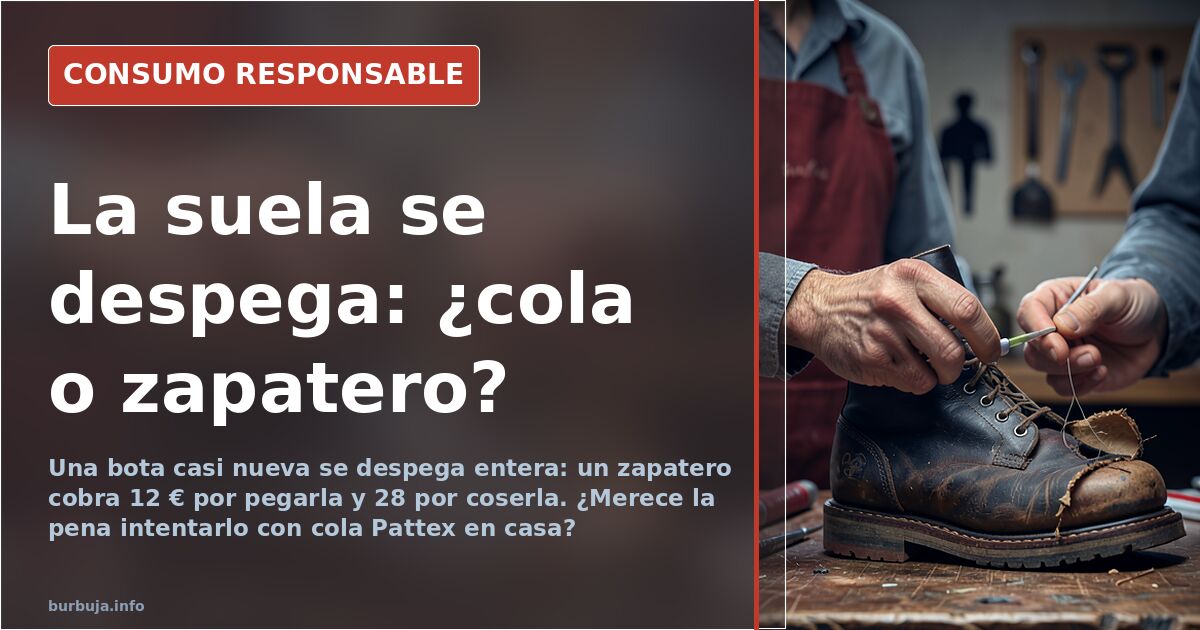
Gluing soles with Pattex: doubts and prices from €12 to €28
A nearly new boot, from a model the owner has used across ten pairs over twenty years, has its entire sole detached. The toe cap remains stitched; the rest is separated as if it never had glue. The owner has a tube of Pattex at home and a reasonable doubt: should I try it myself or take it to the cobbler? The first professional consulted was blunt: gluing is useless, it always comes off. The second gave a price: €12 for gluing and €28 for stitching.
The short answer is that several participants believe it can be glued, but almost no one does it correctly. Contact adhesive — neoprene, polyurethane, gel cyanoacrylate — requires a ritual that is skipped at home: very thin layers on both surfaces, drying until the finger doesn't stick, heat to reactivate the glue, and constant pressure for twenty-four hours. Without a last or clamp, the result is a lottery. And lotteries, with soles, are lost in the worst place.
Why a factory-glued sole detaches
Industrial footwear is not glued by hand. Micrometric layers of adhesive are applied and joined with heat and pressure on a last that leaves no bubbles. Hence the surface remains clean, with no trace of glue: the process is invisible to the eye. Reproducing this in a kitchen is another matter. As one participant summarizes, home repair "is going to be a lottery" and factory glue guarantees nothing when repaired poorly.
There is a nuance worth noting: past quality does not guarantee present quality. Several participants with decades of use of the same model agree that this unit came different, "strange, worse." Cost reduction in the supply chain is the hypothesis hovering.
What glue cobblers use and why household Pattex isn't enough
Contact adhesive is the trade standard. The key is not the brand but the procedure: spread, wait, heat, join, and press. Household Pattex glue is sold for insoles and fabric repairs, not for reconstructing an entire sole. Those who have tried it with this glue summarize it without euphemisms: "a mess, detached on first use."
The chemical alternative exists and is more exotic: dissolving polyethylene foam in gasoline to form a paste, or using halogenated solutions with polyurethane and UV developer. These are workshop formulas, difficult to find and harder to handle. For an unskilled user, the savings are eaten up by the risk.
Nails, screws, and stitching: options that really hold
Glue alone is not enough, experienced voices agree. The sole needs mechanical anchoring. Nails are driven from outside in, with length calculated so they do not peine the fiber midsole: upon reaching that harder layer, the tips bend and hook. From inside, the heads would rub against the foot. Screws trinc the same logic, from the sole toward the inner insole.
Stitching is the noble option, but expensive and delicate: three-centimeter leather needle, waxed thread, pliers to exert force from the interior. For €28, the cobbler assumes the risk of tearing the midsole with so many stitches. And watch out for the toe cap: that factory stitching wears out with use until it breaks.
Glue, stitch, or buy others: the calculation that decides
Arithmetic rules. Below €50, experimenting at home is reasonable. Between €50 and €100, paying for professional gluing is advisable. Above €100, workshop repair is imperative. These boots range around €80-100 on online sales platforms, so the balance tilts toward the cobbler's €12.
The consumer loophole remains: opening a claim on the purchase platform and fighting for a refund or exchange. With a nearly new product and an evident manufacturing defect, it is the most profitable route of all. The least exciting, too.
The prediction, with reservations: whoever glues at home without heat or press will see the sole separate on the second walk. Whoever pays the €12 probably gains months. Whoever stitches, years. And whoever claims, may pay nothing. But that depends on a store that, as of this discussion, no one has called yet.
Also available in: Deutsch
Summary of a discussion on Burbuja.info - Foro de economía, actualidad y política., translated from Spanish and reviewed before publication. Read the full discussion (104 replies).
More summaries
-
Polyurethane soles: The weak spot of many hiking boots
Polyurethane soles expire in five or six years, rendering expensive boots unusable. This thread discusses durability, Vibram, and Gore-Tex controversies.
-
Polyurethane soles: why shoes fall apart after 2 years
Polyurethane degrades on its own: Clarks, Camper and Chiruca shoes disintegrate after two years even if hardly worn. No receipt, no claim.
-
Hiking boots: pay for the brand or hunt for membrane and sole
The search for boots with a waterproof membrane and insulation at a reasonable price runs into Segarra's disappearance from physical stores and the weight of Bestard boots.
-
Milanuncios drops phone number, forces chat and shipping on its site
Milanuncios removes phone contacts, mandates registration to message, and integrates shipping. Sellers report a sharp drop in buyer inquiries.
-
Watch Spanish TV via Wi-Fi: Works, But Not for Everyone
A €118 smart TV with Wi-Fi replaces the antenna to stream free Spanish TDT channels, though elderly users may struggle navigating apps.
-
Eye floaters: Effective treatments and myths for myodesopsia
No non-surgical cure exists for eye floaters. Vitrectomy carries high risks. The effective solution is training the brain to ignore them.