
Dental Implant Costs €1,200 Despite Low Material Price
Forum users debate if a €1,200 implant is worth it when materials cost under €100. Risks of leaving gaps unfilled.
English · Original discussion in Spanish · Published
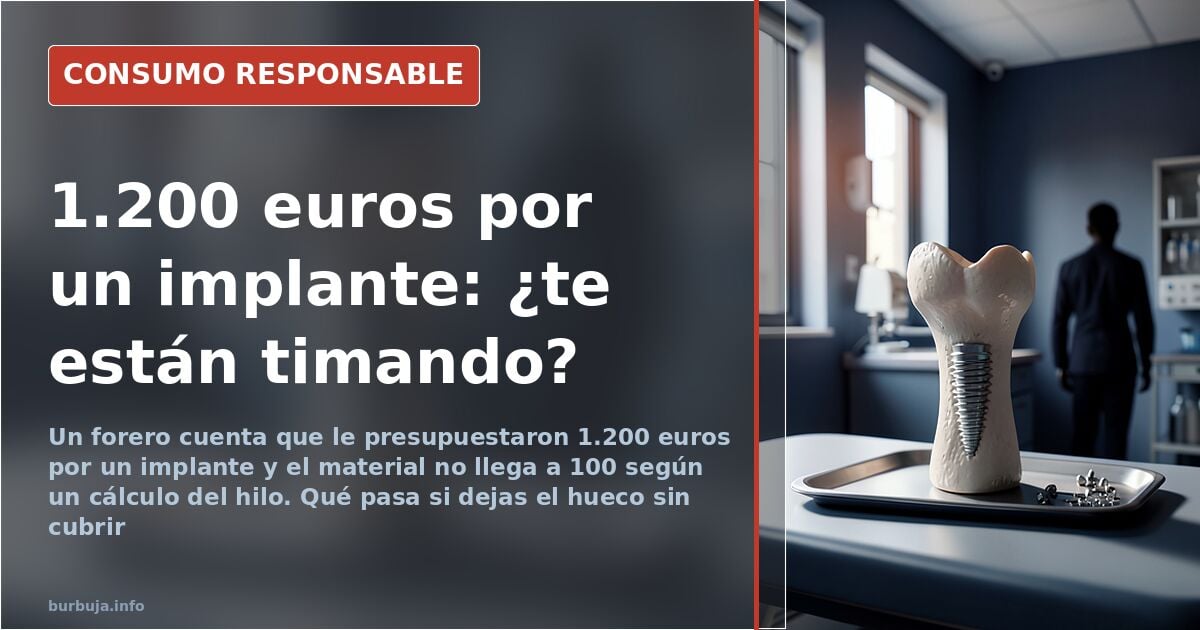
Dental implants cost €1,200 while materials are under €100
Losing a tooth isn't just a gap in your smile. Those who have had an extraction and asked for replacement quotes often face prices around €1,200. This sparks two conflicting narratives: the dentist warning that neighboring teeth will shift, and the patient suspecting they are being overcharged. The debate on whether dental implants are worth it begins at this intersection of health and profit.
The case involves an extracted molar that caused no pain, chewed well, and was invisible when smiling. The dentist warned that without the piece, the rest of the dentition would eventually displace, noting it was a key chewing molar. Quote: €1,200. The patient's doubt—is this honest advice or self-serving sales?—is shared by anyone sitting in that chair.
What happens if you leave the gap unfilled
The professional's warning is not urban legend. The most repeated argument is mechanical: the opposing molar, lacking support, tends to drift seeking the missing piece, damaging its root. Over time, the gap also causes adjacent teeth to tilt and crowd. Some summarize it bluntly: filling the space is not just aesthetic; ignoring it risks losing another tooth.
A real case timeline serves as a benchmark. One patient with a gap for over ten years finally got an implant and soon forgot it was artificial. Another waited nearly a year between extraction and final placement—including six months for bone regeneration after infection—describing the process as tedious but feeling natural within a week. Consensus on timelines suggests about two months between screw and crown.
Price varies from €1,200 to €3,000 depending on location and timing
Here the variation begins. Quotes range from just under €1,000 at chains to €3,000 for an implant in Barcelona in 2007, including €1,300 at clinics using 3D milling and ceramic firing ovens. Differences aren't just geographic: material, brand, and need for bone grafts change the bill. A calculation circulating online breaks down margins: €1,200 per piece, 100 implants monthly, yielding €120,000 gross revenue before costs.
Suspicion about dentist margins pervades the conversation. Some argue biocompatible titanium screws and composite molars cost under €100. Conversely, the view that one shouldn't skimp on oral health gains weight among those who've undergone the procedure: it's money invested in something used five times daily. Options like traveling to Poland, Hungary, or Moldova drop out when the process requires twenty visits.
Titanium, zirconia, and the rejection myth
Implant materials have their own battles. Titanium is the standard, lasting decades: cases exist with zero problems since 2007 or fourteen years ago. Zirconia, more biocompatible and aesthetic, fractures easier and is only advised for front teeth, not molars. Titanium allergy exists but is rare; those claiming it demand biocompatibility tests before surgery.
Skeptics go further, arguing implants and root canals damage the immune system and favor autoimmune diseases. This thesis lacks proven backing and should be treated as opinion circulating without evidence. Peri-implantitis—inflammation of tissues around the implant appearing years later—is debatable; data cited suggests up to half of implant patients might develop it.
Conservative alternative arrives too late
The harshest criticism targets extraction, not the implant. Several messages agree the molar shouldn't have been removed without trying conservative treatment first: killing the nerve and placing a crown. The core issue: dental franchises often push implants because they offer higher margins than root canals. Bridges, the other classic option, seem more aggressive as they require grinding neighboring teeth.
The original case ends with a surprising fact: the patient got the implant, waited six months for bone regeneration, endured many visits, and felt it natural within a week. Not as traumatic as antiestéticared, nor as cheap as desired. Whether it's worth it depends on general health, number of missing pieces, and budget impact. What's certain is that gaps eventually take a toll.
Also available in: Deutsch
Summary of a discussion on Burbuja.info - Foro de economía, actualidad y política., translated from Spanish and reviewed before publication. Read the full discussion (63 replies).
More summaries
-
Dental implants in Spain: quotes range from €600 to €2,000
Dental implant quotes discussed in a Spanish forum range from €600 to €2,000 per tooth. Some argue that a chain's "from €222" offer only covers the…
-
Dental implant cover screw filling keeps falling out, patients warn
The composite covering a dental implant screw pops off repeatedly, and some wonder whether to replace it. Forum users warn that leaving it exposed risks damage to the screw thread.
-
Dental implants: bargain price or questionable quality?
A cost analysis of dental implants: do high prices reflect quality or is it commercial mark-up?
-
How many litres of milk can you get from 1 kg of condensed milk?
A forum calculation says a 1 kg can yields 6.6 to 10 litres, but others warn it's not milk but added sugar.
-
Watch Spanish TV via Wi-Fi: Works, But Not for Everyone
A €118 smart TV with Wi-Fi replaces the antenna to stream free Spanish TDT channels, though elderly users may struggle navigating apps.
-
Spanish cobbler charges €12 to glue sole after Pattex fails
A Spanish forum discusses repairing a detached boot sole. A cobbler quotes €12 for gluing and €28 for stitching, while users doubt domestic Pattex glue effectiveness.