
Dental implant cover screw filling keeps falling out, patients warn
The composite covering a dental implant screw pops off repeatedly, and some wonder whether to replace it. Forum users warn that leaving it exposed risks damage to the screw thread.
English · Original discussion in Spanish · Published
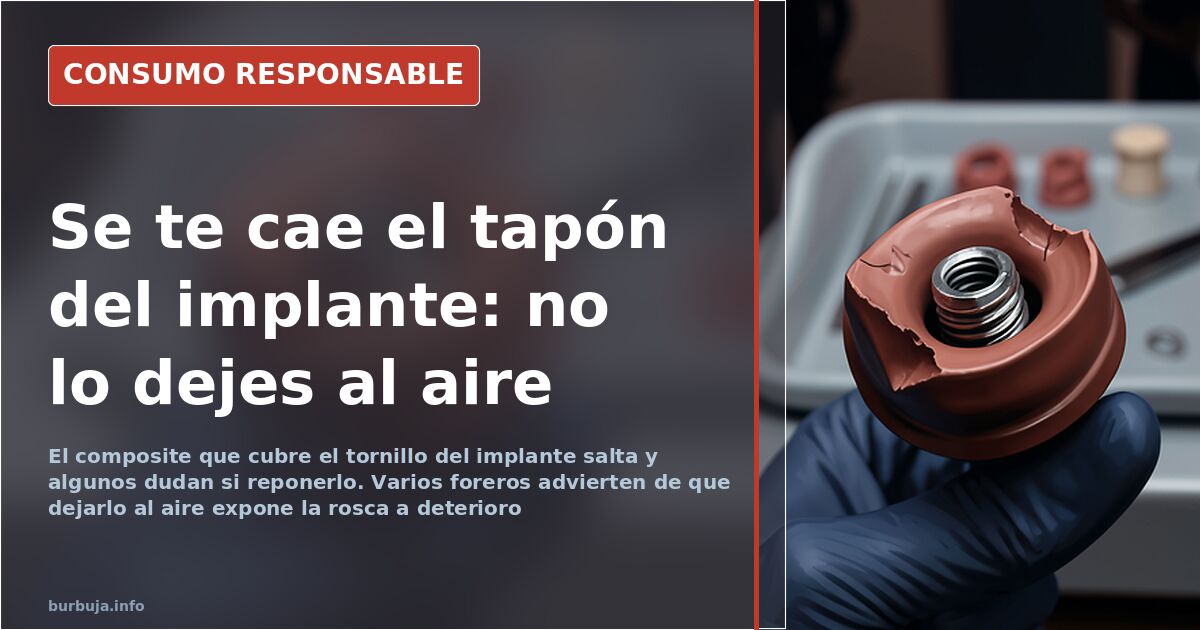
The implant cap that keeps falling out
A dental implant with a screw-retained crown has a small composite filling covering the screw. When that filling pops off, the hole is left exposed. The temptation is to leave it as is: it can't be seen, it's inside the crown, and why bother going to the dentist. But the accumulated experience of people who have had these pieces for years points the other way, and not for cosmetic reasons.
The composite falls out, and it's not always the dentist's fault. The stories repeat themselves: an implant placed seven years ago whose cap came off within hours and, once replaced, never failed again; crowns that lasted a whole year without incident; and cases where the filling came off at one year, at eighteen months, and again after two months. There's no clear pattern to the timing. Some blame an overly aggressive dental cleaning, while others simply can't find an explanation.
The most repeated warning is about the screw thread deteriorating. Leaving the screw exposed subjects a very small thread to food, saliva and brushing, and if that thread gets damaged, the problem stops being a filling that takes five minutes to replace. Several participants agree that the cap should be put back as soon as possible.
Why the implant filling falls out
The professional's argument is that the composite is very small and doesn't bond well to the screw. It sounds reasonable and, at the same time, insufficient: there are materials that last much longer. One specific case mentions a composite cured with infrared or ultraviolet light that lasted almost a year without coming loose. The material is a factor, though no data allows generalizing.
Distrust also comes up. When the cap falls off three times in two and a half years and each replacement is handled by a different professional at the same clinic, the suspicion that the fix is being done half-heartedly to generate visits is hard to dismiss and easy to understand. There's no proof of anything. But the pattern — an upper canine, a small and angled hole — doesn't help the filling hold either.
What happens if you leave the screw exposed
The short answer: the thread can deteriorate. The long answer is that this deterioration turns a recurring nuisance into a problem of another scale, with the crown and the implant at stake. The hole is tiny, yes. It's also the entry point for everything that shouldn't get in.
The other front is the crown. Screws loosen, and it's not unusual: some people have had to go in to have the piece tightened once every few years, sometimes three months after it was placed, sometimes after accidentally biting into a metal staple hidden in their food. When that happens to a natural tooth, the scare is bigger; with an implant, it's solved with a tightening.
The loose screw: how many visits are normal
A loose screw and a falling cap are two different problems that get confused. The first has to do with the mechanics of the prosthesis and allows for occasional maintenance. The second is a sealing problem. Mixing them up leads to wrong conclusions about the quality of the work.
The open question is how many composite replacements a patient should tolerate before someone reviews the design of the screw access. Nobody answers that here. And in the meantime, the hole is still there, waiting for the next visit.
Summary of a discussion on Burbuja.info - Foro de economía, actualidad y política., translated from Spanish and reviewed before publication. Read the full discussion (6 replies).
More summaries
-
Dental implants in Spain: quotes range from €600 to €2,000
Dental implant quotes discussed in a Spanish forum range from €600 to €2,000 per tooth. Some argue that a chain's "from €222" offer only covers the…
-
Dental implants without a written quote: an avoidable risk
Getting a dental implant without a quote can prove costly: between 1,200 and 1,600 euros. The risks and the alternatives.
-
Dental implants: bargain price or questionable quality?
A cost analysis of dental implants: do high prices reflect quality or is it commercial mark-up?
-
KFC sells 22 chicken wings for 9 euros, less than 50 cents each
22 KFC chicken wings for 9 euros cost less than 50 cents each. Details and terms of the limited-time offer in Spain.
-
Aquaservice vs the 1.5-litre bottle: the math doesn't add up
The dispenser is free, but the water isn't: against bottled water at 0.19 cents a litre, home-delivered water jugs don't pay off for an ordinary household.
-
Closing an EVO Banco account: the zero balance that wasn't zero
He was told to empty the account to close it with EVO Banco, a Spanish online bank, but the bank then claimed there were pending amounts. The process stalls and tempers rise.