
Dental implants in Spain: quotes range from €600 to €2,000
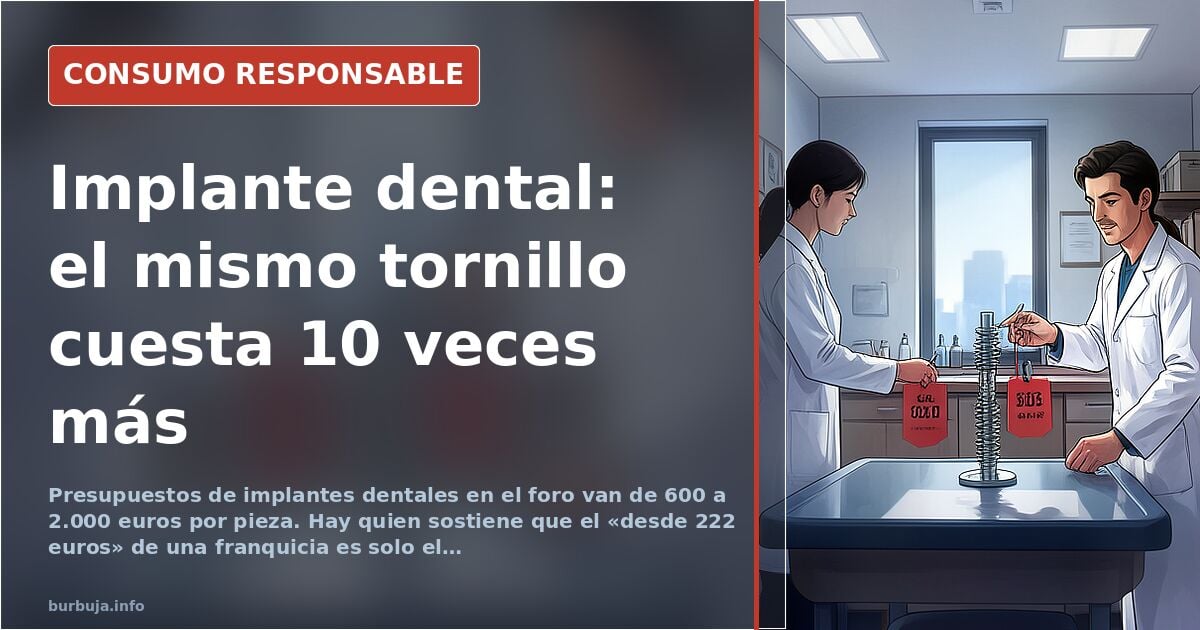
Dental implant quotes discussed in a Spanish forum range from €600 to €2,000 per tooth. Some argue that a chain's "from €222" offer only covers the…
English · Original discussion in Spanish · Published
Dental implants in Spain: quotes range from €600 to €2,000
A quote of €1,300 for a post and crown at the family dentist's clinic. That's the figure that opens the thread and serves as the yardstick for everything that trinc. From there, the numbers mentioned in the conversation range from the €600 one participant says they paid for an implant with root canal treatment included, to the €2,000 per tooth another says they paid after a car accident. In between, a string of quotes ranging from €700 to €1,600, with differences that aren't always explained by the material or the quality of the work.
The price of a dental implant: the real range and the tricks of "from"
The first trap lies in the advertising. According to several participants, that well-known chain advertising implants "from €222" is not selling the complete implant for that price. What costs €200 is just the screw, the titanium post that is anchored into the bone. On top of that you have to add the abutment, the crown, the preliminary assessment, X-rays and, if needed, a bone graft. The final bill multiplies. Several voices warn that this type of clinic operates more like sales agents than dental practices, with advertising they directly call misleading.
The actual quotes discussed in the conversation paint a wide picture. Some say they paid €600 for an implant with root canal treatment included, while others received quotes of €700, €800, €900, €950, €1,100, €1,200, €1,250, €1,300, €1,500, €1,600 and even €2,000 per tooth. The difference between the cheapest and the most expensive exceeds €1,400. And the most expensive isn't always the best, nor the cheapest the worst.
Why does the price of a dental implant vary so much?
The most common explanation has to do with the material. A Chinese-made implant is not the same as a German one, nor is a zirconia crown the same as a titanium one. Brand also matters: some recommend titanium implants from established brands like Straumann or Nobel, in that order, over zirconia. But material doesn't explain everything. The dentist's hourly rate varies enormously depending on the clinic and the city. In some cases, according to a calculation doing the rounds, the final bill can work out at more than €300 per hour of professional work.
Then there's the hidden cost structure. The dentist diagnoses, the surgeon extracts the tooth and places the screw, the dental technician makes the crown and the dentist fits it. Each party charges their share. Some complain that dentists take the biggest cut while paying a pittance to those who actually do the work. Others argue that specialisation is necessary and that each professional contributes their part.
Cheap implants: the risk of dental chains and low-quality materials
The most repeated warning is to steer clear of the big dental chains. They are accused of prioritising sales over health, using low-quality materials and running misleading advertising. One specific case is mentioned: a person who had several €200 implants fitted and every single one failed, with more than two years of constant visits to the clinic without a solution. The clinic's name isn't given, but the message is clear: an implant is no place to take chances.
Against this, the general advice is to find a professional you trust, even if it costs more. A long-standing family dentist, an acquaintance or someone recommended by other patients. The accumulated experience of those who have had high-end implants for years is good: zero problems, teeth you can't notice and that keep working one or two decades later. The crown, however, is usually the first thing to wear out over time.
Dental insurance and low-cost clinics: are they worth it?
Another route that comes up is dental insurance. According to one participant, taking out a policy like Adeslas Dental can bring the implant price down from €1,200 to €850, paying a monthly fee of around €9.50 during the process. The advice is not to go to the insurer's own clinics, but to choose a professional from the list in your city and make sure they work with the policy. If the result is good, you can keep the insurance or stick with the dentist.
Some have also found notable differences between dentists in the same area. The same branded titanium implant can cost €800 at one clinic and €1,330 at another, with identical materials and an all-inclusive fixed price. The €530 difference isn't always justified by quality.
The diagnosis that changes everything: from implant to root canal
One of the most striking twists in the conversation is the wildly different diagnoses. One person went to a consultation with a €1,050 quote for an implant and left with a €180 root canal. The second dentist thought the tooth could be saved by removing the nerve, without extracting it or fitting an implant. The saving exceeds €800. Another similar case: a cracked molar rebuilt with composite and a titanium reinforcement for €90, when the family dentist would have opted to extract the root and fit a €1,200 implant.
These episodes fuel distrust of certain professionals. Some accuse dentists of inventing cavities and drilling healthy teeth to earn commissions. It's a serious accusation that shouldn't be generalised, but it reflects widespread discontent. The reality is that private dentistry in Spain operates as a market with little price regulation, where patients often have no way of knowing whether the proposed treatment is the necessary one or the most profitable for the clinic.
How a real case evolved: from quote to apicectomy
The original post asked for price references. After 55 replies and more than nine years, the person who started the thread came back to tell how it ended: in the end they had an apicectomy, surgery to remove the tip of the infected root, for €300. It was no longer an implant, but an attempt to save the tooth. The case shows that the initial price can come to nothing if the diagnosis changes. And that the most expensive solution isn't always the one that ends up being applied.
Meanwhile, the conversation drifted into broader debates: the lack of transparency in quotes, the absence of itemised invoices, the feeling that dentistry has become an unaffordable luxury. Someone pointed out that thirty years ago it was common to see elderly people with no teeth, something that has now almost disappeared. The dental business has grown, but so have suspicions about its commercial practices.
The underlying question remains unanswered: what is a fair price? The available data doesn't allow us to pin it down. What it does show is that the same implant can cost ten times more depending on where it's fitted. And that patients, in most cases, have no way of knowing whether they're paying too much or too little.
Also available in: Deutsch
Summary of a discussion on Burbuja.info - Foro de economía, actualidad y política., translated from Spanish and reviewed before publication. Read the full discussion (55 replies).
More summaries
-
Dental implants: bargain price or questionable quality?
A cost analysis of dental implants: do high prices reflect quality or is it commercial mark-up?
-
Dental implants: why distrust grows despite success
Cases of neurological complications, the Harvard morgue scandal and the lack of long-term studies fuel distrust towards dental implants…
-
Lacasa Christmas Turrón Ad Sparks Consumer Backlash in Spain
Spanish turrón brand Lacasa faces boycotts after launching a feminist ad claiming women have less leisure time than men.
-
From 142 to 130 kilos in five weeks: the method nobody audits
From 142 to 130 kilos in five weeks on 16/8 fasting and 1,500 kcal, with two kilos back after a single weekend. That's how the real calorie deficit gets measured
-
Ikea or Leroy Merlin kitchen: assembly is what decides the price
Forum debate: Ikea stands out for hardware and warranty, Leroy Merlin for variety, Bricomart for price. The real cost depends on who assembles the units.
-
Butane heaters are back — and beating electric heating on price
With a cylinder at 16.20 euros and a heater that raises an 11-square-metre room from 11 to 19 degrees in under an hour, butane is once again beating electric radiators in Spain.