
Four arrested for shooting neighbor in Benetússer, Spain
David Giménez, 32, was shot dead near his home in Benetússer. Suspects allegedly targeted ecstasy pills he carried.
English · Original discussion in Spanish · Published
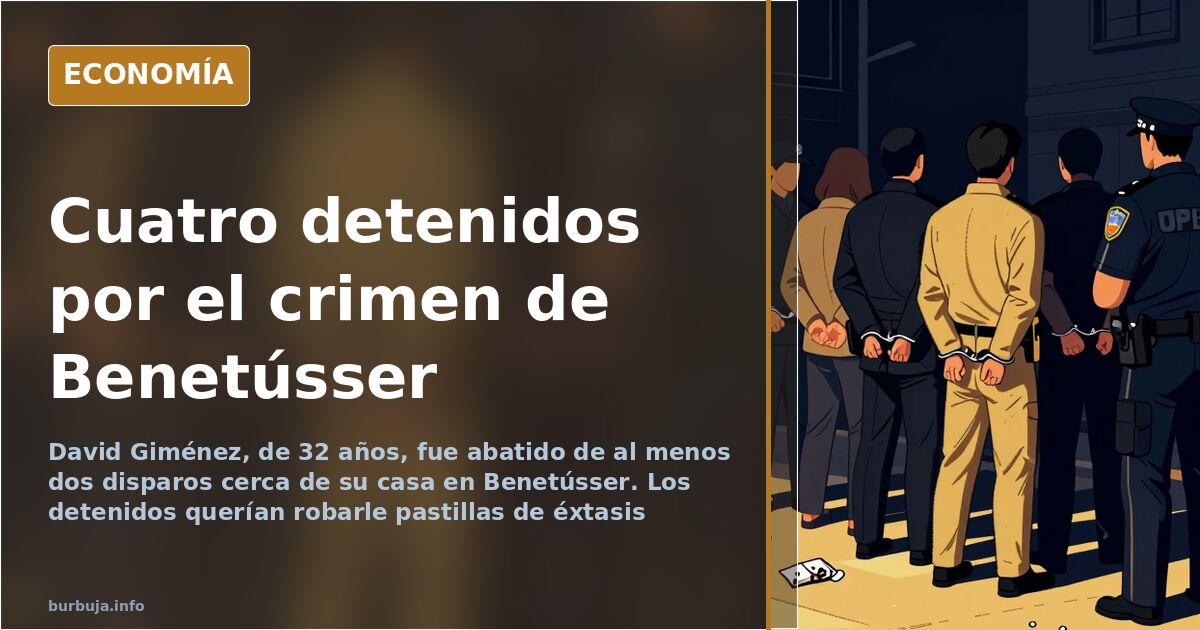
Four arrested for shooting neighbor in Benetússer, Spain
What crime warrants being shot twice in the back just a hundred meters from your own front door? This question lingered on the night David Giménez, a 32-year-old resident of Benetússer known as el Zobe, left his home heading to Spook nightclub in Pinedo to see DJ Richie Hawtin perform. He never arrived. He was killed by at least two shots in the street, near his residence and close to the local police station. What began as an early-morning incident ended with four arrests.
Who was David Giménez, the young man murdered in Benetússer?
He worked as a carpenter in his father's company and had also served as a chef. His hobbies included electronic music and graffiti: traces of his work can be found on train cars from 2008, when he would have been 17 or 18 years old. Those who knew him insisted he was going through a good period and was excited about new projects; they gathered at the scene that same night, in disbelief. The Civil Guard (Guardia Civil), however, looked in another direction from day one: a possible settling of scores over drug debt, since the deceased was a user.
This dual narrative never reached closure. The community spoke of a young man trying to rebuild his life; the investigation pointed to a user with debts in a market that offers no respite. Between both versions lies an uncomfortable fact: the victim had straddled both sides of the same business.
The motive for the crime: a backpack full of ecstasy pills
The initial hypothesis—collecting what was owed—blurred as the judicial proceedings advanced. According to published reports, the alleged perpetrators intended to steal the ecstasy pills the victim carried in a backpack. It was not, therefore, a classic settling of accounts, but a robbery that ended with shots fired into his back.
The nuance is significant. A trafficker executed for non-payment is a predictable story; a user with a bag of drugs ending up dead in the street is something else entirely. If someone receives two shots for some pills, the inevitable question is how much they were carrying to make it worth killing them. The answer is not in the case file, but the scene—shot in the back, with no chance to react—says a lot.
Why kill a user over a drug debt?
Because in the black market there are no collection courts, and non-payment is resolved by private criteria. This is the reasoning repeated by those analyzing these incidents: illegality eliminates any legal recourse and leaves force as the only contract. Hence, small debts rarely end in shootings, and when they do, it is assumed the amount was not small, or simply that there was something to steal.
Around this logic appear two opposing interpretations. One argues that those entering that world accept its rules and consequences. The other emphasizes that no debt justifies an execution and that the underlying problem is an underground market distributing profits and corpses. There is no middle ground between the two: either you look at the victim or you look at the system.
From initial hypothesis to four arrests
The investigation pogre quickly. The case ceased to be speculation when the arrest of four people for the crime was announced. One of the detainees admitted before the judge that they went to steal drugs, according to media trinc the case. The description—going for the backpack, not to settle an outstanding account—fits the scene: a man killed at his doorstep, shot in the back, without option to defend himself.
The disconnect between the official narrative and that of the victim's circle remains open here. Some see a full-fledged settling of scores; others, a robbery gone wrong. The ongoing case file keeps both hypotheses alive while the detainees await further developments.
From the incident to debate on nighttime safety in Valencia
The crime did not remain an isolated incident. It fueled a broader conversation about nighttime safety in Valencia and its metropolitan area, intensified by other stabbing attacks recorded on Eugenia Viñes Street and at Pont 9 d'Octubre, with injured persons transported to various hospitals. Some argue the capital has become more dangerous after dark; others recall that El Carmen and nightlife areas have long been what they are.
Cynicism as response: the welfare society
Acidic readings were not lacking. Part of the commentary used the case to mock the narrative of the welfare society, as if a street homicide disproved any official discourse on security and pogre. Another, colder current reduced it to accounting: unpaid debt, expected consequence. Amidst messages of condolence appear those saying he asked for it and "one less," treating violent death as a balance sheet adjustment. And in the middle, the gray zone: Spook, the venue of the interrupted night, remains open.
In the end, David never saw Richie Hawtin. Justice will determine if he was killed for a debt or for a backpack full of pills. The only verifiable fact is that, in Benetússer, crossing the threshold of one's home cost more than any club ticket.
What crime warrants being shot twice in the back just a hundred meters from your own front door? This question lingered on the night David Giménez, a 32-year-old resident of Benetússer known as el Zobe, left his home heading to Spook nightclub in Pinedo to see DJ Richie Hawtin perform. He never arrived. He was killed by at least two shots in the street, near his residence and close to the local police station. What began as an early-morning incident ended with four arrests.
Who was David Giménez, the young man murdered in Benetússer?
He worked as a carpenter in his father's company and had also served as a chef. His hobbies included electronic music and graffiti: traces of his work can be found on train cars from 2008, when he would have been 17 or 18 years old. Those who knew him insisted he was going through a good period and was excited about new projects; they gathered at the scene that same night, in disbelief. The Civil Guard (Guardia Civil), however, looked in another direction from day one: a possible settling of scores over drug debt, since the deceased was a user.
This dual narrative never reached closure. The community spoke of a young man trying to rebuild his life; the investigation pointed to a user with debts in a market that offers no respite. Between both versions lies an uncomfortable fact: the victim had straddled both sides of the same business.
The motive for the crime: a backpack full of ecstasy pills
The initial hypothesis—collecting what was owed—blurred as the judicial proceedings advanced. According to published reports, the alleged perpetrators intended to steal the ecstasy pills the victim carried in a backpack. It was not, therefore, a classic settling of accounts, but a robbery that ended with shots fired into his back.
The nuance is significant. A trafficker executed for non-payment is a predictable story; a user with a bag of drugs ending up dead in the street is something else entirely. If someone receives two shots for some pills, the inevitable question is how much they were carrying to make it worth killing them. The answer is not in the case file, but the scene—shot in the back, with no chance to react—says a lot.
Why kill a user over a drug debt?
Because in the black market there are no collection courts, and non-payment is resolved by private criteria. This is the reasoning repeated by those analyzing these incidents: illegality eliminates any legal recourse and leaves force as the only contract. Hence, small debts rarely end in shootings, and when they do, it is assumed the amount was not small, or simply that there was something to steal.
Around this logic appear two opposing interpretations. One argues that those entering that world accept its rules and consequences. The other emphasizes that no debt justifies an execution and that the underlying problem is an underground market distributing profits and corpses. There is no middle ground between the two: either you look at the victim or you look at the system.
From initial hypothesis to four arrests
The investigation pogre quickly. The case ceased to be speculation when the arrest of four people for the crime was announced. One of the detainees admitted before the judge that they went to steal drugs, according to media trinc the case. The description—going for the backpack, not to settle an outstanding account—fits the scene: a man killed at his doorstep, shot in the back, without option to defend himself.
The disconnect between the official narrative and that of the victim's circle remains open here. Some see a full-fledged settling of scores; others, a robbery gone wrong. The ongoing case file keeps both hypotheses alive while the detainees await further developments.
From the incident to debate on nighttime safety in Valencia
The crime did not remain an isolated incident. It fueled a broader conversation about nighttime safety in Valencia and its metropolitan area, intensified by other stabbing attacks recorded on Eugenia Viñes Street and at Pont 9 d'Octubre, with injured persons transported to various hospitals. Some argue the capital has become more dangerous after dark; others recall that El Carmen and nightlife areas have long been what they are.
Cynicism as response: the welfare society
Acidic readings were not lacking. Part of the commentary used the case to mock the narrative of the welfare society, as if a street homicide disproved any official discourse on security and pogre. Another, colder current reduced it to accounting: unpaid debt, expected consequence. Amidst messages of condolence appear those saying he asked for it and "one less," treating violent death as a balance sheet adjustment. And in the middle, the gray zone: Spook, the venue of the interrupted night, remains open.
In the end, David never saw Richie Hawtin. Justice will determine if he was killed for a debt or for a backpack full of pills. The only verifiable fact is that, in Benetússer, crossing the threshold of one's home cost more than any club ticket.
Also available in: Deutsch
Summary of a discussion on Burbuja.info - Foro de economía, actualidad y política., translated from Spanish and reviewed before publication. Read the full discussion (107 replies).
More summaries
-
Five officers fail to restrain one person in Spain, sparking police force debate
A viral video in Valencia shows five officers struggling with a single unarmed individual, reigniting the debate on police training, pay, and use of force.
-
Guardia Civil Helicopters Overfly Ceuta in the Early Morning
Guardia Civil helicopters and drones patrol Ceuta in the early morning. Flight tracking suggests a deployment without an official statement.
-
Sex Doll Botellón and Guardia Civil Complaint: What Happened?
A Twitter profile featuring sex dolls and a botellón was reported to the Guardia Civil. The account was closed, and no legal resolution has been confirmed.
-
Red-flag march through Madrid returns to Puerta del Sol
A march with red flags through Madrid returns to Puerta del Sol amid debate over who is behind it
-
Forum debate predicts wealth gap between native and immigrant youth in Spain
Online discussions suggest native Spanish youth will inherit assets while immigrants won't, warning of potential social unrest in two decades.
-
US 10-Year Yield Tops 5.30% After Inflation Data
US 10-year Treasury yield breached 5.30% following higher-than-expected inflation data, while UK 30-year gilts hit 6%, raising refinancing costs.