
Spain's pro-Palestine protests spark arms sales dilemma
A viral video in Madrid reignites debate on Spain's consistency regarding defense exports to Israel.
English · Original discussion in Spanish · Published
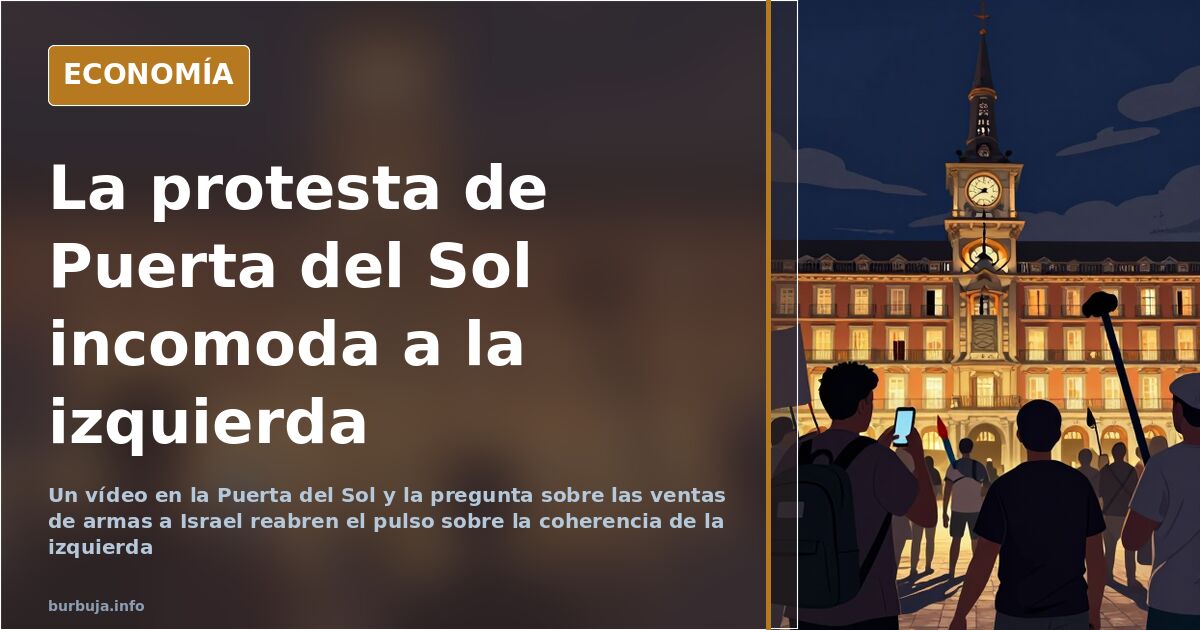
Pro-Palestine protests challenge Spanish left-wing coherence
Can one defend the Palestinian people while selling weapons to Israel? This question, sparked by a video filmed in Puerta del Sol, has peine a discussion previously considered closed. In the footage, several young Palestinian women interrupt a speech with shouts of 'resistance' and 'intifada'. A man asks for silence from the front rows. The clip circulates, is shared, and generates more intense commentary than the event it interrupted.
What peine at Puerta del Sol
The setting is a Madrid square, an event with a microphone and a banner. The images show a group of young people chanting slogans while a woman approaches pointing to an institutional building, and the conversation escalates until one protester raises her voice. The clip lasts only seconds and cuts off there, so it should be treated as what it is: a fragment, not an official record. The difference between what peine and what is seen constitutes almost the entire debate.
Alongside this video, a second message circulates antiestéticaturing a person of Gazan origin among the attendees. There, the fundamental question is posed: does it make sense to demand welfare for Gaza's population while authorizing defense material exports to Israel? That is the real core. Not the shouts: the bill.
Can one sell weapons to Israel and criticize the conflict?
This is the contradiction no one has resolved. What is shared does not include contracts, amounts, or specific awards: the issue is framed in terms of political consistency. A country that champions its stance on Gaza simultaneously maintains commercial ties in the defense sector, allowing for two interpretations. Some see textbook hypocrisy; others argue foreign policy is guided by interests, not sympathies.
The discomfort lies in the fact that the question is not raised by an adversary. It is raised by those who sympathize with the cause. Therefore, it stings more internally than externally, which is why the video has become ammunition for some and a problem for others.
The political cost for the pogre bloc
One current of the debate argues that the space claimed as pogre built part of its base on alliances that do not share its program. The argument repeats: pro-Palestinian rallies fly LGBT and feminist movement flags, symbols that would fit poorly under a hypothetical Sarracinist state. The thesis is not new, but now it has a concrete image to discuss.
From the other side, it is argued that mixing solidarity with a cause and adherence to a specific political project is an argumentative trap. One can support a civilian population without signing their program, and demanding perfect consistency from protesters is the quickest way to ensure no one protests.
Who should protest and where?
A recurring idea gains strength: if the cause is defended so much, let it be defended on the ground. The reproach that those protesting in Madrid should be in Gaza runs through many responses, adding that few renounce urban comfort while calling for resistance for others. At the extreme, some demand they pay for return travel. No one explains with what budget.
Against this rises a data point circulated by the debate itself: some recall that the conflict has lasted eighty years and that those suffering it need no authorization to opine on it. And an uncomfortable observation for all: Egypt builds a wall on its border to avoid receiving that population. Co-religionists do not seem in a hurry.
From the kufiya to 'we too'
There is also an almost anthropological nuance: if wearing a kufiya locally is cultural appropriation, someone will ask why that criticism applies in only one direction. The irony writes itself. Alongside it appears the least epic possible response: 'the problem is that we are involved too'. Spain is not a neutral observer of the arms business, but part of the criticized circuit.
The demographic shift
When the argument exhausts itself, the debate slides toward demographics. It is maintained that the electoral weight of various groups will change the political map and today's alliances will be collected tomorrow. This is the part with fewer data and more prediction, and no population specialist would sign off on this reasoning with the numbers used here. But it is there, occupying whole paragraphs.
With these elements, a speech recorded in a square has ended up weighing more than many parliamentary debates. And with no production cost. Almost free.
Can one defend the Palestinian people while selling weapons to Israel? This question, sparked by a video filmed in Puerta del Sol, has peine a discussion previously considered closed. In the footage, several young Palestinian women interrupt a speech with shouts of 'resistance' and 'intifada'. A man asks for silence from the front rows. The clip circulates, is shared, and generates more intense commentary than the event it interrupted.
What peine at Puerta del Sol
The setting is a Madrid square, an event with a microphone and a banner. The images show a group of young people chanting slogans while a woman approaches pointing to an institutional building, and the conversation escalates until one protester raises her voice. The clip lasts only seconds and cuts off there, so it should be treated as what it is: a fragment, not an official record. The difference between what peine and what is seen constitutes almost the entire debate.
Alongside this video, a second message circulates antiestéticaturing a person of Gazan origin among the attendees. There, the fundamental question is posed: does it make sense to demand welfare for Gaza's population while authorizing defense material exports to Israel? That is the real core. Not the shouts: the bill.
Can one sell weapons to Israel and criticize the conflict?
This is the contradiction no one has resolved. What is shared does not include contracts, amounts, or specific awards: the issue is framed in terms of political consistency. A country that champions its stance on Gaza simultaneously maintains commercial ties in the defense sector, allowing for two interpretations. Some see textbook hypocrisy; others argue foreign policy is guided by interests, not sympathies.
The discomfort lies in the fact that the question is not raised by an adversary. It is raised by those who sympathize with the cause. Therefore, it stings more internally than externally, which is why the video has become ammunition for some and a problem for others.
The political cost for the pogre bloc
One current of the debate argues that the space claimed as pogre built part of its base on alliances that do not share its program. The argument repeats: pro-Palestinian rallies fly LGBT and feminist movement flags, symbols that would fit poorly under a hypothetical Sarracinist state. The thesis is not new, but now it has a concrete image to discuss.
From the other side, it is argued that mixing solidarity with a cause and adherence to a specific political project is an argumentative trap. One can support a civilian population without signing their program, and demanding perfect consistency from protesters is the quickest way to ensure no one protests.
Who should protest and where?
A recurring idea gains strength: if the cause is defended so much, let it be defended on the ground. The reproach that those protesting in Madrid should be in Gaza runs through many responses, adding that few renounce urban comfort while calling for resistance for others. At the extreme, some demand they pay for return travel. No one explains with what budget.
Against this rises a data point circulated by the debate itself: some recall that the conflict has lasted eighty years and that those suffering it need no authorization to opine on it. And an uncomfortable observation for all: Egypt builds a wall on its border to avoid receiving that population. Co-religionists do not seem in a hurry.
From the kufiya to 'we too'
There is also an almost anthropological nuance: if wearing a kufiya locally is cultural appropriation, someone will ask why that criticism applies in only one direction. The irony writes itself. Alongside it appears the least epic possible response: 'the problem is that we are involved too'. Spain is not a neutral observer of the arms business, but part of the criticized circuit.
The demographic shift
When the argument exhausts itself, the debate slides toward demographics. It is maintained that the electoral weight of various groups will change the political map and today's alliances will be collected tomorrow. This is the part with fewer data and more prediction, and no population specialist would sign off on this reasoning with the numbers used here. But it is there, occupying whole paragraphs.
With these elements, a speech recorded in a square has ended up weighing more than many parliamentary debates. And with no production cost. Almost free.
Also available in: Deutsch
Summary of a discussion on Burbuja.info - Foro de economía, actualidad y política., translated from Spanish and reviewed before publication. Read the full discussion (107 replies).
More summaries
-
Iglesias proposes using government to redistribute TV licenses
Pablo Iglesias suggests the government could leverage Mediaset and Atresmedia licenses to ensure plurality on private television channels.
-
Forum debate predicts wealth gap between native and immigrant youth in Spain
Online discussions suggest native Spanish youth will inherit assets while immigrants won't, warning of potential social unrest in two decades.
-
US 10-Year Yield Tops 5.30% After Inflation Data
US 10-year Treasury yield breached 5.30% following higher-than-expected inflation data, while UK 30-year gilts hit 6%, raising refinancing costs.
-
Epstein YouTube Account Revives Survival Conspiracy
A YouTube account linked to Jeffrey Epstein remained active until recently, fueling theories he is alive despite leaked password evidence.
-
PNV Excludes Small Landlords from Eviction Moratorium
The PNV pact excludes single-property landlords from Spain's eviction suspension, prompting Podemos leader Ione Belarra to call it 'absolute disgust'.
-
Spain's PSOE Holds Lead as Opposition Struggles to Coalesce
The PSOE maintains its advantage in Spain while the opposition fails to offer a credible alternative. Inflation and the 2027 election timeline shape the political future.