
Espresso machine debate: the grinder matters more than the brand
Two dead machines in five years and a forum consensus: under 100 euros they are all basically the same machine, and the grinder matters more than the brand.
English · Original discussion in Spanish · Published
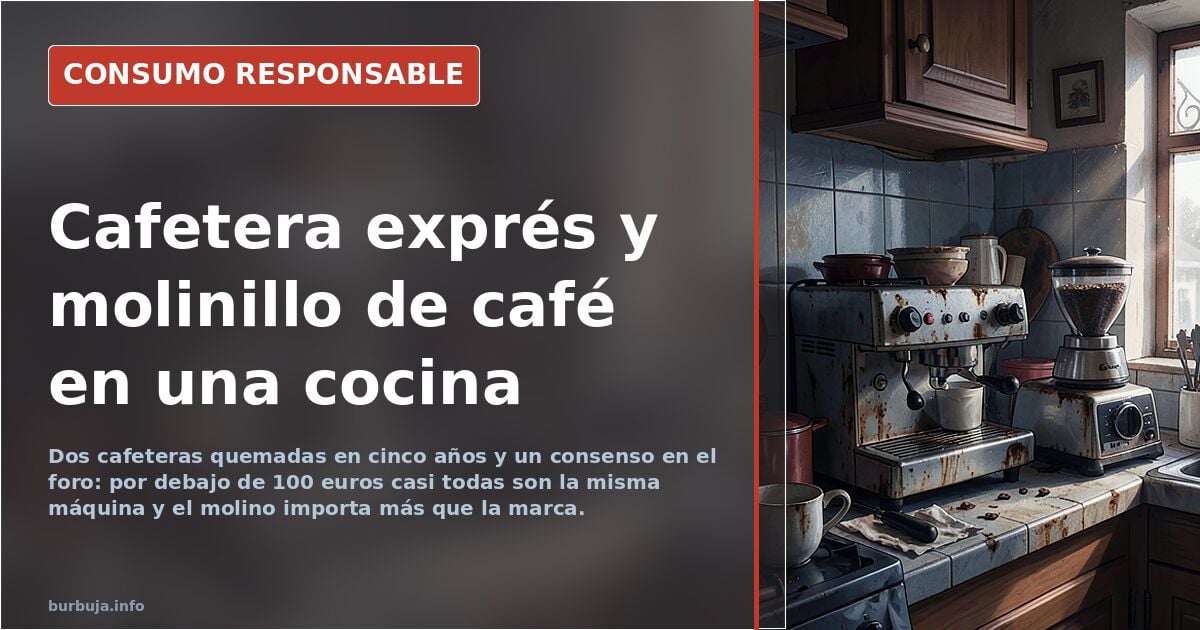
Espresso machines: the coffee matters more than the machine
Two espresso machines dead in five years. One was struck by lightning; the other, a UFESA, gradually lost pressure until it made noise but produced no coffee. With that track record, the search begins for a "good and cheap" espresso machine, with a steel body and ugly if necessary. The answer that wins the conversation has nothing to do with brands or prices: the correct order is beans, grinder, machine, in that order, according to a participant who introduces himself as a coffee enthusiast. Everything else is decoration.
The consensus, surprising for anyone arriving looking for a model and a price, is that below 100 euros almost all home espresso machines are the same machine with a different shell, in the opinion of several forum users. Stripped bare, it is hard to spot the differences. Hence the practical recommendation: go with a well-known brand —Gaggia, Solac, Minimoka, Ufesa, Orbegozo, De'Longhi— rather than a no-name one with no customer service behind it. The figure repeated as an entry-level reference: the Cecotec Power Espresso 20, at 59 euros, comes out well in several posts, though with the warning that its after-sales service has a courtroom fruta.
The burr grinder, the piece almost nobody looks at
Here is the twist. Buying pre-ground coffee is compared bluntly to opening a beer in the morning and drinking it in the afternoon. The aroma fades. The recommendation is a burr grinder —ceramic or steel, it doesn't matter— for around 50 euros, and banishing blade grinders, which chop the beans unevenly. A 10-euro hand grinder will also do to start.
The argument has its own economic logic: a mediocre machine with freshly ground coffee beats a 3,000-euro machine with stale coffee, according to this camp. The origin of the coffee, they say, weighs more than the hardware. And water is better mineral than from the tap, though here opinions split: those who have used tap water for years without problems, and those who blame limescale for breakdowns.
Why they break down: filters, limescale and lightning
The loss of pressure that leaves a machine making noise without producing coffee has a usual suspect: the clogged filter. The home remedy circulating is a fine needle to unclog it and a periodic clean in the dishwasher. Hard water is also pointed to as a silent killer.
The longevity figures that come up in the conversation are startling: a Philips Saeco Poemia with four years and at least four espressos a day, always with mineral water, without a single breakdown. A supermarket Silvercrest, with six coffees a day, outlasts several higher-end Krups machines. And a 100-euro Gaggia passes the four-year mark, though its owner already notices the pressure weakening. The brand does not predict lifespan; use and maintenance do.
Automatics, capsules and stovetop coffee
The super-automatic has defenders for convenience —get up, press a button, done— and heavyweight detractors: those who consider themselves coffee enthusiasts insist they will never own a super-automatic because it fakes an espresso it cannot deliver. Maintenance and cleaning are cited as its Achilles heel. At the opposite end, Turkish coffee and the moka pot claim the artisanal ground: a copper pot and twenty euros well spent, according to this camp, beat any machine in a hurry.
The detail that stuns and closes the circle: the first machine did not die from being bad. A lightning bolt killed it during a storm.
Also available in: Deutsch
Summary of a discussion on Burbuja.info - Foro de economía, actualidad y política., translated from Spanish and reviewed before publication. Read the full discussion (78 replies).
More summaries
-
Technical guide for high-quality espresso
Learn key technical parameters for brewing quality espresso, from grinding to extraction pressure.
-
AliExpress: Bargains That Still Pay Off Despite VAT
Discover AliExpress deals that remain cost-effective even with new VAT rules and customs fees. Find tools, parts, and gadgets that save you money.
-
MacBook Air M5 vs Windows: best laptop for €1,500?
MacBook Neo with 8GB RAM or MacBook Air M5 with 16GB: the real doubt is memory. The refurbished ThinkPad enters the fight.
-
Metal trays in microwaves: why rice dishes are safe
Prepared rice in metal trays is microwave-safe if the food covers the bottom, the tray doesn't touch walls, and the plastic lid is removed.
-
Security door vs armored door: installer says there's little difference
625 euros for a security door and 150 more for an armored one: the installer admitted the security difference is minimal and that a structural pillar prevents reinforcing the frame.
-
Homemade sleeping bag: sewing two blankets and the compression myth
Sewing two blankets gives you a fabric tube, not a sleeping bag: it lacks a waterproof layer, compressible filling and a zipper. The DIY version keeps you warm, but it won't fit in a backpack.