
Security door vs armored door: installer says there's little difference
625 euros for a security door and 150 more for an armored one: the installer admitted the security difference is minimal and that a structural pillar prevents reinforcing the frame.
English · Original discussion in Spanish · Published
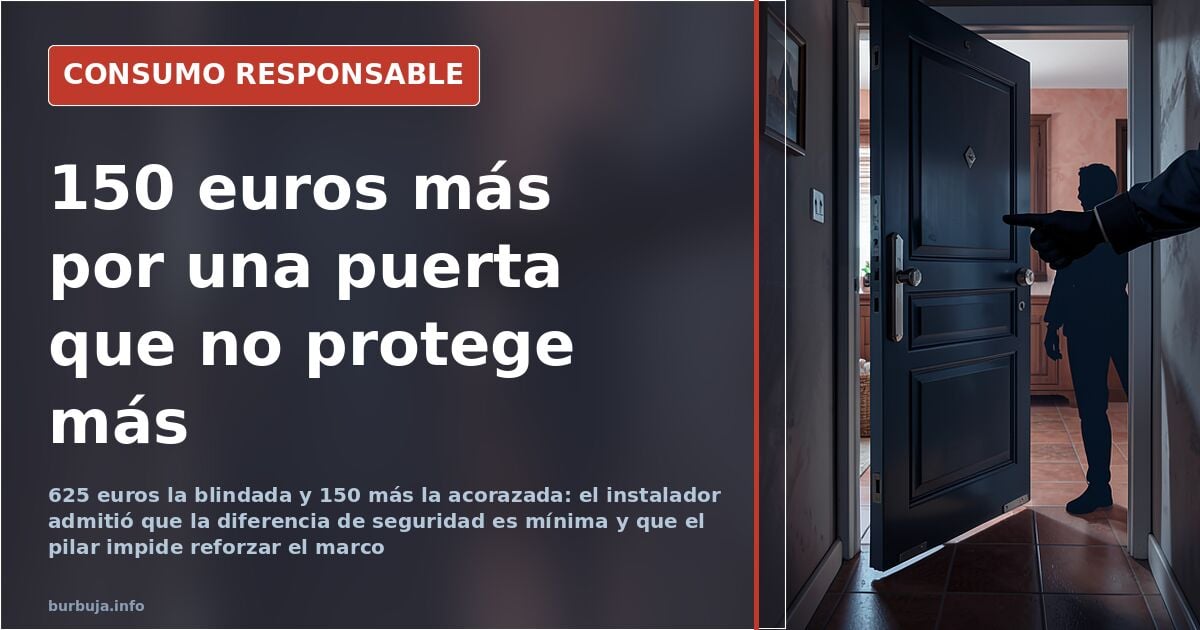
Security door or armored door: the 150 euros that don't buy safety
A 1950s apartment, an ugly factory door and a carpenter with a catalog. The dilemma is straight out of a textbook: 625 euros for a security door or 150 more, VAT excluded, for the armored one. The owner was leaning toward the second — after all, it's only 150 euros — until the installer himself talked him down: between what he sells and what the owner had in mind, there's no big difference in security. The armored door shows a steel frame on the inside and hinges that, in the installer's words, are uglier than sin.
What's the difference between a security door and an armored door
The armored door adds a steel frame and subframe plus a metal leaf that, according to a participant who claims to have seen tests, withstands an axe blow quite well. The security door makes do with steel sheet and a three-point lock. That's where the theory ends. In practice, the apartment has a structural pillar just inches from one side of the door, so the frame's reinforcing rods don't fit. Half an armored door is an expensive security door.
The conclusion that comes up most often in the conversation is uncomfortable for the seller: what protects you isn't the door leaf, it's the lock. A participant with twenty years of experience with an armored door describes every locksmith visit as a three-ring circus, and even so the technical consensus points to a door being only as strong as its lock. Some add the FAC bolt as a complement, and others point out that a lever lock anchored to the floor and the door jamb makes the leaf almost irrelevant.
The weak point isn't the door: it's the wall
Here comes the part no catalog prints. In a building with 3-centimeter solid brick partitions laid on edge, the intruder doesn't need to smash the door: he rips the whole assembly out of the opening. The image of a shove that takes down half a wall with the closed door inside isn't a dinner-table joke, it's bad-news physics. Against that, 150 euros of steel do nothing.
The other line of analysis is the double obstacle: two doors, one behind the other, and an alarm in between. Time wasted is the only real deterrent. And the domestic detail that sinks any investment: the door is useless if the latch is left on. There's a well-known technique that involves removing the peephole and slipping a hook in to reach the handle.
When it makes sense to spend on an armored door
The criterion that emerges isn't price, it's inventory. Anyone who doesn't keep money or jewelry at home and leaves the Velázquez at the museum isn't buying security: they're buying looks and peace of mind. And there's a barely disputed side effect: a flimsy door doesn't attract attention; an armored one announces there's something inside worth stealing.
The owner ended up where he started, with a three-point security door and the feeling of having dodged a sales pitch. He had been living since 1991 with doors that weren't even security doors. He has never lived in a home with a security door.
Also available in: Deutsch
Summary of a discussion on Burbuja.info - Foro de economía, actualidad y política., translated from Spanish and reviewed before publication. Read the full discussion (25 replies).
More summaries
-
Reinforced door security: wall anchoring or just deterrence
A technical analysis of whether armoring a door is enough or whether the frame must be anchored to the wall to prevent forced entry.
-
Security doors: grades, costs, and why installation matters
Security doors in Spain range from €1,600 to €6,000. Experts note that the cylinder and installation quality outweigh the door leaf itself.
-
Why erasing a JCM Go2 garage remote's memory almost never works
A JCM Go2 remote that activates on its own every six seconds has no reset button: the code lives on an integrated circuit, and the only way out is reprogramming or replacing the remote.
-
Wallapop requires power of attorney to Mangopay to use its wallet
Wallapop requires granting Mangopay power of attorney and renewing every 180 days to move wallet money. No signing all four conditions, no payout.
-
Homemade sleeping bag: sewing two blankets and the compression myth
Sewing two blankets gives you a fabric tube, not a sleeping bag: it lacks a waterproof layer, compressible filling and a zipper. The DIY version keeps you warm, but it won't fit in a backpack.
-
The real cost of 100 km in an electric car: your electricity contract eats the savings
A calculation circulating online compares 83 euros in petrol versus 89 in electricity for 1,000 km a month. The contracted power and fixed charge decide the outcome.